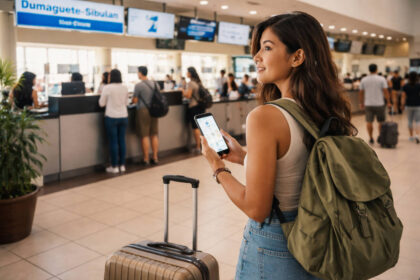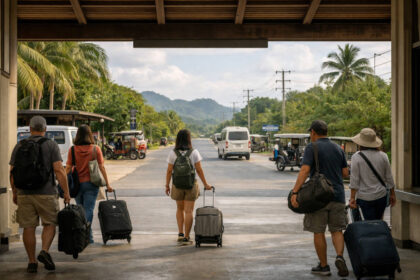
The first time you commute in the Philippines, it can feel like a movie scene: buses rumbling in, vendors calling out snacks, a line that looks messy until you realize it’s actually a line, and someone kindly pointing you to the right bay because you looked lost for two seconds. It’s organized chaos, but there’s also a lot of human help baked into it—people ask around, share change, and teach you the rules by doing.
This Philippines public transport guide is a traveler-friendly way to understand that “commute culture.” We’ll cover provincial buses, UV Express vans, jeepneys, tricycles, and ferry or RoRo routes—plus realistic sample fare examples (with clear disclaimers because fares vary and change), safety habits that actually help, and mini-scenarios so you can picture what a real travel day feels like. If your goal is getting around the Philippines without a car, you’ll leave this Philippines public transport guide feeling capable, not overwhelmed.
For more practical travel habits that make trips smoother, you can also browse Tips and Inspiration.
The Commute Culture of the Philippines
Terminals, “punuan,” and learning by asking
Public transport in real life usually starts at terminals: provincial bus terminals, UV Express (FX) terminals, port terminals, and informal loading points. There’s a route culture too—drivers and conductors know the rhythm, commuters know the cues, and visitors learn fast by asking. In this Philippines public transport guide, I’ll keep repeating one truth: asking is normal here.
“Punuan” is a word you’ll hear a lot. It means “full.” UV Express vans often depart when full. Some jeepney routes become “punuan” quickly at rush hour. Buses may still have seats, but queues can grow. The best way to commute in the Philippines is to accept this as part of the rhythm and plan your buffer.
Kindness is common, but you still stay alert
In many cities and towns, someone will genuinely help you find the right ride. You’ll experience that “Ate, dito po kayo” kindness. This Philippines public transport guide is warm about that—but also practical: keep valuables close, don’t flash big bills, and choose official terminals when you can.
The Golden Rules That Make Everything Easier
Carry small bills (and keep them in an easy pouch)
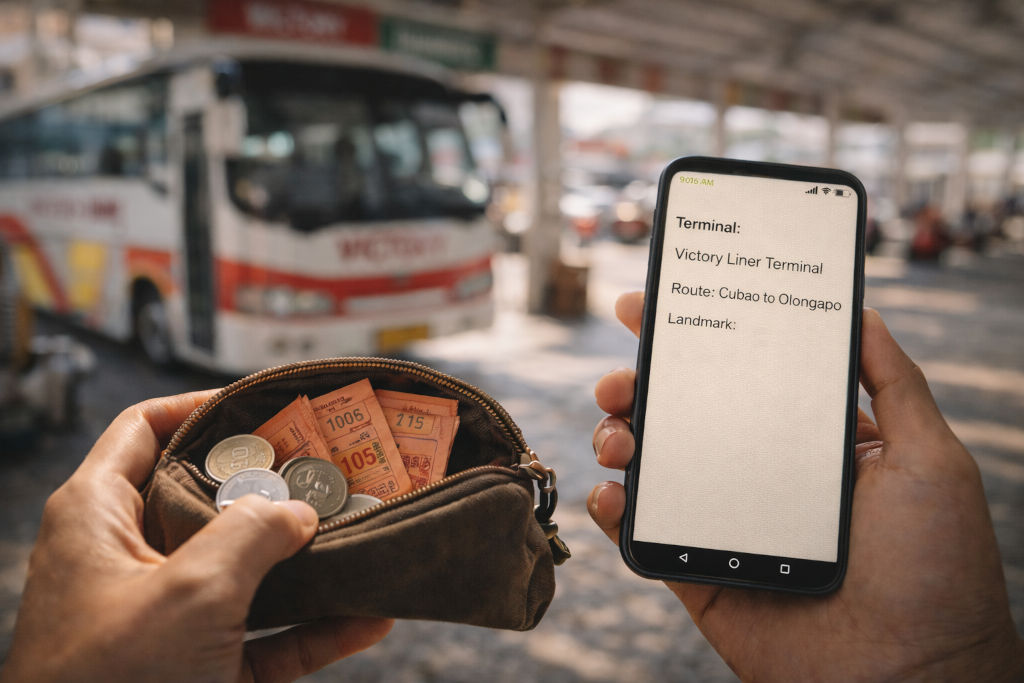
Small bills matter because change can be limited—especially early mornings, late nights, or inside jeepneys where change is passed back through several hands. In this Philippines public transport guide, my small ritual is a “commute pouch”: coins + small bills + my ticket stubs. It reduces stress instantly.
Screenshot addresses, terminals, and landmarks
If you’re using a hotel address or a friend’s pin, screenshot it. Signal can drop around ports, rural highways, or thick city blocks. A public transportation Philippines guide trick I swear by is saving two references: the exact address and one landmark (like “near the public market” or “beside the mall”).
Buffer time is your best travel insurance
Traffic, queues, weather, and “punuan” all affect timing. If you’re catching a flight, ferry, or tour, add generous buffer. In this Philippines public transport guide, I’d rather you arrive early and eat merienda than arrive late and panic.
Learn one magic line: “Dadaan po ba ito sa ___?”
How do you read signage and ask for the right ride? Signage can be short, local, and sometimes confusing. Your safest move is to ask the driver, conductor, dispatcher, or a nearby commuter:
• “Dadaan po ba ito sa ____?” (Does this pass by ____?)
• “Hanggang saan po ’to?” (Up to where does this go?)
• “Saan po bababa pag ____?” (Where should I get off for ____?)
This is the heart of how to commute in the Philippines: you confirm in real time.
Provincial Buses: The Long-Distance Backbone
How it works: terminals, tickets, seats, and baggage
In this Philippines public transport guide, think of provincial buses as your “backbone” for intercity travel. You usually start at a provincial bus terminal, find your route or destination sign, then either buy a ticket at a booth or pay on board depending on the system. You’ll choose a seat if assigned, or sit where available if it’s open seating.
Baggage is typically stored underneath in the compartment, with smaller bags kept with you. Keep valuables (passport, wallet, phone) in your day bag on your lap or across your body, not in the under-bus compartment.
Ordinary vs aircon vs deluxe: what comfort actually feels like
Bus categories vary by operator, but travelers often see terms like “ordinary,” “aircon,” and sometimes “deluxe” or “luxury.” In a practical Philippines public transport guide sense:
Ordinary: usually cheaper, can be warmer, and may stop more often.
Aircon: cooler and often more comfortable for longer rides, but bring a light layer because aircon can feel intense.
Deluxe/luxury: may have more legroom or nicer seats, but don’t assume it will be “perfect.” Always bring your own small comforts: water, wipes, and a hoodie.
Rest stops, snack culture, and “bus ride survival”
Long rides often include rest stops—sometimes planned, sometimes flexible. This is part of getting around the Philippines without a car: you learn to eat when you can, use restrooms when you can, and refill water when you can. Snack culture is real (chips, kakanin, boiled corn, coffee in a plastic cup), and it’s one of the little joys of road travel.
Sample fare examples (distance-based, posted, and changeable)
What are realistic sample fares (and how do you confirm posted fares on-site)? Provincial bus fares are commonly distance-based and may be posted at terminals or available via a fare matrix concept. For example, a short provincial hop might cost roughly within the tens to low hundreds of pesos, while longer inter-province trips can climb into the hundreds or more depending on distance and bus type. Fare petitions happen, and fares can change—so treat any online number as outdated until proven otherwise.
How to confirm on-site (Philippines public transport guide style): check posted boards at the terminal, ask the cashier “Magkano po hanggang ____?”, and keep your ticket or receipt.
UV Express Vans: Point-to-Point Shared Rides
How it works: terminal queue and “alis pag puno”
UV Express (FX) routes are usually terminal-based, with a queue system and a very common rule: the van leaves when it’s full (“alis pag puno”). In this Philippines public transport guide, UV Express is your “faster-but-less-flexible” option: quick point-to-point travel when the route matches your destination.
When to choose UV Express vs bus
When should you choose bus vs UV Express? Choose UV Express when you want speed and directness, your luggage is manageable, and you’re okay waiting for the van to fill. Choose a bus when you want more space, more predictable schedules, or you have bigger bags. A public transportation Philippines guide reality: UV seats can feel tight for long rides, especially with bulky backpacks.
Fares and luggage comfort (confirm posted routes at terminals)
Routes and fares are commonly posted at UV Express terminals. Sample fares are often in the tens to low hundreds of pesos depending on distance, but this varies by route, region, and updates. In this Philippines public transport guide, the safe method is: read the posted board, ask the dispatcher, and keep small bills ready.
Jeepneys: The Everyday Icon (and How to Ride One Calmly)
 Step-by-step: finding the right jeepney and getting on
Jeepneys can be the most “Philippines” part of your trip: colorful, practical, and community-based. In this Philippines public transport guide, here’s the calm step-by-step:
1) Find the route: look at the signage on the windshield/side, then ask “Dadaan po ba ito sa ____?”
2) Get on (or queue at a known stop).
3) Sit and scoot in—space is shared, and people sit close.
4) Pay after you settle, not while balancing at the step.
How to pay: passing coins forward and getting change back
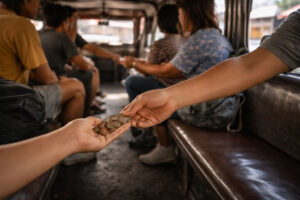
How do you pay on jeepneys and why do small bills matter? Jeepney payment is communal. You hand your fare (preferably exact or close) to the person nearest the driver, and it gets passed forward. Your change is passed back the same way. It’s one of those tiny daily kindness systems that makes commuting feel shared. Small bills keep the system smooth, which is why this Philippines public transport guide keeps emphasizing them.
“Para po!” and getting off safely
When you’re near your stop, say “Para po!” clearly. Then prepare to get off quickly and safely: hold your bag close, watch for moving traffic, and step down carefully. If you’re unsure where to alight, ask early: “Pakisabi po pag ____ na.” People will often help.
Jeepney etiquette that makes you look like you belong
In this Philippines public transport guide, these small habits go a long way:
• Pass fare and change with your hand, not by tossing coins.
• Move your knees and bags in; don’t block the aisle.
• Avoid loud calls or phone speaker audio.
• Be ready to get off promptly when you say “para.”
Sample jeepney fare example (illustrative, not a forever guarantee)
Jeepney fares are regulated and can be computed using a fare matrix approach. The structure commonly uses a minimum fare that covers an initial distance (often a few kilometers) plus a per-kilometer add-on beyond that. Modern PUJs may have a higher minimum than traditional PUJs, with a different per-kilometer add-on. Discounts for students, seniors, and PWDs may apply where honored and properly presented.
Illustrative example only: If a traditional PUJ minimum covers the first 4 km, then a 6 km ride would be: minimum fare + (2 km x per-km add-on). A modern PUJ might compute similarly but with a higher minimum and higher add-on. Because these rates can change, this Philippines public transport guide recommends confirming posted fare tables on vehicles/terminals when available and asking politely if unsure.
If you want a simple explanation of how fare matrices are made (without memorizing numbers), this official explainer is useful: LTFRB: How fare matrix is made.
Tricycles and the Last Mile: The “Door-to-Door” Shortcut
Why tricycle fares vary by town (LGU ordinances)
How do tricycle fares work and why do they vary per LGU? Tricycles are often regulated locally through city/municipal ordinances, which is why fares can vary from town to town. One place may have a posted matrix per zone, another may use per-kilometer or negotiated “special trip” rates. In this Philippines public transport guide, the key is: don’t assume the fare from one town applies in another.
How to handle it politely: ask before you ride
The smoothest way to avoid awkwardness is to ask calmly before you get in:
• “Magkano po hanggang ____?”
• “Special po ba ’to or per passenger?”
If the price feels high, you can respond kindly: “Pwede po bang ____ na lang?” If not, thank them and ask another driver. Keeping your tone calm is part of how to commute in the Philippines without stress.
When to choose tricycle vs jeepney vs walk
When should you choose jeepney vs tricycle? Choose tricycle for short last-mile trips, especially when you have luggage, it’s late, or the route is not jeepney-friendly. Choose jeepney for main roads and predictable routes. Walk for short distances when it’s safe and comfortable—heat and sidewalks vary, so don’t force it. This Philippines public transport guide is pro-comfort: a short tricycle ride can save your energy for the actual trip.
Ferries and RoRo Routes: Island Connectors That Make Overland Travel Possible
 Fastcraft vs RoRo: what’s the difference?
How do ferries and RoRo routes fit into overland travel between islands? Fastcraft generally focuses on passengers (and can be quicker), while RoRo (Roll-on/Roll-off) ferries carry vehicles plus passengers and are a backbone of “overland across islands” travel. If you’re getting around the Philippines without a car, you’ll still use RoRo routes as part of bus + ferry + van combinations, especially on well-connected corridors.
The port rhythm: arrive early, terminal fee, ID, baggage checks
Ports have their own rhythm: arrive early, pay terminal fees (common), present ID if required, pass baggage checks, then wait for boarding calls. In this Philippines public transport guide, I treat ports like airports but simpler: bring snacks, water, a light jacket, and patience.
Strong Republic Nautical Highway: a simple mental map
The Strong Republic Nautical Highway concept is a helpful way to understand how islands connect through a network of roads and RoRo links—often described in Western, Central, and Eastern route groupings. You don’t need to memorize every leg. You just need to recognize that your “bus ride” might include a ferry leg as naturally as a rest stop.
If you want an official reference matrix you can skim for context (not schedules), this is a useful document: MARINA: Philippine Nautical Highway Matrix.
Examples of “bridge routes” (no schedules, just the idea)
In this Philippines public transport guide, examples of common “bridge” legs include routes like Luzon-to-Mindoro connections, Bicol-to-Samar via Matnog/Allen, and Leyte-to-Mindanao legs via ports in Southern Leyte and Surigao areas—exact operators and schedules vary, so use this only as a mental model. For deeper ferry planning habits, these internal guides help: Philippines ferry travel guide and RORO routes and Philippine ferry travel advisory guide and Cebu and Bohol itinerary loop: ferries, bases, and low-stress route planning.
When to Choose Bus vs UV Express vs Jeepney vs Tricycle
A simple decision tree for travelers
If you want the same logic in a quick visual, see our Philippines transport decision tree.
If you only remember one section from this Philippines public transport guide, make it this:
Bus: best for longer distances, more luggage, more breathing room.
UV Express: best for faster point-to-point routes when luggage is small and you can wait for “punuan.”
Jeepney: best for everyday city/municipal routes and short-to-medium hops with local rhythm.
Tricycle: best for last-mile, door-to-door, or places without regular jeepney routes.
Comfort reality: heat, traffic, and the “standing and waiting” part
How to commute in the Philippines includes waiting—sometimes in heat, sometimes in rain, sometimes in traffic that makes you question your life choices. The calming move is preparation: water, a hat or umbrella, a light layer for aircon, and snacks. This Philippines public transport guide is not here to pretend it’s always comfy. It’s here to make you ready.
Safety Tips That Actually Help (Non-Alarmist, Real-Life)
Bag placement, phone habits, and small-body positioning
What are the best safety habits for everyday commuting? Keep your bag in front of you (especially in crowded terminals), keep your phone use discreet in busy areas, and avoid placing valuables in easy-access pockets. On buses, keep your day bag on your lap or strapped to your body. On jeepneys, hold your phone firmly and avoid scrolling near open sides when traffic is close.
Official terminals, well-lit pickups, and nighttime choices
When possible, use official terminals and established loading areas—especially at night. If you arrive late, choose a tricycle from a known terminal queue rather than an isolated pickup. If something feels off, you can exit politely: “Ay sorry po, may hinihintay lang ako,” then step toward a busier area.
How to confirm posted fares and avoid awkward disputes
Posted fares (when available) are your friend—look for boards, stickers, or dispatcher lists. Always ask before boarding tricycles. For buses and UV Express, keep your ticket/receipt if provided. If a situation feels tense, stay calm and choose a different ride instead of escalating. For broader safety mindset (practical, not fear-based), this helps: Travel safety Philippines guide.
What a Real Travel Day Feels Like: Mini-Scenarios
Scenario A: Provincial bus + tricycle to hotel
You arrive at a provincial bus terminal sweaty from the midday sun, clutching your small bills pouch like it’s a talisman. In this Philippines public transport guide moment, you ask: “Dadaan po ba ito sa ____?” The conductor nods. You settle in. Two hours later, you get off at a drop point that feels unfamiliar—but there are tricycles lined up, and a driver asks where you’re going. You confirm the fare before you ride. You arrive at your hotel tired, but proud: you just did getting around the Philippines without a car the local way.
Scenario B: UV Express + jeepney + walk
You queue at a UV Express terminal, waiting for “punuan.” It’s a little warm, but you have water and a snack. When you arrive in town, you hop on a jeepney for the last stretch. Coins move forward; change comes back. You say “Para po!” and step down carefully. Then you walk five minutes to your café, feeling like you’ve leveled up. This is how to commute in the Philippines: one simple connection at a time.
Scenario C: Bus + RoRo ferry + van to destination
You start with a bus, then reach a port where everyone lines up with bags and cardboard boxes tied with string. You pay a terminal fee, wait for boarding calls, then find your seat and watch the shoreline slide away. After the ferry, you take a van to the final town. It’s not “smooth” like a single train ride, but it’s satisfying—because you moved across islands through real infrastructure and real people. This Philippines public transport guide is built for exactly this kind of day.
Tools and Shortcuts: Practical Helpers That Reduce Confusion
Sakay.ph for Metro Manila route planning
In Metro Manila, route planning can feel like a puzzle—so using a route planner helps. Sakay.ph is a practical tool for figuring out combinations (walk + jeepney + train + bus) and estimating travel time. In this Philippines public transport guide, I recommend using it as a planning assistant, then still confirming on the ground with “Dadaan po ba ito sa ____?”
For city-specific examples of routes and local transport, see How to Get Around Cebu City: Tricycles, Vans, and Local Transport and How to Get Around Iloilo City: Tricycles, Vans, and Local Transport.
A simple note-taking system for terminals and landmarks
Create one note called “Transport.” Save: terminal name, route name, last bus time (if you learn it), hotel landmark, and backup options. Add a screenshot of your destination address. This small habit turns public transportation Philippines guide theory into real-life calm.
Packing tips that make commuting easier
For daily commute comfort: bring a reusable water bottle, a small towel or wipes, a light jacket for aircon, and a rain cover for your bag. If you want a broader packing refresher, this internal guide is helpful: 10 smart packing tips travelers should know.
Philippines Public Transport Guide FAQ
How does public transport work in real life (terminals, route culture, “punuan,” asking around)?
It’s terminal-based for many modes, with a strong culture of confirming routes by asking. “Punuan” means full; UV Express vans often depart when full, and queues shift with rush hours. Asking “Dadaan po ba ito sa ____?” is normal and helpful.
When should you choose bus vs UV Express vs jeepney vs tricycle?
Bus for long-distance and luggage, UV Express for faster point-to-point routes, jeepney for everyday local routes, and tricycle for last-mile trips or areas without regular jeepneys.
How do you read signage and ask for the right ride?
Read route names on windshields or terminal boards, then confirm verbally with staff or commuters. Use “Dadaan po ba ito sa ____?” and “Saan po bababa pag ____?”
How do you pay on jeepneys and buses, and why do small bills matter?
Jeepney fares are passed forward, and change is passed back. Buses may use ticket booths or conductors. Small bills matter because change is sometimes limited, especially during peak hours.
What are realistic sample fares (and how do you confirm posted fares on-site)?
Fares vary by distance, mode, and local updates. Short rides may be in the tens of pesos, while longer provincial trips can be in the hundreds or more. Confirm using posted boards, vehicle stickers (when available), and by asking terminal staff. Keep tickets or receipts if provided.
How do tricycle fares work and why do they vary per LGU?
Tricycle fares are often set locally through ordinances and can vary per town/city. Ask the price before riding and clarify if it’s a special trip or per passenger.
How do ferries and RoRo routes fit into overland travel between islands?
They connect road networks across islands, letting you do bus + ferry + van combinations. Arrive early at ports, expect terminal fees and boarding calls, and use the nautical highway idea as a mental map.
What are the best safety habits for everyday commuting?
Keep bags in front, use official terminals when possible, confirm fares calmly, avoid night swimming-style risks (late isolated rides), and step away politely if a situation feels off. This Philippines public transport guide is all about being alert without being afraid.