I started journaling while traveling for a simple reason: I kept forgetting the best parts. Not the “top 10” highlights—the tiny things that made the trip feel like my trip. The smell of garlic rice drifting out of a carinderia at 6 a.m. The exact way the sea looked when the boat turned. A trike driver’s joke that made me laugh when I was tired and sulky. Photos are amazing, yes, but they don’t always hold the feeling. A journal does.
This guide is my honest, practical take on travel journaling essentials. Not a stationery shopping list, not a scrapbook flex, and not a “write 3 pages daily or you failed” kind of vibe. It’s the method I use on busy days, messy days, and those days when nothing “special” happened—because that’s real travel too. Along the way, you’ll learn how to start a travel journal, what to write in a travel journal when you feel blank, and how to build reflective travel writing habits that don’t feel like homework.
If you enjoy simple travel habits that make trips feel lighter and more meaningful, you can browse Tips and Inspiration for more practical reads.
The Mindset Shift: Don’t Record Everything—Record What Moved You
Your journal isn’t a receipt; it’s a memory keeper
 When people ask me about travel journal essentials, they usually imagine they need to capture every landmark and every meal. You don’t. Your journal doesn’t have to be a complete record. It can be a small, chosen collection—the way you hold onto shells after a beach day. If it moved you, puzzled you, comforted you, made you laugh, made you feel brave or homesick or soft… that’s the material.
What changed in you is the story
Reflective travel writing is less about “where I went” and more about “who I became there.” Even if the change is small—a calmer morning, a new food you didn’t expect to love, a moment you felt safe and held by strangers—it matters. Travel journaling tips often sound like assignments. Mine is simpler: follow your emotional breadcrumbs.
First impressions are gold—capture them before they fade
First impressions disappear fast. The first scent you notice stepping out of a station. The first thing you think when you see the ocean. The first time you hear a new accent. When I’m trying to write meaningful entries (not just a recap), I treat first impressions like fresh fruit: best consumed immediately, or at least saved quickly.
Mika’s Simple Capture System: The Three Layers
Why a layered system makes journaling doable
Here’s the truth: on a real trip, you won’t always have time or energy for long writing. That’s why my travel journaling essentials are built as a three-layer system. Each layer is small on purpose, and each one supports the next. If you miss one layer, the whole thing still works.
Layer 1: In-the-moment notes (30 seconds to 3 minutes)
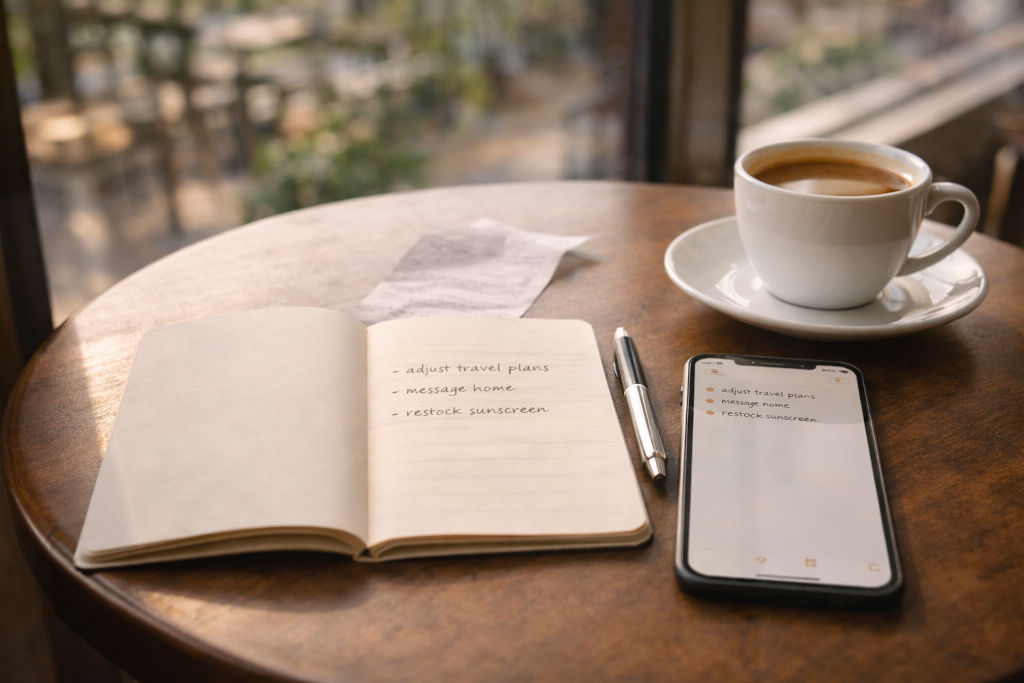
This is my “capture crumbs” layer. I open a small notebook or my notes app and jot fragments: a smell, a line of dialogue snippets, a funny sign, a food detail, a color. I’m not trying to write beautifully. I’m trying to pin butterflies to a page before they fly away.
How does Mika capture emotion in real time on a busy travel day? I don’t chase emotion directly. I chase sensory proof of emotion: the sweaty palms, the cold aircon, the sudden quiet, the way my shoulders dropped when I finally sat down. I write those physical clues because they lead me back to the feeling later.
Layer 2: End-of-day “scene + feeling” entry (5–15 minutes)
This is where the fragments become a small scene. I aim for one scene only—like a short film clip—and I name the feeling. If the day was chaotic, I write one honest paragraph. If the day was calm, I write one grateful paragraph. The goal is consistency, not length. This is one of my core travel journaling tips: one scene is enough.
Layer 3: Post-trip reflection (what changed in you)
After the trip—sometimes a week later, sometimes a month—I do one reflection entry. I ask: What did this trip change in me? What did I learn about how I move through the world? What did I need more of, less of? This is where travel writing becomes meaning-making, not just documentation. If you’ve ever wondered how to write meaningful entries not just a recap, this layer is the answer.
If you like stories that happen when plans fall apart (and how that shapes you), you might enjoy Unplanned travel: best stories.
The Essentials Kit: Minimal, Realistic, and Light
What are the true essentials for travel journaling (and what can you skip)?
Let’s answer this clearly. The true travel journaling essentials are:
1) One place to write: a small notebook or a notes app.
2) One reliable tool: a pen that doesn’t leak or a phone you can type on comfortably.
3) One simple way to hold paper bits: a tiny pouch or envelope for receipts, tickets, and small maps.
What you can skip: fancy markers, bulky scrapbooking supplies, multiple journals “for different vibes,” and anything that makes you afraid to use the page. The best travel journal essentials are the ones you’ll actually pull out while waiting for your order or sitting on a ferry.
What I personally carry (and what I leave behind)
I carry one slim notebook or I commit to one notes app folder labeled by trip. I carry one pen I trust. And I carry one small pouch for mementos (tickets, receipts, a tiny map corner) so my bag doesn’t become a crumpled-paper tornado. I leave behind: heavy journals, glue sticks, and the pressure to make it pretty. Pretty is a bonus; consistent is the goal.
If you want a travel-light mindset that supports journaling, this helps: 10 smart packing tips travelers should know.
Paper vs digital vs hybrid: which is best?
Paper vs digital vs hybrid: what’s the simplest setup for most travelers? For most people, the simplest is whichever you already use daily. If you love handwriting, go paper. If you live on your phone, go digital. If you want the best of both worlds, hybrid journaling is my favorite: quick notes digitally, then one handwritten page when you feel like slowing down.
My honest take: paper feels more emotional. Digital is more convenient. Hybrid is the most sustainable habit. The only “wrong” choice is the one that makes you stop.
How I Capture Emotion: A Mini-Template You Can Copy Anywhere
The “scene + body + meaning” template
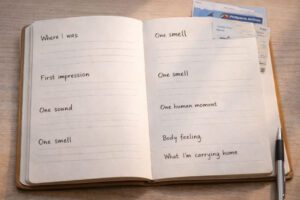
When people ask what to write in a travel journal, they often want prompts. I get it. But prompts can feel random unless they point you toward feeling. Here’s my repeatable mini-template (I use this in my notes app or notebook):
Where I was: (be specific—street, seat, corner, shoreline)
What I noticed first: (first impressions, one detail)
One sound: (music, chatter, engines, birds)
One smell: (rain, sunscreen, garlic, ocean, dust)
One human moment: (a kindness, a joke, a small conflict, a gesture)
What I felt in my body: (tight chest, relaxed shoulders, heavy eyes, calm belly)
What I’m carrying home: (a lesson, a craving, a shift in perspective)
This is the core of my travel journaling essentials because it catches emotion without forcing it.
Five senses writing without exaggerating
How do you use the five senses to describe a place with honesty and clarity? The trick is to be specific, not dramatic. Instead of “the food was amazing,” write: “The soup smelled like ginger and toasted garlic; the first sip warmed my throat and made me stop talking.” Instead of “the beach was perfect,” write: “The sand felt coarse under my toes, and the wind carried a salty, metallic smell.” Five senses writing isn’t about poetic fireworks—it’s about clarity that revives the moment.
Dialogue snippets: how to capture people without turning them into characters
I love dialogue snippets because they instantly transport me back. I write short lines like: “Ate at the counter said, ‘Mainit pa ’yan, iha—wait lang,’” or “Driver joked, ‘Ma’am, dito mabilis ang oras, but slow ang traffic.’” The rule: keep it respectful, don’t mock accents, and don’t include private details that could identify someone. Your journal can hold warmth without taking from people.
Micro-Prompts That Work Anywhere (Even in a Terminal, Bus, or Café)
Senses cluster: the fastest way to get unstuck
When my brain is blank, I start with senses. Try:
• What color is the light right now?
• What’s the strongest smell in this moment?
• What texture did I touch today that I’ll remember?
• What sound is the “background music” of this place?
People cluster: small interactions, big meaning
Prompts:
• Who helped me today (even in a tiny way)?
• What phrase did I hear repeatedly?
• What small courtesy did I witness or receive?
• What did I learn about local rhythm from watching people?
Food cluster: beyond “masarap”
Prompts:
• What was my first bite and my last bite of the day?
• What did I crave unexpectedly?
• What did I eat that tasted like “home,” and why?
• If I had to caption the meal in one sentence, what would it be?
Fear/discomfort cluster: write it gently, write it safely
Prompts:
• What made me feel uneasy, and what did I do to feel safer?
• What was harder than I expected?
• What did I need in that moment (food, rest, quiet, reassurance)?
Surprise, gratitude, humor cluster: the heart-softeners
Prompts:
• What made me laugh today (even a small laugh)?
• What surprised me in a good way?
• What’s one thing I’m grateful for right now?
• What would I tell a friend about this exact moment?
Turning Notes Into Writing With Heart (Without Being Cheesy)
How to move from “we went here” to “this is how it felt”
This is the most important part of travel journal essentials: the shift from recap to reflection. A recap is not wrong—it’s just incomplete. The bridge is adding sensation + meaning.
Before/after example: recap vs reflective travel writing
Before (recap): “We went to the market and ate noodles. Then we walked around.”
After (with heart): “At the market, the air smelled like vinegar and frying oil. I ate noodles standing beside a stranger who smiled at me like we were both in on a small secret: this is where the real day begins. I felt my shoulders drop—like my body finally believed we were on vacation.”
Before (recap): “The sunset was nice.”
After (with heart): “The sky turned peach and dusty pink, and for ten minutes everyone got quieter. I noticed I stopped checking my phone. I didn’t want to miss the last light touching the water.”
Photo captions as journal fuel
Sometimes I use photo captions as a stepping stone. I’ll write a caption first (one sentence), then expand: Why did I take this photo? What was happening just outside the frame? If you’re doing digital journaling, pairing a photo with two sentences can be a perfect minimum entry that still feels alive.
The Tired-Day Plan: Keeping the Habit Gentle
How to keep a travel journal when you’re tired
How to keep a travel journal when you’re tired? I lower the bar on purpose. I have a “minimum viable entry” rule: three bullets only.
• One sensory detail
• One feeling word
• One tiny moment
Example: “Smelled rain on hot pavement. Felt relieved. Ate taho near the station and it tasted like childhood.” That’s it. That counts. This is one of my most reliable travel journaling tips because it protects the habit when energy is low.
What to write when the day felt ordinary
What do you write when the day felt ordinary? Ordinary days are actually the easiest to write with heart—because you can notice the quiet. Ask: What was steady today? What was comforting? What was repetitive in a way that made me feel held? Some of my favorite entries are about “nothing special”: laundry drying by a window, the way a neighborhood smells at dusk, a slow breakfast, a short conversation with a tindera. Ordinary is where your life lives.
How to keep journaling from feeling like homework
Two rules: keep it short, keep it yours. Don’t write for an imaginary audience. Don’t force a lesson. If the day was messy, write honestly: “I felt irritable and overstimulated.” That’s still reflective travel writing. Your journal is a friend, not a teacher with a red pen.
Also: give yourself permission to skip. Skipping one day isn’t failure; it’s rest. If you want to explore more about traveling without rigid pressure, this can be a comforting companion read: Budget travel Philippines: explore more for less.
From Quick Notes to Reflective Entries Later
How do you turn quick notes into a reflective entry later?
This is where the three layers work together. When I have time (often on the ride back, or the next morning), I open my crumbs and ask: “Which moment has a pulse?” I choose one. Then I expand using the template: scene, senses, body, meaning. A reflective entry doesn’t need to be long. It needs to be specific.
My “two-pass” method: write messy, then write kind
Pass one is messy: raw notes, honest feelings, unpolished phrases. Pass two is kind: I rewrite one paragraph so it reads smoothly, and I add one line of meaning (what it taught me, or what it revealed about me). This keeps the entry human—real first, then readable.
 Voice memos: the underrated travel journal essentials tool
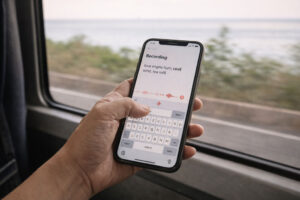
On days when my hands are full, I record a 20–40 second voice memo. I describe what I see and how I feel, quickly. Later, I transcribe a few lines or turn it into a paragraph. Voice memos are my secret weapon for how to start a travel journal when you think you “don’t have time.” You always have 30 seconds.
Mementos Without Bulk: Tickets, Receipts, Maps (Keep It Light)
How do you handle mementos without making your journal bulky?
I’m not a full scrapbooker on the road. My method is simple: I keep mementos in one pouch while traveling, and I choose only a few to attach later. I also flatten everything immediately (receipts especially), because crumpled paper becomes clutter fast.
The “photograph it, then release it” strategy
If a receipt or ticket is meaningful but bulky, I take a clear photo and write one sentence: why it mattered. Then I let the paper go. The meaning stays. This is one of those travel journal essentials that keeps your bag lighter and your journal usable.
Maps: keep a corner, not the whole thing
If you pick up a map, you don’t have to keep the entire sheet. Tear (or cut) a small corner with the place name or a route you took—then tuck it in your pouch. Small pieces carry big memory.
Protecting Your Journal: Privacy, Safety, and Backups
How do you keep journaling private and safe while traveling?
This matters, and I’m glad you’re asking. If you’re writing real feelings, you deserve privacy.
If digital: passcodes, offline access, and backups
If you journal on your phone, use a passcode or app lock. Keep important entries available offline in case you lose signal. Back up regularly (even just when you’re on stable Wi-Fi). I also like keeping a “travel notes” folder separate from work files, so I don’t accidentally share something personal.
If paper: label strategy, what not to write, and photo backups
If you use paper, don’t put your full address, exact room number, or sensitive details in the journal. I label the notebook with an email address (not a phone number) so it can be returned without exposing too much. And yes—I photograph key pages occasionally, especially if the notebook starts to feel precious. A small backup is a gentle kind of security.
A quick note on what travel writing is (and why it matters)
If you want context, travel writing has a long history—part diary, part observation, part storytelling. You can read more here: Travel writing. And if you’ve ever loved the intimacy of a diary, this overview is a good reminder that private writing has always been a human comfort: Diary.
FAQ
What are the true essentials for travel journaling (and what can you skip)?
Essentials: one place to write (paper or app), one reliable pen or keyboard, and one pouch for paper bits. Skip anything bulky or “precious” that makes you afraid to use it.
How does Mika capture emotion in real time on a busy travel day?
I capture sensory and body details quickly—what I noticed first, one sound/smell, and what my body felt like. Those clues lead me back to the emotion later.
What do you write when the day felt ordinary?
Write the quiet truths: what comforted you, what repeated, what felt steady. Ordinary moments often reveal what you actually needed.
Paper vs digital vs hybrid: what’s the simplest setup for most travelers?
The simplest is what you’ll use consistently. Paper feels emotional, digital is convenient, and hybrid is the most sustainable for many people: quick notes digitally, one short handwritten scene later.
What prompts does Mika use when she feels blank?
I use micro-prompts: first impression, one sound, one smell, one human moment, one body feeling, and one thing I’m carrying home.
How do you keep journaling from feeling like homework?
Lower the bar, keep it short, and write for yourself. Use a minimum viable entry on tired days and give yourself permission to skip without guilt.
How do you turn quick notes into a reflective entry later?
Pick one moment with “pulse,” then expand with scene + senses + body + meaning. One paragraph is enough if it’s specific.
How do you handle mementos without making your journal bulky?
Keep paper bits in one pouch, attach only a few later, and photograph the rest. Keep corners of maps, not entire sheets.
Write Your Journey With Heart, Not Pressure
The best part about travel journaling essentials isn’t the notebook or the pen—it’s the way the habit teaches you to notice your life. You start paying attention to first impressions, to dialogue snippets, to the smell of rain or the sound of a city waking up. And later, when you’re back home and the trip feels like a dream you’re losing, you’ll open your pages and find the real souvenir: the version of you who was there, feeling it all. Write gently. Write honestly. Write in a way you can keep.