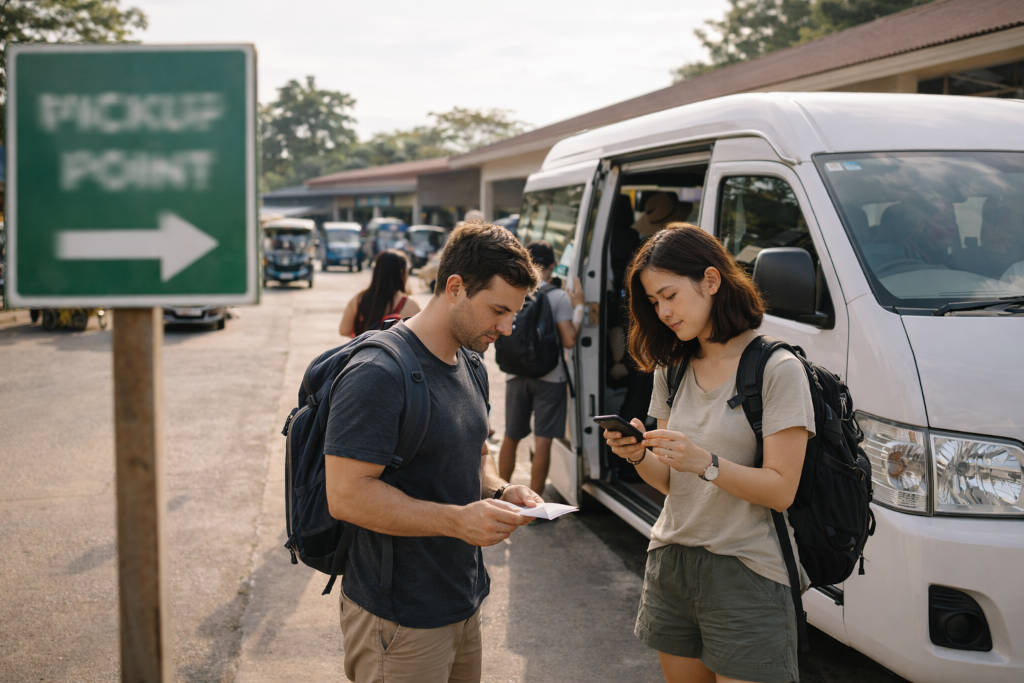
In the Philippines, “van transfer” can mean very different things depending on where you are. Sometimes it is a tourist shared shuttle between destinations. Other times it is a commuter-style UV Express van on a fixed city route. Both can be useful, but both can also fail your day if you expect bus-level space or airline-level timing. This guide explains what a Philippines van transfer usually looks like on the ground, when it makes sense, and what to do when the plan does not work.
The focus here is planning-first: time, cost, comfort, safety, weather, and realistic backup options. Nothing is “one rule for the whole country,” so use the decision rules and confirm local details at your terminal, hotel desk, or operator.
At-a-Glance: The Practical Decision
- Use vans when: you want fewer stops than a bus, you need a direct connection, or you are splitting a private ride as a group.
- Avoid vans when: you need reliable timing, you have big luggage, or you are facing long hours in tight seating.
- Expect waiting: many routes operate “fill-and-go” (puno) and may not depart until seats are filled, though some places do scheduled dispatches.
- Plan for heat: vans can feel cramped on hot days and dehydration can sneak up, especially with limited stopovers.
- Have a Plan B ladder: next dispatch, bus, private transfer, ferry/flight reroute, or overnight reset.
Reality check: The best transport choice is not the fastest on paper. It is the one that stays workable even with delays, weather, and full vehicles.
Before You Choose a Van: A Quick Planning Lens
Before committing to Philippines van transfers, decide what matters most for the day: arriving at a specific time, staying comfortable, carrying bulky luggage, or minimizing transfers. Then match transport to that priority rather than choosing based on “what everyone does.”
If you are new to planning transport days in the Philippines (buffers, early starts, and how to structure a travel day), start with travel planning guide for first-time travelers.
Two questions that prevent most problems
- Timing question: “Do I need to arrive by a fixed hour?” If yes, be careful with fill-and-go routes and build a bigger buffer.
- Luggage question: “Can I carry my bag comfortably on my lap or at my feet if needed?” If no, a bus or private transfer may be safer.
Reality check: Vans are often chosen for speed, but waiting for departure can erase that advantage.
What Vans Are and How They Operate
In Philippine travel conversations, “van transfer” usually refers to two common models. Knowing which one you are dealing with helps you set expectations around timing, comfort, and ticketing.
A) Tourist shared shuttle vans between destinations
This is what many travelers mean by “shuttle van Philippines” or “tourist van transfer Philippines.” These are often sold per route in tourist areas and may be terminal-to-terminal or include hotel pickup and drop-off (sometimes with limits, like only within town proper). The vehicle is typically a van or minibus with air-conditioning, and the trip may include one planned stopover (for comfort break or meals) depending on distance.
Timing reality: Some tourist vans depart on a schedule, but many still follow a fill-and-go pattern if demand is low. Even on “scheduled” services, dispatch times can shift with traffic, loading, and passenger coordination.
Reality check: Tourist shared vans can be direct and convenient, but do not assume airline-style punctuality or fixed nationwide standards.
B) UV Express-style commuter vans on fixed terminals/routes
 UV Express Philippines services are commuter vans that run on set routes and terminals, especially in cities and nearby provinces. They are designed for regular transport demand, and the norms can include queueing at a terminal, paying cash, and departing once the vehicle is full. For a general reference on what UV Express is, see https://en.wikipedia.org/wiki/UV_Express.
Fill-and-go (puno): Many UV Express routes wait until enough seats are filled before leaving. Some areas also use dispatch schedules at peak hours, but it depends on place and demand.
Reality check: UV Express vans can be efficient for commuters, but for travelers with luggage or tight schedules, they can be uncomfortable or unpredictable.
Pickup points, stopovers, and “terminal-to-terminal” language
 Terms you will hear:
- Pickup point: a specific hotel, corner, terminal, or landmark where passengers are expected to wait.
- Terminal-to-terminal: you go to a dispatch point and get dropped at another terminal, not necessarily at your hotel.
- Stopover: one planned break for restroom/food. Some trips have none; others may have more than one depending on distance.
- Fill-and-go (puno): the van may wait until enough seats are filled.
Reality check: If your day depends on a connection (ferry/flight/tour), treat these details as plan-changing, not “small print.”
When Vans Make Sense: Decision Rules and Practical Examples
Vans can be a smart choice when they reduce transfers and keep the day simple. Use these rules as a framework rather than a promise.
Rule 1: Short to medium land trips where fewer stops matter
If a bus route exists but is slower due to many stops, a shared van Philippines option can be worth considering—especially when you want a more direct trip between two tourist hubs. The advantage is often fewer stops and a straighter route, but only if departure waiting time is reasonable.
Reality check: Ask how long people typically wait to fill seats at your time of day. A “fast” van that waits an hour to depart is not fast.
Rule 2: When vans provide a direct connection that buses do not
In some areas, vans cover point-to-point tourist routes that are awkward by bus (multiple transfers or inconvenient terminals). In that case, a shuttle van Philippines option can reduce complexity even if the ride itself is not luxurious.
Reality check: Direct does not always mean comfortable. Confirm seating, stopovers, and luggage handling before you commit.
Rule 3: When a group can split a private van for comfort and control
If you are traveling as a group, a private van transfer can make sense because you gain control over pickup time, stopovers, and luggage space. The cost per person may become reasonable when split across multiple travelers.
Reality check: Private transfers still face traffic, weather, and road conditions. Control helps, but it does not erase delays.
Rule 4: When ferry or flight schedules do not align and you need a same-day land option
Sometimes the practical goal is “arrive same-day,” not “arrive early.” If ferry/flight schedules do not match your plan, a van can be a workable land bridge—especially when it prevents losing an entire day to waiting.
Reality check: If you are using a van to catch a boat or plane later the same day, increase your buffer and consider a more reliable option if timing is critical.
When Vans Don’t Make Sense: Decision Rules That Protect Comfort and Timing
Some situations make vans a poor fit. These are the cases where buses, private cars, or rerouting usually win.
Rule 1: Long hours with tight seating and limited legroom
Vans are often tightly seated. On long trips, limited legroom can increase fatigue, stiffness, and discomfort. If you have back issues, knee issues, or simply struggle with cramped seating, a bus with more space may be a better choice even if it is slower.
Reality check: Discomfort compounds over hours. A “faster” trip that leaves you exhausted can reduce your next day’s quality.
Rule 2: Big luggage, bulky suitcases, or fragile gear
 Many vans have limited cargo space. Bags may be placed behind seats, between rows, or (on some services) on a roof rack. If you are carrying large suitcases, bulky dive gear, or fragile equipment, you may be asked to pay for extra space or an extra seat as a common practice in some places—though it is not a universal rule and varies by operator.
Reality check: If your luggage cannot fit safely without blocking aisles or crowding passengers, choose a bus or private transfer.
Rule 3: High heat days if you struggle with dehydration
Even with air-conditioning, vans can feel warm when doors open repeatedly, when traffic slows, or when the sun is strong. If you know you struggle with heat, plan extra water and avoid peak hours. Seasonal heat and heavy rain patterns can also affect road travel and comfort; use Philippines weather guide and best months to plan more conservatively.
Reality check: Heat discomfort is not just annoying—it can turn into headaches, nausea, and a wasted afternoon.
Rule 4: Night travel (fatigue, visibility, fewer backup options)
Night van travel can carry extra risk: driver fatigue, lower visibility, and fewer “Plan B” options if something goes wrong. If you can travel in daylight, it is usually the safer, more comfortable call—especially in unfamiliar areas.
Reality check: “Arriving late” is not always a win if it means you arrive drained and with limited transport options at your destination.
Rule 5: If you need reliable timing
If you must arrive by a fixed hour (connecting ferry, flight, wedding, tour check-in), vans can be risky because of fill-and-go waiting, passenger pickup delays, and traffic. In these cases, a private transfer or an earlier bus schedule can be more dependable.
Reality check: The risk is not only road time—it is the waiting before the van even leaves.
Comfort and Luggage Expectations: Set Realistic Standards
Comfort varies widely by operator, vehicle model, and route demand. Treat comfort as “variable,” not guaranteed.
Seating, legroom, and aircon
Many vans are dense in seating. Legroom may be tight, especially for taller travelers. Air-conditioning is common, but the actual comfort depends on maintenance and how full the vehicle is. If you are sensitive to cold aircon, bring a light layer; if you are sensitive to heat, bring water and pace your day around recovery.
Reality check: A full van is normal. If you need extra space to feel okay, consider paying more for a bus with more legroom or a private ride split with a group.
Stopovers: sometimes one, sometimes none
Many tourist vans plan one stopover for restroom and snacks on longer trips, but short routes may not stop at all. UV Express-style routes may not have a formal stopover. Always ask before boarding if you need a restroom break within a certain window.
Reality check: “We stop” can mean “only if needed” or “only once.” Clarify it early.
Luggage handling: behind seats, at feet, or on roof racks
Luggage may be stored behind the last row, placed between seats, or placed on a roof rack in some cases. If a roof rack is used, bags should be secured properly. If you are uncomfortable with roof storage (rain risk, dust, securing), choose another option or protect your bag with a rain cover and keep valuables with you.
For a packing approach that fits tight transport days (including what to keep on your person), use packing list guide for different trip types.
Reality check: If the van is already full of people and bags, adding one more large suitcase can create a problem for everyone. Having a Plan B is part of good travel behavior.
Cost Expectations: Van vs Bus vs Private Transfer
Van pricing varies by destination, operator, and season. In general, shared vans can cost more than buses on similar routes because they are more direct and have fewer stops. Private vans cost more, but become more reasonable when split among a group and when they prevent an overnight stay.
To frame your overall trip budget (and decide where paying more saves the day), compare your plan with sample travel budget examples.
Reality check: The real cost is not only the fare. It is also the time you lose if the van is full, delayed, or uncomfortable enough to slow you down the next day.
Safety and “Normal Behavior” Checklist
Vans often operate with local norms that can surprise first-timers. Some behaviors are normal. Others are red flags. For broader safety principles across the country, reference travel safety guide for the Philippines.
A) Normal behavior you can expect (not automatically a scam)
- Waiting to fill seats (fill-and-go / puno), especially off-peak.
- Assigned pickup points rather than door-to-door pickup for everyone.
- One planned stopover on longer tourist routes.
- Drop-off at a nearby terminal or main road instead of a small inner street.
- Asking passengers to be ready early to avoid delaying the whole van.
Reality check: These practices can be inconvenient, but they are common. The key is to confirm details before you commit.
B) Red flags to walk away from
- Obvious overloading beyond available seating or seatbelts.
- Driver seems impaired, extremely fatigued, or reckless.
- No clear destination or route confirmation (vague answers, changing story).
- Unclear pricing or payment (“pay later” with no number, or sudden add-ons not explained).
- Unsafe baggage on the roof without proper securing.
- Pressure to board immediately without letting you confirm pickup/drop-off details.
 Seat belt reminder: Use a seat belt where available, especially in front seats, even if others do not. If there is no working seat belt for your seat and you feel unsafe, it is okay to choose another option.
Reality check: It is better to lose an hour changing plans than to stay in a situation that feels unsafe.
How to Buy Tickets and Reserve Seats (Step-by-Step, PH Reality)
There is no single nationwide system for Philippines van transfers. The purchase method depends on whether you are using a tourist shuttle or a commuter UV Express route. Use the steps below to reduce uncertainty.
 Option 1: Terminal or dispatch booth (day-of)
- Go to the correct terminal/dispatch area and ask for the route and departure pattern (fill-and-go or scheduled dispatch).
- Confirm the drop-off point (terminal, town center, or specific landmark).
- Ask about stopovers (whether there is one, where it is, and approximate timing).
- Clarify luggage expectations (where bags go, roof rack use, extra seat practice if needed).
- Pay as instructed (often cash), keep your ticket/receipt if provided, and take a photo of any written details.
Reality check: “Next trip” can mean “next dispatch once full.” Ask what “next” usually means at that time of day.
Option 2: Hotel/hostel or local agency coordination (common in tourist areas)
- Ask your accommodation to arrange a shuttle van Philippines transfer and request written confirmation of pickup point and time window.
- Confirm whether pickup is from your hotel or a nearby pickup point.
- Ask what happens if the van is delayed or full (next dispatch, alternate pickup, or refund policy).
- Save screenshots of the confirmation offline in case signal is weak.
Reality check: Hotel coordination is convenient, but it can still involve waiting and shared pickups. Confirm the “where to stand and when” details.
Option 3: Online booking for some tourist shuttle routes (varies by destination)
Some tourist routes offer online booking. Availability and reliability vary by destination. When you use online booking, look for the details that matter operationally: pickup point list, drop-off point, dispatch times, baggage rules, and contact method for day-of updates. Travel Palawan is one example of a site style that shows the kind of details travelers should look for (route info, schedule tables, pickup points), but always verify current operations directly with the provider for your specific date.
Reality check: A booking confirmation is helpful, but you still need a day-before reconfirmation—especially during peak season or bad weather weeks.
Practical tips that prevent common mistakes
- Arrive early in peak season and on weekends (queues and seat demand rise fast).
- Confirm the exact pickup point and drop-off point (name a landmark, not only a town name).
- Ask about stopovers and approximate ride length (as a range, not a guarantee).
- Clarify luggage rules before paying, especially for large suitcases.
- Keep small cash ready for fares and stops.
- Save confirmation screenshots offline and download an offline map of your drop-off area.
Reality check: Most van problems come from missing one detail: “Where exactly do I get picked up and dropped off?”
Backup Options if Vans Are Full: A Simple Plan B Ladder
Vans fill up, weather changes, and terminals get chaotic. A backup ladder keeps you from losing a full day. Use these steps in order and stop when you reach an option that protects your time and comfort.
Plan B Step 1: Take the next dispatch (or check an alternate terminal)
If the van is full, ask about the next dispatch and whether another terminal or pickup point nearby has earlier availability. This is sometimes possible in larger towns or cities where multiple dispatch points exist.
Reality check: “Wait a bit” is fine if you are not missing a connection. If you are, move to Step 2 quickly.
Plan B Step 2: Switch to a bus (often slower, but more space)
Buses are often slower but usually offer more luggage space and clearer seating. If you need room for bags or a less cramped ride, a bus can be the better call. For bus/jeepney/ferry basics and how terminals usually work, use public transport guide in the Philippines.
Reality check: If you are traveling in a group, a bus can keep everyone together and reduce the stress of splitting into multiple vehicles.
Plan B Step 3: Price out a private transfer and split the cost
If timing matters or luggage is bulky, a private transfer can save the day. The key is to calculate per person cost and compare it to the value of not losing a full day (or paying for an extra night). Ask for clear inclusions: pickup point, drop-off point, stopover rules, and what happens if weather affects the road.
Reality check: Private transfers are most worth it when they prevent a missed ferry/flight or avoid a stressful late-night arrival.
Plan B Step 4: Reroute using ferry or RORO if it prevents losing a day
Sometimes a sea route (or a different land-to-sea combination) can be a better reset than waiting for vans. If you are considering this, use ferry and RORO travel guide to understand how rerouting and terminals typically work.
Reality check: Rerouting only helps if it is realistic for the day. Factor in port queues, boarding times, and weather conditions.
Plan B Step 5: Stay overnight and reset early the next day
If all options are full, weather is bad, or it is getting late, the most conservative choice is to stay overnight and depart early. This reduces night travel risk and gives you first access to morning dispatches.
Reality check: An overnight reset can feel like “losing time,” but it often prevents a chain of fatigue and missed plans over the next two days.
LTFRB and “Official” Context (What Travelers Should Know)
Transport regulation in the Philippines involves multiple layers, and rules can vary by area and service type. If you want to understand the regulatory context and official transport information, the LTFRB NCR portal is one reference point: https://ptops-ncr.ltfrb.gov.ph/en. For travelers, the practical takeaway is simpler: prioritize clear route confirmation, safe vehicle practices, and reliable dispatch points.
Reality check: You do not need to be an expert in regulation to travel well—you need clear details, safe behavior, and a backup plan.
Before You Board a Van: Mini-Checklist for First-Timers
 Use this short checklist right before you commit. It is designed to prevent the most common “small problems” that turn into big delays.
- Confirm pickup point and drop-off point (name the landmark or terminal).
- Confirm whether it waits to fill seats (fill-and-go) or has a scheduled dispatch.
- Ask about stopover (yes/no, where, and roughly when).
- Secure small cash for fare and stops; avoid relying on cards.
- Bring water and a simple snack; plan for heat and delays.
- Charge your phone and power bank; save confirmation screenshots offline.
- Download an offline map of your drop-off area.
- Keep valuables on you (not in roof rack luggage).
- Use a seat belt if available.
- Message someone your expected arrival time and route.
Reality check: This checklist takes two minutes and can save you hours of stress later.
Closing: Choose the Option That Stays Stable When Plans Change
Philippines van transfers can be a smart tool when used for the right day: direct routes, fewer stops, and group-friendly private options. They can also be a poor fit when timing is strict, luggage is bulky, or conditions are hot and exhausting. If you plan around fill-and-go realities, confirm pickup and drop-off points, and keep a Plan B ladder, a Philippines van transfer becomes a practical choice rather than a gamble.
For more planning-first travel content, browse more tips and inspiration.