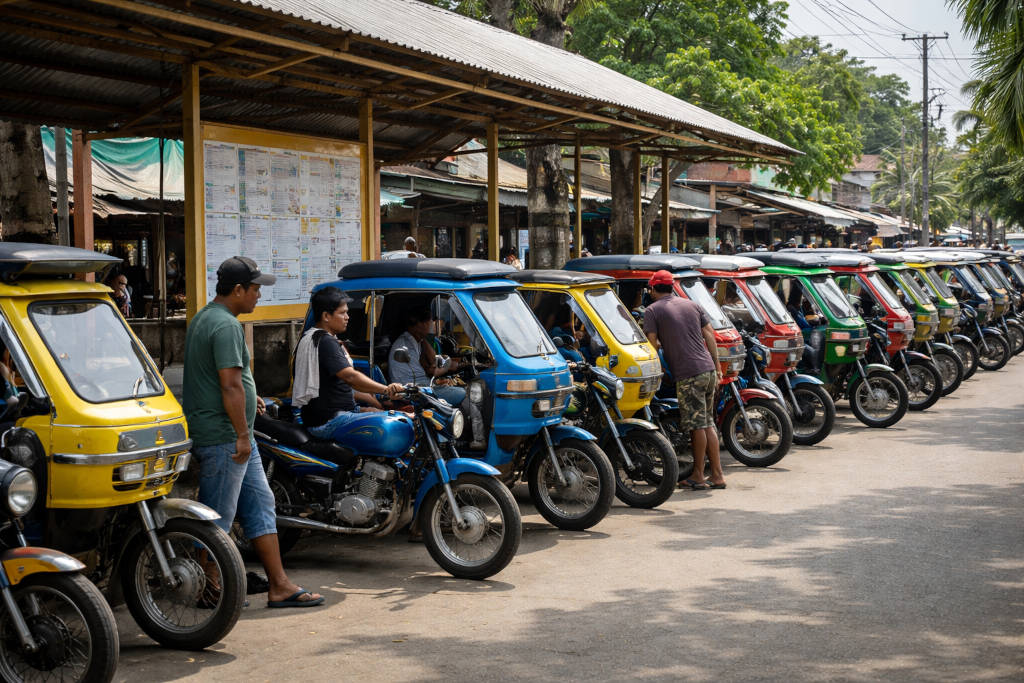
Philippines tricycle fare is usually simple once you know the two pricing models and where rules come from: local ordinances, terminal practices, and posted fare matrices. The confusion often happens when visitors assume there’s one national price list. In reality, tricycle pricing Philippines-wide varies by town and city, and the same ride can be “shared per head” in one place and “special trip” in another. This guide explains how the system typically works, what to confirm before you ride, and how to avoid surprise fees—especially with luggage, at night, or far from terminals. If you want the wider context for last-mile transport, skim the public transport guide so tricycle expectations fit into your full route plan.
At-a-Glance
 Fast decision rule: If a posted matrix exists, follow it. If there’s no matrix and you’re off-route or late at night, agree on a total before moving.
Best for short hops: Shared per head when you’re near a terminal or common route.
Best for luggage/late night: Special trip only if the total is clear and you feel safe.
Budget band: Expect low minimum fare for short rides, then add-ons for distance, waiting time, or exclusivity—varies by LGU.
Comfort/safety backup: If the quote feels unclear or you’re pressured, step away and switch to a taxi, app ride, or a different queue.
Reality Check: A calm, clear agreement is more valuable than shaving off a small amount—most problems with Philippines tricycle fare start with “Sige na” without confirming the total.
What to know before you ride (the 30-second method)
Before you sit down, treat Philippines tricycle fare like a quick checklist. You’re not trying to “win” a bargain—you’re trying to remove surprises. In most places, drivers can explain the basis (per head vs per ride) in one sentence if you ask clearly. If you’re planning your first local rides in the country, it helps to review first-time Philippines trip planning (useful for first trip planning and simple planning habits) so you can build simple habits: small bills, quick questions, and a safe pickup point.
Reality Check: If you feel rushed or pressured, that’s already useful information—slow down and confirm the basics before committing to Philippines tricycle fare terms.
Ask these 3 questions: total fare, per head vs per ride, special trip or regular
These three questions solve most Philippines tricycle fare confusion:
1. Total fare: “Magkano po lahat hanggang ____?” (How much total to ____?)
2. Basis: “Per head po ba o per ride?” (Per person or per ride?)
3. Type: “Special po ba ito o regular?” (Is this special trip/private hire or regular/shared?)
If the driver answers clearly, you can decide quickly. If the answers keep changing, it’s okay to step away and find a clearer option—especially if your luggage is already being handled.
Reality Check: Some areas use local terms like pakyaw or arkila; don’t assume the meaning—ask what it includes so Philippines tricycle fare stays predictable.
Where to look for clues: terminal queues, posted matrix, IDs/stickers, tricycle number
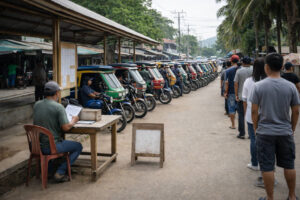
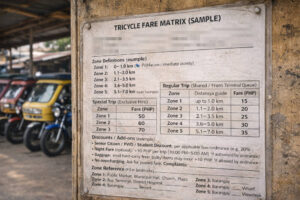 In many towns and cities, the safest, simplest Philippines tricycle fare experience starts at a terminal or official queue. Look for:
- A posted fare matrix (sometimes called a tricycle fare matrix Philippines travelers ask about), often near the waiting area
- A TODA presence (Tricycle Operators and Drivers Association), dispatchers, or an organized line
- A franchise sticker or permit markings, sometimes referred to as MTOP (Motorized Tricycle Operator’s Permit) in some LGUs
- A visible tricycle number (painted or stickered) that you can note if needed
- A route/zone sign that suggests this tricycle is assigned to a particular area
None of these guarantee a perfect ride, but they usually reduce the chance of surprise “extras.” For broader context on how local transport works across the country, skim public transport in the Philippines.
Reality Check: If you’re far from a terminal, pricing can become more negotiable—so it’s even more important to confirm Philippines tricycle fare as a total, not as a vague “mura lang.”
Why tricycle fares vary by town and city
Travelers often look for “one standard” Philippines tricycle fare, but tricycle operations are usually shaped locally. That means pricing, zones, and where tricycles can pick up or drop off may change from one municipality to the next—even if the distance looks similar. If you’re budgeting a longer trip, you’ll feel these differences across islands and cities; use sample Philippines travel budgets to plan a cushion for local transport variability.
Reality Check: When you cross into a different city or town, assume rules might change—reconfirm Philippines tricycle fare instead of relying on what worked yesterday.
Fares and routes are set locally (brief, simple explanation; don’t get legal-heavy)
In plain terms: tricycle routes and fare matrices are commonly handled by local government units (LGUs) through local offices and boards, guided by local ordinances. This is why “minimum fare” and zone pricing can differ. If you want one concrete example that regulation is handled locally, Quezon City’s tricycle franchising system is publicly described here: tricycle franchising is handled by LGUs.
Practical takeaway: if there’s a posted matrix, it usually reflects the local ordinance for that area. If there’s no posted matrix, you’re operating on negotiated pricing and should confirm the total clearly.
Reality Check: Even within the same city, some zones use terminals and fixed pricing while others rely on negotiation—so check signs and ask before agreeing to Philippines tricycle fare.
National-highway limits can change where tricycles can take you
Another reason Philippines tricycle fare can feel inconsistent is route limitation. Many areas restrict tricycles on national highways or major roads, which can force transfers. This is where you’ll hear terms like “crossing” (dropping you at the edge of a main road) or “hangtod ra ko dira” (I can only go up to there). The practical impact is: you may pay one tricycle ride to reach a transport hub, then switch to another mode for the highway portion.
If you want a policy reference that helps explain why route limits exist in some areas, see this DILG memo circular on national-highway restrictions. Use it as context, not as a map—actual enforcement and designated roads can vary by locality.
Reality Check: If a driver insists on taking a route that locals say is restricted, treat that as a cue to pause and rethink Philippines tricycle fare and safety—transfers might be the normal approach there.
Pricing model 1: per person / per head (shared ride)
One common Philippines tricycle fare model is per head (per person) in a shared ride. This is often used near terminals, along common routes, or in areas where tricycles function like short-distance public transport. You may hear “per head,” “per person,” or “isa” (one person) when discussing the fare.
Reality Check: Shared rides can feel crowded, especially at peak hours—if you have fragile items or you’re uncomfortable sharing, consider a different option instead of forcing a shared Philippines tricycle fare setup.
What’s normal: minimum fare, short distance add-ons, paying per head
What’s usually normal in a shared per-head Philippines tricycle fare setup:
- There’s a minimum fare for short distances, sometimes stated by zone
- You pay per head (per person) rather than per ride
- Small add-ons may apply for longer distances outside the core zone, but the driver can explain the basis clearly
- Payment often happens at the end, but agreeing on the basis early helps avoid confusion
If a fare matrix is posted, use it. If a dispatcher is present, ask them the expected amount; it’s often the quickest way to keep Philippines tricycle fare aligned with local practice.
Reality Check: If you’re unsure whether the quote is per head or total, don’t guess—confirm, because that single detail can double what you expect for Philippines tricycle fare.
What’s not normal: sudden “extra person” charges after you agree, unclear total
Common problems in shared rides are usually communication problems. In a shared Philippines tricycle fare situation, these are red flags:
- The driver agrees to a per-head amount, then adds a new “extra person” fee mid-ride without explanation
- The driver won’t state whether the price is per head or total
- The driver changes the price after you’re already moving, especially with pressure or guilt-tripping
If any of these happen, you can ask to stop at a safe, busy spot and end the ride. It’s better to reset than to continue with unclear terms.
Reality Check: Confusion can happen honestly—but repeated vagueness is not a normal Philippines tricycle fare experience at an organized terminal.
Pricing model 2: per ride / special trip (private hire)
The second common Philippines tricycle fare model is per ride, usually framed as a special trip (private hire). This means you’re paying for exclusivity: the tricycle won’t pick up other passengers, or the driver is agreeing to an off-route request. You may hear “special,” “pakyaw,” or “arkila.” In some places, people also say “double pay” when they’re paying extra to keep the ride private.
Reality Check: Special trip pricing can be reasonable in context, but it’s also where many surprise fees happen—so Philippines tricycle fare should be agreed as a total, not as “depende na.”
What “special trip / pakyaw / arkila” usually means in plain language (private hire, no sharing)
In plain language, special trip (pakyaw/arkila) usually means: “You’re hiring the tricycle for this ride, and the driver won’t share the sidecar with other passengers.” It’s closer to a private ride than a public one. Definitions vary by locality, but the idea is consistent: you’re paying for the vehicle’s time and exclusivity.
If you want a neutral definition of special trip terms, you can also look up “pakyaw” or “tricycle” usage in general references like Wikipedia, but for planning purposes the best confirmation is still: “Special po ba ito o regular?” and “Magkano po lahat?” so your Philippines tricycle fare is clear.
Reality Check: Some drivers use “special” as a default word for tourists—so don’t treat it as a fact until the total and the basis are clear.
When it makes sense (late night, luggage, no passengers, far from terminal)
A special trip Philippines tricycle fare can be reasonable when:
- It’s late and shared passengers are unlikely
- You have luggage and need the space (with a clear luggage plan)
- You’re far from the terminal or outside normal routes
- You need the driver to wait briefly (waiting time should be discussed as part of the total)
When you accept special trip, treat it like a mini-contract: confirm total, destination, whether waiting time is included, and where you’ll be dropped off.
Reality Check: Late-night convenience can cost more—if the quote feels too high, step into a well-lit area and compare options before locking in Philippines tricycle fare.
When it’s a red flag (you’re at a queue, short hop, driver refuses to say total)
A special trip quote is a red flag when:
- You’re at an official terminal queue with posted fares, but someone insists everything is special trip
- The trip is a very short hop, yet the driver won’t give a clear total and keeps saying “bahala na”
- The driver only answers in vague ranges (“mga ganito”) and refuses to say the final amount before you ride
In these situations, the safest move is to walk away and find a dispatcher, another tricycle in the queue, or a different transport mode. It’s not worth gambling on unclear Philippines tricycle fare terms.
Reality Check: If the driver is calm and transparent, special trip can be fine. If the driver is evasive, it’s often not worth it.
When to negotiate and when not to
Negotiation is not “always required” for tricycles, and not negotiating is often the calmer choice when rules are posted. The goal is not to bargain hard—it’s to agree on a clear total and avoid surprises. This is where Philippines tricycle fare planning becomes practical: you match your approach to the setting.
Reality Check: The same town may have fixed pricing at terminals and negotiated pricing off-route—confirm the context before negotiating Philippines tricycle fare.
When NOT to negotiate: posted fare matrix, official terminal queue, fixed zone fares
Don’t negotiate when:
- There’s a posted fare matrix (especially in a terminal/queue)
- A dispatcher or TODA system is clearly managing the line
- The area uses fixed zone fares (common in organized terminals)
In these cases, asking “Magkano po sa matrix hanggang ____?” is usually enough. Negotiating here can backfire or confuse things; it can also frustrate other passengers waiting in line. If you’re unsure how to read zone fares, ask the dispatcher so your Philippines tricycle fare matches local practice.
Reality Check: If a driver tries to override a posted matrix with a higher “tourist price,” that’s a good reason to step back and ask the dispatcher directly.
When negotiation is normal: off-route requests, waiting time, private hire
Negotiation is more normal when:
- You’re requesting an off-route drop-off (not within the tricycle’s usual zone)
- You want the driver to wait (waiting time adds cost—confirm if it’s included or separate)
- You’re choosing special trip/private hire (pakyaw/arkila)
- You have bulky luggage and need exclusivity or careful handling
In these situations, Philippines tricycle fare is often a total-package agreement: distance + time + exclusivity. The key is to agree on total before you ride and to clarify if any “night rate” or “capacity fare” is being applied.
Reality Check: If the price keeps changing as you talk, it’s often a sign the negotiation won’t end cleanly—switch to a clearer option.
Simple scripts in Filipino/Taglish to confirm total
Keep it short and respectful. These scripts help lock in Philippines tricycle fare without sounding confrontational:
- “Magkano po lahat hanggang ____? Total na po.”
- “Per head po ba ito o per ride?”
- “Special po ba ito o regular? Kung special, magkano po total?”
- “Kasama na po ba ‘yung hintay (waiting time)?”
- “May extra po ba sa maleta? Magkano po total kasama lahat?”
If you want more short-ride etiquette context that applies across the country, this can fit naturally: jeepney and tricycle short-ride basics (a practical jeepney and tricycle guide for short rides).
Reality Check: You don’t need perfect Filipino—clarity and a calm tone usually matter more than grammar when confirming Philippines tricycle fare.
Luggage handling: avoid damage and surprise fees
Luggage is one of the biggest trigger points for surprise charges and unsafe rides. Many tricycles are simply not designed for large suitcases, and forcing it can cause damage to your bags—or worse, make the ride unstable. Planning Philippines tricycle fare with luggage means planning the physical setup first, then agreeing on the total that matches that setup. If you’re packing for multiple destinations, use packing list for Philippine trips (helpful for packing for commuting and a smarter bag setup) so you can travel lighter and reduce friction.
Reality Check: If your bag doesn’t fit safely, it’s not a fare issue—it’s a safety issue. Choose another mode even if Philippines tricycle fare seems cheaper.
Small bag vs big luggage: what’s realistic for a tricycle
Small bag/daypack: Typically manageable in the sidecar, on your lap, or on the floor area if space allows. This usually works with regular shared pricing in many places.
Big luggage (large suitcase): Often requires a special trip (private hire) or a different vehicle entirely. Some drivers may quote a higher total because the luggage reduces passenger capacity (a capacity fare idea). If you accept it, confirm the Philippines tricycle fare total before loading the bag.
Reality Check: If a driver suggests hanging a bag off the side or balancing it loosely, skip the ride—no discount is worth that risk.
Safe placement: keep valuables on you, avoid hanging bags, confirm where luggage will go
For safe handling:
- Keep valuables (phone, wallet, passport) on your body, not in a loose tote
- Avoid bags hanging from handlebars, hooks, or outside the sidecar—this increases loss risk
- If luggage must be placed behind or strapped, confirm stability and your ability to see it
- Sit so you can keep a hand on your bag strap if possible
If you’re connecting to ports or ferry terminals, plan extra time—transfers plus luggage friction can add up. This becomes especially important near RoRo routes; this guide can help with the broader connection logic: ferry and RoRo travel guide.
Reality Check: A common mistake is agreeing to Philippines tricycle fare first, then discovering the luggage setup is awkward—check the setup before you finalize the deal.
Fee expectations: agree on total before you ride
Some drivers may ask extra for bulky luggage, exclusivity, or longer loading time. That can be reasonable in context, but it must be part of the agreed total. The safest approach is to ask: “Kasama na po lahat? Wala nang dagdag?” and get a clear yes before moving. In other words, Philippines tricycle fare should be a total-package number when luggage is involved.
Reality Check: If the driver says “Saka na” (later) about luggage fees, treat that as a likely surprise later—decline and find a clearer ride.
Safety basics for tricycles
Tricycles are a normal part of local life in many places, but safety depends heavily on vehicle condition, road conditions, weather, and how the passenger is seated. You can reduce risk with a few practical checks and by choosing a safer option when conditions are poor. For broader guidance that applies across transport types, keep travel safety in the Philippines in your planning notes as a set of simple safety habits.
Reality Check: If you’re tired, it’s raining hard, or the roads are fast and dark, the “cheapest” Philippines tricycle fare can become the least sensible choice.
Choose the safer seat, keep limbs inside, watch door/cover
Safety basics that typically help:
- Prefer the sidecar seat over unsafe positions (avoid perching in ways that leave you exposed)
- Keep arms, legs, and bags fully inside the sidecar
- Ensure the door/cover (if present) closes properly so you’re not leaning out into traffic
- Hold onto a stable handle point inside the sidecar during uneven roads
Philippines tricycle fare is never worth riding in an unsafe position. If the only available option puts you at risk, walk to a better pickup point or switch transport.
Reality Check: If the sidecar feels unstable or the door doesn’t secure, don’t “try it anyway”—find another ride.
Night and rain safety: slower rides, visibility, where to wait, when to skip tricycles
At night or in rain, prioritize visibility and calm pickup points. Choose well-lit areas (near a barangay hall, a staffed terminal, a convenience store entrance) and avoid isolated roads. Rain reduces traction and can limit visibility for both driver and other vehicles. If it’s the rainy season, it helps to plan around it using Philippines weather guide.
Some drivers quote a “night rate” or add waiting time. That can happen—just fold it into the agreed total so Philippines tricycle fare stays clear. If rain is heavy or roads are fast, consider skipping tricycles entirely in favor of a safer enclosed vehicle.
Reality Check: If you can’t see the road clearly or you’re getting splashed by traffic, that’s a sign conditions aren’t tricycle-friendly—even if the Philippines tricycle fare is low.
Driver condition and vehicle condition red flags
Walk away if you notice:
- The driver appears intoxicated, overly aggressive, or dangerously distracted
- The brakes feel weak, tires look bald, or the sidecar connection seems loose
- The vehicle is overloaded beyond a safe capacity
- The driver insists on a prohibited route in that area (especially major highways where restrictions are known locally)
If you’re ever unsure, the correct move is to decline. Philippines tricycle fare savings are not worth risk.
Reality Check: You don’t need to “prove” anything to walk away—if your gut says no, step back and choose another ride.
Normal vs Not Normal checklist (scannable)
This section is meant to be a quick scan before you commit to Philippines tricycle fare. Use it like a personal safety filter—especially when you’re tired, carrying bags, or traveling at night.
Reality Check: A normal ride usually feels boring and straightforward. If it feels chaotic, rushed, or secretive, pause.
Normal
- Driver states the total before you ride, and you understand whether it’s per head or special trip.
- Fare basis is clear (per head, per ride, or matrix/zone-based), and the driver can explain it calmly.
- You can see identifiers like a tricycle number, franchise sticker/permit markings, or a clear terminal/route assignment.
- You keep your phone and wallet secure and your valuables stay on you.
- Luggage placement and any extra fee (if any) are agreed before moving.
Not normal
- Refuses to say the price, then demands more mid-ride.
- “Tourist price” comments or jokes that signal you’ll be charged extra because you’re not local.
- Adds fees after you’re already moving (extra for distance, extra for luggage, extra for “traffic”) without prior agreement.
- Wants you to ride in an unsafe position or hang luggage outside the sidecar.
Intoxicated or aggressive behavior, or pressuring you to take a route that locals say is restricted in that area.
What to do if you think you were overcharged
Even with good prep, misunderstandings happen. If you think your Philippines tricycle fare was unfair or changed mid-ride, focus on documenting calmly and choosing a safe channel to raise the concern. Avoid escalating in the street if it feels unsafe; your first priority is to get to a well-lit place, and this approach can avoid awkward disputes that are not worth the risk.
Reality Check: If you feel unsafe, end the interaction and leave—recovering a small amount is not worth personal risk.
What to record: tricycle number/plate, pickup point, time, agreed fare
If it’s safe, note:
- Tricycle number (painted/stickered) and plate details if visible
- Pickup point and drop-off point (landmarks, terminal name, barangay)
- Time and date
- What you agreed to (per head vs special trip, total amount, any waiting time or luggage agreement)
- A photo of the tricycle number or permit sticker if you can take it discreetly and safely
This makes your report more actionable than a general complaint about Philippines tricycle fare.
Reality Check: Don’t take photos if it will escalate tension—writing down the tricycle number is often enough.
Who to contact: barangay/terminal dispatch, city/municipal tricycle regulation office
 Keep it general and practical:
- If you boarded at a terminal or TODA queue, start with the dispatcher/terminal person in charge—they may recognize the unit and mediate.
- If you’re near a barangay hall or local help desk, you can ask where tricycle complaints are handled locally.
- Many LGUs have a tricycle regulation or franchising office/board (names vary). Ask for the correct office rather than searching for random numbers online.
If you’re traveling across multiple towns, note that complaint channels vary just like Philippines tricycle fare does—this is another reason to prefer official queues when possible.
Reality Check: The most effective reports are calm and specific: unit number, place, time, and what changed.
FAQ
Reality Check: There is no single nationwide price list—confirm Philippines tricycle fare locally, especially when you change towns or islands.
How are tricycle fares set in the Philippines, and why do they change by town or city?
Philippines tricycle fare is usually set locally through LGU ordinances, zone systems, and terminal practices. That’s why minimum fare, distance brackets, and special trip norms differ by location. Use posted matrices and official queues when available; otherwise, confirm total before riding.
Do you pay per person or per ride, and how do you confirm which one applies?
Both exist. Shared rides often use per head (per person), while private hires use per ride (special trip/pakyaw/arkila). To confirm, ask directly: “Per head po ba o per ride?” and “Magkano po lahat?” This keeps Philippines tricycle fare from turning into a surprise mid-ride.
What does “special trip” mean, and when is it reasonable to accept it?
Special trip usually means private hire: no sharing, often off-route, sometimes with waiting time. It can be reasonable late at night, when there are no other passengers, or when you have luggage. The rule is to agree on Philippines tricycle fare as a total (including any waiting time or luggage consideration) before you move.
When should you negotiate, and when should you follow a posted fare matrix without bargaining?
Follow a posted matrix and terminal rules without bargaining when they exist—this is often the clearest and fairest system. Negotiate only when you’re off-route, requesting waiting time, or choosing private hire. In negotiation settings, Philippines tricycle fare should be a clear total, not a vague estimate.
What are common “surprise fee” situations and what’s normal?
Common triggers are luggage (bulky bags reduce capacity), waiting time, night rides, and requests outside the usual zone. Some add-ons can be normal, but only if explained and agreed before the ride starts. If the driver adds charges mid-ride without agreement, that’s not a normal Philippines tricycle fare situation.
What should you look for on the tricycle before riding?
Look for a tricycle number, franchise/permit markings (often called a franchise sticker locally), and signs of an organized terminal or TODA system. If a fare matrix is posted, use it. These cues won’t guarantee perfect pricing, but they help keep Philippines tricycle fare closer to local rules.
How do you handle luggage safely on a tricycle without losing items or getting stuck?
Keep valuables on you, avoid hanging bags outside, and confirm exactly where the luggage will sit before you agree to the ride. If a suitcase can’t be placed safely, choose another mode. If luggage changes the ride type (shared to private), confirm the updated Philippines tricycle fare total before loading.
What safety basics matter most for passengers?
Choose a safer seated position in the sidecar, keep limbs and bags inside, and avoid rides that feel unstable or overloaded. At night or in rain, wait in well-lit areas and consider skipping tricycles if conditions are poor. Safety is part of the “real cost” of Philippines tricycle fare decisions.
Do tricycles require helmets, and what should passengers do for safety?
Helmet rules can be misunderstood. Republic Act 10054 (Motorcycle Helmet Act) is primarily aimed at motorcycle riders, and the law’s text includes an exemption for tricycle drivers; local enforcement and local rules may still vary by area and vehicle setup. Rather than relying on one rule, prioritize what you can control: safer seating, keeping limbs inside, avoiding unsafe riding positions, and skipping rides when weather or driver condition makes it risky. If you choose to wear a helmet where practical, that’s a personal safety step—but Philippines tricycle fare planning should not depend on assumptions about universal helmet enforcement.
What should you do if you believe you were overcharged?
Move to a safe place, record the tricycle number and details, and raise it through the most relevant local channel: terminal dispatcher/TODA point person, barangay guidance, or the LGU’s tricycle regulation/franchising office. Specific details help more than arguments. This approach keeps Philippines tricycle fare disputes practical and safer to handle.
If you want more planning reads, explore more planning tips. A simple habit to keep: treat every ride like a quick agreement—total fare, basis, and luggage plan—so Philippines tricycle fare stays predictable wherever you travel.