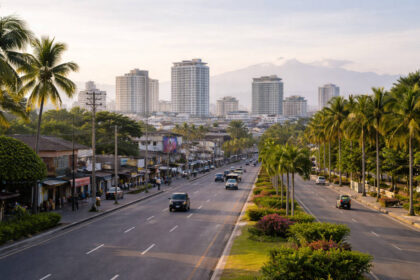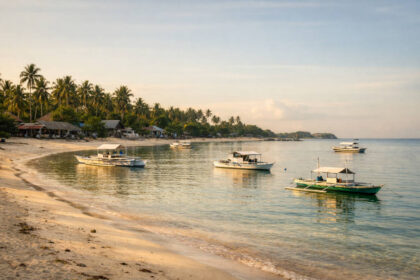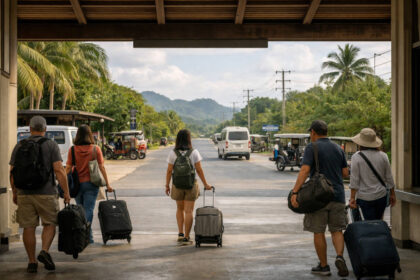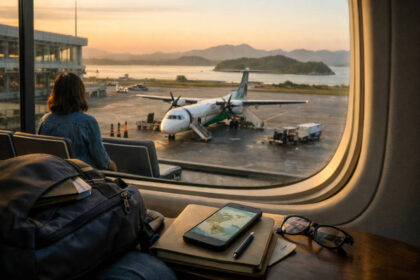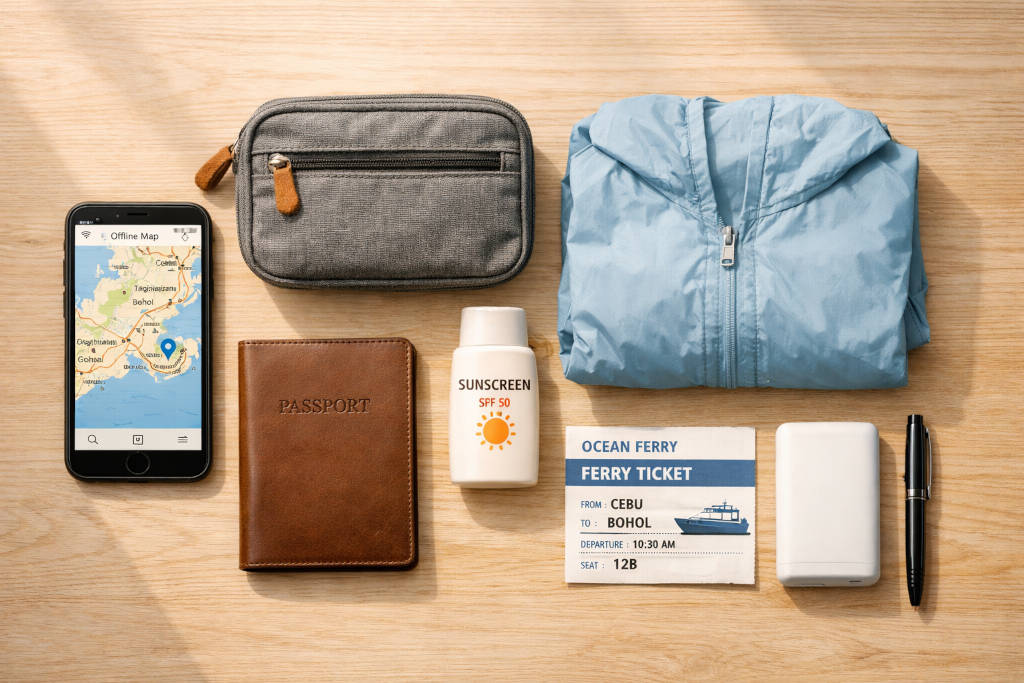
The Philippines can feel “hard to plan” because it’s not one easy loop—it’s an archipelago with shifting weather, inter-island transfers, and a hundred tempting side trips. The trick is to plan like a local would advise: decide what matters, accept a little friction, and build a few smart buffers so the trip stays enjoyable even when plans flex.
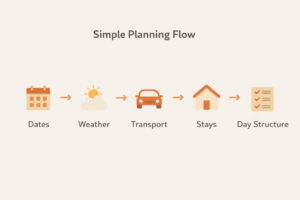
This Philippines travel planning guide is designed for first-timers who want a realistic itinerary without overthinking. It follows a simple sequence—dates → weather → transport → stays → day structure—because that order reduces decision fatigue and helps avoid the classic mistake: booking hotels before understanding transfers and seasonal conditions.
At-a-Glance
 Best timing window: Dry-season weeks are generally easier for boat days and beach plans, while shoulder months can mean better value with some rain risk.
Realistic travel time: Assume transfers take half a day to a full day once you include checkouts, ports, airport lines, and local rides.
Budget band: Comfort rises fast with direct flights, better-located hotels, and fewer transfers; budgets stretch when you slow down and use public transport well.
Crowd and traffic risk: Holidays and long weekends can spike prices and congestion.
Rain/heat backup: Keep one “city or indoor” day ready and plan boat trips early in the itinerary when possible.
Reality Check: The Philippines rewards flexibility. A simple plan with buffers often feels more “luxury” than a packed schedule that leaves no room for weather, queues, or rest.
Start here: what makes the Philippines “hard to plan” (and how to simplify)
Most first-time stress comes from three things: (1) too many islands to choose from, (2) transfers that look short on maps but take time in real life, and (3) weather that changes the feel of a beach day, a ferry day, or a mountain day. This is why a calm Philippines travel planning guide focuses on logistics before aesthetics.
The simplifier: choose fewer hubs, protect transfer days, and design your days around a steady rhythm—one main outing plus optional add-ons. That way, even if a boat schedule changes or rain rolls in, the trip still works.
Reality Check: It’s normal to feel like you’re “missing” islands. But in the Philippines, doing less often means seeing more—because you’re not spending the best hours of the day in transit.
Step 1 — Choose dates first (and what “enough time” looks like)
Start with your dates before picking regions. The calendar determines prices, crowd levels, and whether you’ll be comfortable with transfer buffers. It also determines how ambitious your route should be.
How many days are “enough” for a first trip?
As a planning baseline: 7 days is best as one region with a single base (or two nearby bases). 10 days gives you room for two hubs and one major transfer. 14 days supports two to three hubs with rest days and weather buffers. If flights are long, consider your first and last days “soft days,” especially if arrivals are late or departures are early.
Reality Check: A 7-day trip with one good base can feel richer than a 10-day trip that squeezes in three inter-island jumps.
Step 2 — Match dates to weather (dry/rainy, typhoon buffers) and set expectations
Once you have dates, match them to weather patterns so you can plan boat days, hikes, and beach time realistically. The Philippines has dry and rainy seasons that vary by region, and it’s the “feel” of travel that changes: seas can get choppy, sunsets hide behind clouds, and inland roads can slow down.
Use this regional overview to get your bearings, then refine with a trusted reference: Philippines Weather Guide: Best Months to Visit Each Region. For official, up-to-date advisories and warnings, check PAGASA as your travel dates approach.
A simple rainy-season and typhoon mindset
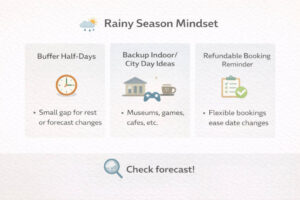 Rainy season does not mean “don’t go.” It means: (1) schedule boats and long drives with extra slack, (2) avoid stacking multiple transfers back-to-back, and (3) build one or two backup days that still feel satisfying if it rains (food crawls, museums, markets, spa time, a slow café day, a heritage walk with a rain jacket).
Two buffer habits that help a lot: plan “transfer the morning after” (arrive, sleep, then transfer next morning) and protect an extra half-day before any flight you cannot miss. If you can choose refundable or rebookable options for at least one major piece (a hotel night or a domestic flight), that flexibility can save the trip’s mood.
Reality Check: Weather is part of the Philippines’ personality—lush and dramatic. Planning for it doesn’t make the trip less fun; it makes it less stressful.
Step 3 — Choose a region by time + vibe (Luzon vs Visayas vs Mindanao) with quick decision rules
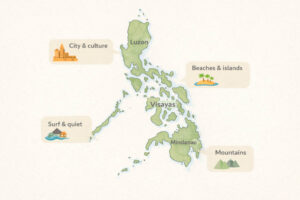 Now that dates and weather expectations are clearer, choose your “shape” of trip: culture and cities, beaches and islands, surf and quiet, or mountains and cool air. This Philippines travel planning guide keeps it flexible—think in vibes and travel time, not a checklist of famous names.
Quick decision rules (simple and flexible)
- Luzon: Best for big-city energy, history, food trips, highlands and cool-weather escapes, and road trips. Good choice if you want culture plus mountains, and you prefer fewer flights.
- Visayas: Best for classic island-hopping energy—beaches, snorkeling/diving culture, sandbars, and shorter hops between popular island areas. Good choice if your dream is “water every day.”
- Mindanao: Best for a quieter pace in many areas, surf and nature, and off-the-main-loop experiences. Good choice if you have more time, prefer fewer crowds, and can plan routes thoughtfully.
If you’re torn, choose based on this question
“Do you want city and culture days to balance beach days?” If yes, lean Luzon or a two-hub mix. If no and you want maximum water time, lean Visayas with one strong base and optional day trips. If you want calm nature and a slower, less touristy rhythm in many areas, explore Mindanao with extra buffers.
Reality Check: Region choices are also transport choices. The more islands you add, the more your trip becomes about schedules—so pick the region that matches your energy for planning friction.
Step 4 — Sketch transport before you pick hotels (flight/ferry reality, transfer buffers)
This is where first-time itineraries usually go sideways: hotels get booked first, then transfers are forced to fit around them. Flip it. Sketch transport corridors and transfer days first, then lock in stays that support those moves. A strong Philippines travel planning guide treats transfer days as real travel days, not “free time.”
Inter-island transfers: the hidden time cost
A flight or ferry is rarely just the scheduled time. Add: getting to the airport/port, arriving early, potential delays, queue time, baggage rules, tricycle/van rides after landing, and check-in windows. That’s why a “short hop” can still eat half a day.
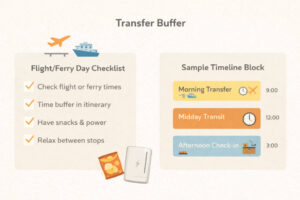 Transfer buffers that keep you calm
- Prefer morning transfers so delays still leave daylight for check-in and a simple dinner.
- Avoid double-transfer days (example: ferry + flight) unless you have no choice.
- Protect the day before an international flight by being on the same island/city the night before.
- Designate one “administrative hour” after arrival: cash, SIM setup, water, snacks, and finding your ride.
For a deeper look at how local transport works—from buses and ferries to the everyday reality of getting around—use Philippines Public Transport Guide when deciding whether to DIY or book transfers.
Reality Check: In the Philippines, the “stress” often isn’t danger—it’s timing. Transport is doable, but it rewards patience and an itinerary that doesn’t demand perfection.
Step 5 — Pick stays and set a simple day structure (base-and-day-trip mindset)
After your transport sketch is set, choose stays that reduce daily friction. For first-timers, the most reliable structure is: one base in a convenient area, then day trips that return you to the same bed. If you add a second stay, keep it purposeful (a different vibe, a quieter beach, a cooler mountain town) rather than a random stop.
A day structure that prevents burnout
- Morning: one “anchor plan” (beach time, a tour, a museum loop, a hike).
- Afternoon: flexible add-on (market, café, viewpoint, rest).
- Evening: food and an early night if tomorrow is a transfer day.
Hotel location matters more than star rating when it saves you time. A slightly smaller room can feel like an upgrade if it’s closer to transport, walkable to food, or less exposed to long, daily commutes.
Reality Check: Air-conditioning, hot showers, and quiet nights are not “extras” for many travelers in humid weather—budget for comfort where it protects your energy.
7-day framework templates (with swaps)
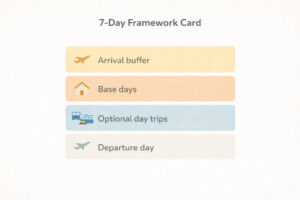 These frameworks are intentionally non-specific so they can fit Luzon, Visayas, or Mindanao. Use them as scaffolding, then layer in your preferred vibe. A Philippines travel planning guide works best when you pick a structure first, then choose experiences that match it.
Framework A: One-region base + day trips (lowest friction)
Shape: Arrive → settle → 4–5 day trips or themed days → depart. Best for: first-timers, families, anyone who dislikes constant packing. Swap ideas: Beach swap (more water days), mountain swap (cooler mornings), city swap (food and culture focus).
Framework B: One base + one nearby “quiet” stay (two stays, still calm)
Shape: 3–4 nights in a convenient hub → 2–3 nights in a quieter area → depart. Best for: travelers who want both convenience and a slower last stretch. Swap ideas: Replace the quiet stay with a surf-focused coast, a small island with easy boats, or a cooler inland retreat.
If your international flight arrives late, consider a gentle arrival buffer day in the capital so you’re not rushing straight into a transfer. Use Manila Itinerary 24 Hours as a low-stress template for that first night and next morning.
Reality Check: Seven days disappears fast once you add an inter-island flight. If you want a truly relaxed pace, keep it to one region.
10-day framework templates (with swaps)
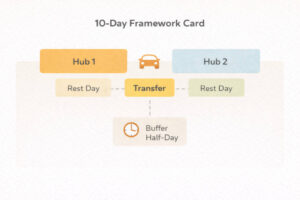 Ten days is the sweet spot for two distinct vibes—just keep the transfer count low. This Philippines travel planning guide suggests one major transfer (maybe two, if they’re simple and early).
Framework A: Two hubs with one transfer (classic first-timer balance)
Shape: 4–5 nights Hub 1 → transfer day → 4–5 nights Hub 2. Best for: city + beach, or beach + mountains. Swap ideas: Switch Hub 2 to a quieter coast, replace a beach hub with a culture hub, or add a nature-focused hub if roads are straightforward.
Framework B: One main base + a short “side loop” (controlled variety)
Shape: 6–7 nights main base → 2-night side stay → return to main base (optional) → depart. Best for: travelers who want variety but hate repacking too often. Swap ideas: Turn the side stay into a boat day cluster, a waterfall-and-river day, or a food-and-market weekend.
Reality Check: Two hubs is plenty when transfers are involved. Ten days can feel surprisingly packed if you try to squeeze in a third region.
14-day framework templates (with swaps)
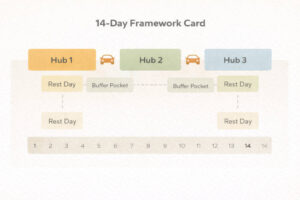 Fourteen days gives breathing room for rest days, weather buffers, and a deeper sense of place. A Philippines travel planning guide for two weeks should protect downtime, not just add more stops.
Framework A: Two hubs + rest days (most comfortable)
Shape: 6–7 nights Hub 1 (with one pure rest day) → transfer day → 6–7 nights Hub 2 (with one pure rest day). Best for: couples, families, and anyone who wants a “vacation” feel, not a race.
Framework B: Two to three hubs with a “buffer pocket”
Shape: 5 nights Hub 1 → transfer → 4 nights Hub 2 → transfer → 4–5 nights Hub 3, with at least one half-day buffer after each move. Best for: travelers who are comfortable with logistics and want distinct landscapes. Swap ideas: Make Hub 2 a mountain climate break, swap Hub 3 into an island base with day boats, or keep Hub 3 as a city food-and-shopping decompression before flying out.
Reality Check: More days doesn’t automatically mean more islands. Two hubs done well in 14 days often feels more “complete” than four hubs done fast.
Budgeting without spreadsheets: budget vs comfort tradeoffs (where to spend, where to save)
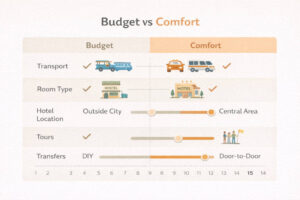 Budgeting in the Philippines is less about one number and more about comfort choices. Two travelers can spend very differently and both have a great time—if they align spending with what actually changes the experience. This Philippines travel planning guide keeps it simple: spend on time-savers and sleep quality; save where flexibility is high.
Where money changes the experience the most
- Flights vs ferries: Flights can save a day but may add baggage rules and airport time; ferries can be cheaper but are weather-sensitive and slow.
- Private transfers: Worth it when you’re tight on time, arriving late, traveling with kids/elders, or carrying bulky gear.
- Hotel location: Paying for a more walkable area can cut daily transport costs and stress.
- Air-conditioning rooms: In humid months, AC is often the difference between “fine” and “exhausted.”
- Tours: Guided days can streamline logistics for waterfalls, islands, or remote spots; DIY days are great for cities and walkable areas.
Where you can usually save without suffering
- Slow down: Fewer transfers means fewer fees, fewer ride costs, and fewer “emergency” purchases.
- Eat like a local: Carinderia meals and neighborhood cafés often deliver the most satisfying flavors.
- Mix paid and free days: Alternate tour days with simple beach or city wandering days.
Reality Check: The cheapest plan isn’t always the most affordable emotionally. If one paid transfer prevents a missed ferry and a domino of stress, it can be a smart “splurge.”
Booking order: what to reserve early vs keep flexible (peak season notes)
To avoid overthinking, follow a ladder. Your goal is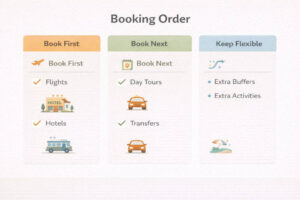 to lock in the items that can “break” the itinerary, then leave room for mood, weather, and energy. A Philippines travel planning guide should feel like guardrails, not handcuffs.
Book first (anchors)
- International flights (once dates are set)
- One or two key domestic legs if your route depends on them
- First 2–3 nights of accommodation (especially after arrival)
Book next (comfort and availability)
- High-demand hotels in peak season or holiday weeks
- Must-do small-group tours with limited slots
- Airport transfers for late-night arrivals or early departures
Keep flexible (the fun parts)
- Most day tours in shoulder or low season, if operators run daily
- Beach days and “wander days” (choose based on weather)
- One buffer night you can move if a transfer shifts
Timing rules of thumb
Peak season and holidays: book earlier, especially for popular islands and well-located hotels. Shoulder season: you can often hold more flexibility, but keep weather in mind for ferry days. If you plan to rely on buses, ferries, and everyday transport, review Philippines Public Transport Guide so your timing assumptions stay realistic.
Reality Check: Overbooking can create pressure to “perform” the itinerary. Reserve the essentials, then let the trip breathe.
Connectivity basics (SIM/eSIM, signal expectations, offline maps)
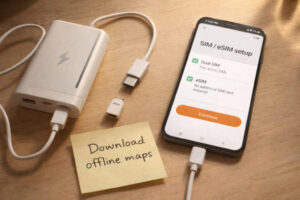 Connectivity affects everything from ride-hailing to checking ferry updates. A Philippines travel planning guide should treat mobile data as a travel essential, not a bonus. If your phone supports it, eSIM can be convenient; if not, a physical SIM is still common and practical.
Signal expectations (general): big cities and many tourism centers tend to be more reliable, while remote beaches, mountain roads, and smaller islands can be patchy. Plan for dropouts without panic.
A simple connectivity kit
- SIM/eSIM set up early (ideally on Day 1)
- Offline maps downloaded for each area (pins saved for hotels, ports, clinics, and meeting points)
- Power bank for long days and transfer days
- Download habits: save tickets, confirmations, and screenshots; keep a notes file with addresses
For a deeper checklist (apps, adapters, download routines, and low-stress tech habits), use Travel Tech Philippines as a companion resource.
Reality Check: The goal isn’t perfect signal—it’s being prepared when it drops. Offline maps and screenshots can feel like magic in a no-service moment.
Minimum viable prep checklist (packing + health + safety)
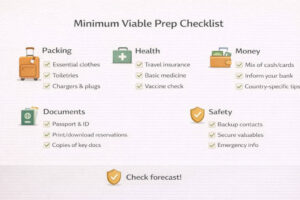 Think of this as the “calm essentials” list: enough to handle sun, rain, boats, and basic stomach or headache issues, without packing like you’re moving. A Philippines travel planning guide should keep prep light but meaningful.
Before you book and before you fly
- Check entry rules and passport validity using Philippines Entry Requirements Update, then confirm official updates through Bureau of Immigration.
- Travel insurance that covers delays and medical basics (especially helpful in rainy-season months).
- Digital and paper copies of passport, bookings, and emergency contacts.
Packing essentials for sun, rain, and boats
- Sun: sunscreen, cap/hat, sunglasses, light layers
- Rain: packable rain jacket, small dry bag or zip pouches, quick-dry clothes
- Boats: sandals with grip, motion-sickness support if needed, a light layer for windy decks
- Footwear: one comfortable walking pair plus one water-friendly pair
For a smarter, less-bulky approach (and the small details people forget), pair this with 10 Smart Packing Tips Every Traveler Should Know.
Health, hydration, and money basics
- Basic meds: pain reliever, antihistamine, anti-diarrheal, oral rehydration salts
- Hydration: reusable bottle, electrolytes for hot days
- Cash: keep small bills; ATMs exist widely but can be limited on smaller islands
- Common-sense safety: watch your belongings in crowded areas, avoid isolated places late at night, and trust your comfort level
Reality Check: Most “problems” are small: wet shoes, low phone battery, no small bills, or underestimating heat. Pack for comfort and the trip instantly feels smoother.
Philippines Travel Planning Guide FAQ
How many days do you need for a first trip?
Seven days works well for one region and a single base. Ten days can handle two hubs with one major transfer. Fourteen days is ideal for a slower pace with rest and weather buffers.
How many islands should you do in one trip?
For first-timers, fewer is better: one main base (plus optional day trips) is the calmest. If you want variety, aim for two hubs with one transfer rather than hopping every two nights.
Is rainy season a bad time to visit?
Not automatically. Rainy season asks for buffers and flexibility—especially for ferries and island days. Plan morning transfers, keep backup indoor/city days, and monitor official updates close to travel dates.
When should you book flights and hotels?
Book international flights once dates are fixed. Then lock in any domestic legs that “define” your route and your first few hotel nights. Keep the rest flexible unless it’s peak season or a high-demand property.
What’s the best way to get around—flights, ferries, or buses?
It depends on your time and comfort: flights save time, ferries can be scenic but weather-sensitive, and buses are great for land routes if you plan for traffic and longer travel blocks. Build transfer days into the itinerary either way.
Should you get a SIM or an eSIM?
If your phone supports eSIM, it can be convenient. Physical SIMs are also common. Either way, download offline maps, keep screenshots of bookings, and carry a power bank—especially if you’re moving between islands.
Do you need to plan every day in advance?
No. Reserve what can sell out (key flights, peak-season stays, limited-slot tours), then keep day-to-day plans flexible so you can match weather, energy, and local conditions.
Planning the Philippines doesn’t have to be complicated. Start with dates, respect the weather, sketch transport like it’s part of the itinerary (because it is), then choose stays that make days easy. A good Philippines travel planning guide isn’t about squeezing in everything—it’s about designing a trip that still feels calm, even when it needs to adjust.