If you ride a bicycle or a small motorcycle (under 400cc), Luzon can feel both close and surprisingly complicated—especially once you start planning around Limited Access Facilities and expressways. This guide is for calm, planning-first travelers who want No expressway routes Luzon small motorcycle days that are realistic on time, conservative on safety, and flexible when weather or traffic changes the plan.
 Before anything else, anchor your trip mindset: your biggest wins come from buffers, visibility, and decision points—not speed. If you want a strong planning template you can reuse for every ride, start with Philippines Travel Planning Guide for First Trip and adapt it to two wheels.
At-a-Glance: No Expressway Days In Luzon
Best time window: Cooler months under Amihan often feel easier on the body, but any season works if you plan around heat and afternoon rain.
Realistic travel time: Expect slower progress than car-based estimates because you will avoid expressways and pause more often for safety and hydration—especially for No expressway routes Luzon small motorcycle travel.
Budget band: Plan for extra fuel stops, snacks, water, and at least one “just in case” overnight if you are doing a long day.
Crowd and traffic risk: High near Metro Manila and major town centers; calmer in daylight mid-morning on many national roads.
Rain and heat backup: Have a clear “stop, shorten, overnight, or transfer” rule before you leave.
Reality Check: Even “short” Luzon distances can feel long on two wheels when the shoulder disappears, trucks appear, or rain forces a long stop. Plan your day so you can stop early without feeling like you failed.
No-Expressway Travel In Luzon: What Changes When You’re Under 400cc Or On A Bicycle
No expressway routes Luzon small motorcycle planning is less about finding a clever alternative and more about accepting different constraints: lower average speed, more stops, and more attention to shoulders, sightlines, and speed differences. For cyclists, add the reality that some stretches feel fine on a map but become stressful in real life when the shoulder narrows or traffic compresses.
The Real Impact On Time, Fatigue, And Budget
Without expressways, your “moving time” becomes only part of the day. Add rest breaks, water refills, sunscreen re-application, rain pauses, food stops, and route re-checks. The more conservative you are, the safer your ride tends to be—but it also means you should budget for extra snacks, hydration, and sometimes an overnight. No expressway routes Luzon small motorcycle days often cost more in small, boring ways: extra bottled water, more frequent meals, and occasional paid parking for safer stops.
Reality Check: If you plan to arrive at a fixed time (like a late check-in) with no buffer, you will be tempted to “push through” risky conditions. Build in time so stopping feels normal, not dramatic.
Why Planning Matters More Than Speed
Your plan should reduce surprises. That means choosing daylight windows, identifying safe stop points, and setting a maximum “stress level” you will accept before changing the plan. A calm goal for No expressway routes Luzon small motorcycle travel is to finish the day with enough energy to think clearly—because tired riders make rushed decisions near ramps, intersections, and town traffic.
Reality Check: Luzon roads can change quickly: construction zones, sudden one-way schemes in towns, and shoulder blocks that force you into the lane. Planning is how you keep those changes from becoming emergencies.
The 400cc Expressway Rule In Plain Terms
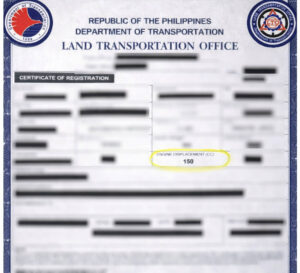 In many parts of Luzon, limited access expressways are typically restricted to motorcycles at or above a certain engine displacement. In simple terms: if you are under 400cc, assume expressways are off-limits unless signage and current operator rules clearly say otherwise. For cyclists, assume Limited Access Facilities are not for you. That assumption is the foundation of No expressway routes Luzon small motorcycle planning.
What “Limited Access Facilities” And Expressways Mean In Practice
“Limited Access Facilities” usually means roads designed for faster, controlled entry and exit—think ramps, barriers, and toll systems. These roads prioritize high-speed flow, not mixed traffic. That’s why small motorcycles and bicycles should treat them as “do not enter” by default and rely on national roads, service roads, and local roads instead. For a plain-language legal reference, you can read DOTC Department Order No. 2007-38 and then follow the most current signage and operator advisories on the ground.
Reality Check: Enforcement is not a debate you want on a hot roadside. Your safest plan is the one that avoids questionable entries in the first place.
How To Verify Your Engine Displacement On Your Registration
Check your Official Receipt and Certificate of Registration (often called OR/CR). Look for the engine displacement listed in cubic centimeters (cc). If your papers show under 400cc, plan as if expressways are not allowed—full stop. For No expressway routes Luzon small motorcycle rides, your documents matter because that is what enforcers can verify quickly.
Reality Check: Even if your bike “feels powerful,” what matters in enforcement is what’s on the registration and what signage requires at that entrance.
Why “Almost 400cc” Still Matters In Enforcement
A motorcycle that is 390cc or 399cc is still under 400cc. “Almost” is not a category that helps you at a checkpoint or ramp. If you upgraded parts or changed something mechanically, do not assume it changes what is legally recognized. For No expressway routes Luzon small motorcycle planning, treat the displacement on your papers as the deciding number, and treat signs and enforcers as the final authority.
Reality Check: If you are tired, sunburned, and rushing, it’s easier to rationalize risky choices. Make the decision at home: under 400cc means your plan avoids expressways.
Route Planning Without Turn-By-Turn Directions
This guide will not give turn-by-turn directions. Instead, it gives a “how to choose” framework you can apply anywhere in Luzon. The goal of No expressway routes Luzon small motorcycle planning is not the shortest line—it is the route that keeps speed differences manageable and gives you room to react.
Use A “Risk Filter” Instead Of Chasing The Shortest Line On A Map
When you look at a map preview, ask: Where will I have space? Where will faster vehicles pass? Where can I stop if rain starts? Build your route around safer segments, not perfect efficiency. A good risk filter prioritizes: consistent shoulders, fewer blind curves, and predictable intersections where drivers expect mixed traffic.
Reality Check: A route that looks clean on a screen can feel totally different when tricycles, buses, and trucks share the same narrow corridor.
Safer Road Cues: Visibility, Shoulders, Predictable Intersections, Fewer Blind Curves
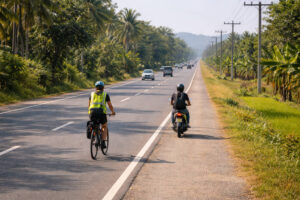 Look for road segments that offer long sightlines and a usable shoulder—space that lets you stay out of the main flow when you need to. Predictable intersections (clear merges, fewer surprise U-turn slots) reduce sudden conflicts. If you are choosing between two options, the calmer choice is usually the one with fewer “forced merges” and fewer sharp, blind turns—especially for No expressway routes Luzon small motorcycle travel where your margin is smaller.
Reality Check: In some areas, the shoulder exists but is blocked by parked vehicles, vendors, or roadworks. Your plan should include “what if the shoulder disappears for 2 kilometers?”
Higher-Risk Cues: No Shoulder, Fast Truck Mix, Frequent Overtakes, Long Unlit Stretches
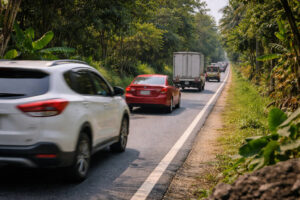 Higher-risk segments often share the same feeling: nowhere to go. Narrow lanes with no shoulder, high speed limits, and frequent truck traffic create big speed differentials. Add frequent overtakes and you get unpredictable lateral movement—dangerous for bicycles and stressful for small motorcycles under 400cc. In No expressway routes Luzon small motorcycle planning, treat “no escape space” as a serious warning sign.
Reality Check: Some corridors feel “fine” until the sun drops or rain starts—then the risk level jumps fast.
Navigation App Habits To Avoid Accidental Toll Or Expressway Routing
Accidental expressway entry is common when riders blindly follow audio prompts near ramps. Build habits that reduce that risk:
- Preview before you roll: Zoom in on the first 10–20 minutes and identify any ramp-like shapes, toll icons, or “controlled access” warnings.
- Set avoidance options: Use app settings like “avoid tolls” and re-check after any update. Do not assume yesterday’s settings are still active today.
- Re-check after every major stop: Fuel, food, or a photo stop can reset your mental map. Before moving again, confirm you are not pointed toward a ramp.
- Do not follow audio alone near interchanges: Slow down early, scan signs, and choose the path that clearly keeps you on public roads and away from controlled access entries.
If you are starting near Metro Manila, ramp density and confusing merges are part of the challenge—use a careful route preview and read signage like your safety depends on it (because it does). For Manila context and planning, see Manila Travel Guide.
Reality Check: The moment you realize you are near an expressway entry is often the moment you are already committed to a lane. Slow down early and commit to re-checking before complex junctions.
Quick Sidebar: A Safer Way To Test Your Setup Before A Long Day
If you want a confidence-building warm-up before a big No expressway routes Luzon small motorcycle day, consider doing a shorter daylight “systems check” ride closer to home: brakes, lights, hydration routine, and how your body feels after two hours. Many riders use nearby day-ride areas for this kind of test; for inspiration in a popular near-Metro Manila zone, browse Rizal Travel Guide.
Reality Check: A test ride is not about speed. It’s about discovering the annoying problem (like a loose mirror or hot spot in your shoe) while you are still close to help.
Daylight Vs Night: Choose Your Risk
For most cyclists and small motorcycles under 400cc, daylight is the safer default. No expressway routes Luzon small motorcycle travel works best when you can see road texture, potholes, debris, and the real width of the shoulder.
Daylight Advantages And The Best Departure Window
Daylight gives you better visibility, more open establishments, and more chances to ask for help if something breaks. A practical rhythm is to depart after first light (so drivers can see you clearly), aim to be past your most complicated urban segment before peak congestion, and plan to be near your destination before late afternoon weather shifts. In Luzon, glare can be intense—use a clear visor or sunglasses that still let you read the road surface.
Reality Check: Midday heat can quietly drain you even when the road feels “easy.” If your mood gets irritable, that is often dehydration showing up early.
Night Riding Risks For Luzon National Roads And Service Roads
Night risks stack up: unlit stretches, faster vehicles, tired drivers, and reduced roadside assistance options. Potholes and uneven patches become harder to spot. For cyclists, being seen is the main battle; for small motorcycles, being seen and being predictable both matter. If you are aiming for No expressway routes Luzon small motorcycle travel, night riding often increases stress without saving much time.
Reality Check: Some towns are bright and busy at night, but the “in-between” stretches can be very dark. Plan as if the dark parts are what will define your safety.
If You Must Arrive Late: Minimum Visibility Rules And A Conservative Speed Mindset
If late arrival is unavoidable, treat visibility as non-negotiable: a strong front light, a bright rear light, reflective elements on moving parts (ankles, pedals, wheels), and a clean helmet visor. Keep speeds conservative, increase following distance, and avoid overtakes that require quick acceleration. For broader safety practices you can apply anywhere, review Philippines Travel Safety Guide.
Reality Check: The most dangerous moment is the “I’m almost there” rush. Slow down when you feel that urge.
Weather That Forces Plan Changes: Rain, Heat, And Sudden Forecast Swings
Weather in Luzon can go from bright to dramatic in one stoplight cycle. No expressway routes Luzon small motorcycle planning should treat weather as a decision-maker, not background scenery.
Habagat Vs Amihan Expectations In Simple Terms
Amihan (often around November to March) can feel cooler and less sticky, but wind and sudden showers still happen. Habagat (often around June to October) tends to bring heavier rains and more frequent afternoon downpours. Shoulder flooding and slippery surfaces are more common in wet months. For a month-by-month planning overview, check Philippines Weather and Best Months Guide.
Reality Check: Even on “low chance of rain” days, localized thunderstorms can hit hard. Your plan should not rely on perfect forecasts.
What To Do When The Sky Changes: Stop, Shorten, Overnight, Or Transfer
When conditions change mid-ride, use a simple sequence instead of improvising under stress:
- Pause: If rain becomes heavy, visibility drops, or you feel traction change, stop at a safe covered area (not a blind curve or a narrow shoulder).
- Re-check time and daylight: Ask, “If I leave in 30–60 minutes, will I still arrive in safe light?”
- Shorten: If your remaining distance forces night riding or high-risk corridors, shorten the day and choose a nearer stop.
- Overnight: If storms are persistent or fatigue is rising, treat an overnight as a safety tool, not an inconvenience.
- Transfer: If conditions are unsafe or you are losing time fast, consider transferring by public transport rather than pushing through.
Reality Check: Wet paint lines, metal plates, and smooth concrete sections can be surprisingly slippery. If you feel even one “micro-slide,” that is a signal to slow down and reassess.
Heat Planning: Hydration, Cooling Breaks, And Signs You Should Stop
Heat in Luzon is not just uncomfortable—it affects decision-making. Build a hydration routine (small sips often), plan cooling breaks in shaded areas, and watch for warning signs: headache, dizziness, cramps, chills despite heat, or confusion. For No expressway routes Luzon small motorcycle travel, heat planning is also traffic planning: slow, hot stop-and-go in towns can be more draining than open-road riding.
Reality Check: If you are “suddenly not enjoying anything,” assume heat or dehydration is driving the mood. Stop early, cool down, and eat something salty.
Minimum Gear Checklist For Cyclists And Small Motorcycles
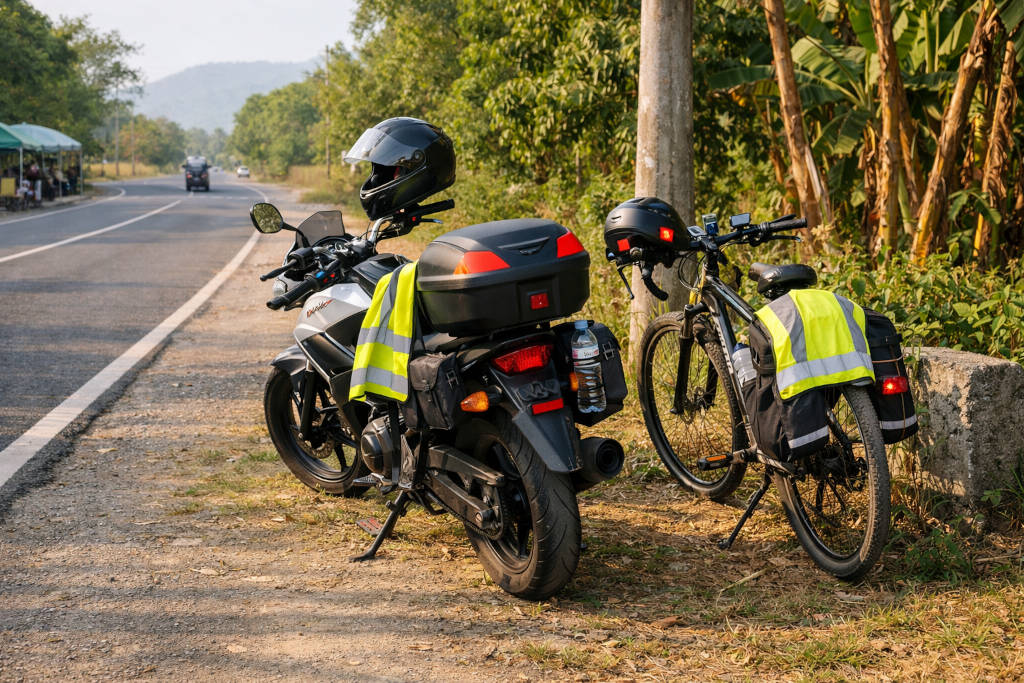
Gear is not about looking technical—it’s about reducing the consequences of the common problems: being unseen, getting wet and cold, or losing time to a small failure. For No expressway routes Luzon small motorcycle days, pack for the boring stuff.
Visibility Essentials
- Bright front light (aimed to light the road surface, not blind others)
- Reliable rear light (steady plus blinking mode if available)
- Reflective elements on ankles, shoes, or wheels for “moving visibility”
- High-contrast outer layer (vest or jacket) that stays bright when wet
- For cyclists: clear hand signals and lane positioning basics—see Quezon City Government Bike Safety Tips
Reality Check: Many close calls come from drivers who “didn’t see you” soon enough. Your goal is to be obvious from far away, not just visible up close.
Hydration And Sun Or Rain Protection Essentials
- Water capacity that matches your heat tolerance (more than you think you need)
- Electrolytes or a salty snack plan
- Sunscreen and lip balm
- Light rain layer (packable) and dry bag or plastic liner for valuables
- Small towel or face cloth for sweat and sudden rain
Reality Check: Convenience stores are common in many areas, but not evenly spaced. Plan hydration like signal coverage: assume there will be gaps.
Basic Tools And Spares For Punctures And Small Failures
- For motorcycles: tire plug kit, compact inflator or pump, and basic wrench set
- For bicycles: spare tube or patch kit, tire levers, mini pump, and multi-tool
- Chain quick link (bike) or basic chain care kit if your setup needs it
- Zip ties and tape for “temporary fixes”
- Small first-aid kit for minor scrapes
Reality Check: The most common roadside problems are small and solvable—if you have the basics and the patience to stop in a safe spot.
Phone Power, Offline Backup, And Emergency Contacts
- Power bank plus a cable that you know works
- Phone mount only if it does not tempt you to stare at the screen
- Offline map area saved before you leave
- Emergency contacts written on paper (in case your phone dies)
- Simple “check-in schedule” with family or friends (example: every fuel stop)
Reality Check: A dead phone turns a minor delay into a real problem. Treat battery like fuel: top up early, not when it’s almost empty.
Decision Tree: Ride Today Or Change The Plan
A decision tree keeps you from arguing with yourself on the shoulder. For No expressway routes Luzon small motorcycle travel, your best decision is usually the one you can make early—before fatigue or weather forces your hand.
Green Light Conditions (Safe To Ride Today)
- Forecast shows manageable heat and low thunderstorm risk during your ride window
- Your lights, brakes, tires, and hydration plan are ready
- You have buffer time (you can arrive before late afternoon)
- Your route preview avoids toll icons and controlled access entries
Reality Check: “Green” does not mean fast—it means you can ride conservatively without being forced into risky timing.
Yellow Light Conditions
- Scattered thunderstorms likely later in the day
- You feel slightly under-rested, or you are carrying more weight than usual
- You expect heavy traffic near towns or weekend congestion
- Your shoulder confidence is low (new bike setup, new tires, new load)
Reality Check: Yellow is where most smart travelers adjust: start earlier, stop earlier, and keep the day gentle.
Red Light Conditions
- Persistent heavy rain, flood advisories, or very low visibility expected
- You are already fatigued, unwell, or dealing with pain that changes your focus
- Long night riding becomes unavoidable if you continue
- Mechanical issues that could worsen (overheating, unstable handling, repeated punctures)
If “transfer” becomes the safer choice, plan it like a normal option, not a last resort. For practical expectations on buses and other options, use Philippines Public Transport Guide.
Reality Check: A smart transfer protects your next riding day. Pushing through can cost more in repairs and recovery than one paid ride.
Budget And Time Buffer Rule Of Thumb For No-Expressway Days
For No expressway routes Luzon small motorcycle travel, a simple rule helps: add 25–40% time buffer over your “moving time” estimate, then add a separate buffer for weather (30–90 minutes). Budget for one unplanned paid stop (secure parking, a snack-heavy break, or a short stay). If you want sample travel budgets you can adapt, see Philippines Travel Budget Examples.
Reality Check: Buffers feel “wasteful” until the day you need them. Then they feel like the best money you never spent.
Choosing Stays With Secure Parking Or Bike Storage
Where you sleep affects how safely you can travel. If you are doing No expressway routes Luzon small motorcycle days, choose stays that reduce stress at the end of the ride—especially around arrival time, rain, and parking.
What To Ask Before Booking
“Secure” should mean more than “you can park outside.” Ask direct questions:
- Is parking inside a controlled gate, or is it street parking?
- Is there CCTV covering the parking area?
- Is there a lock point (post or rail) for bicycles?
- Can I bring a bicycle indoors or into a storage area if rain is heavy?
- What time does the gate close, and who can open it late?
Reality Check: A place can be honest and still not suitable for your needs. If the answer sounds vague, choose somewhere else while you still have options.
Realistic Check-In Timing When You’re On Slower Roads
No expressway routes Luzon small motorcycle travel often means later-than-expected arrivals because of traffic friction and safety stops. Aim for an arrival window that does not rely on “perfect flow.” If check-in is strict, message ahead with a conservative ETA and ask about late arrival procedures.
Reality Check: The most stressful check-ins happen when you arrive hungry, wet, and rushing. A wider arrival window is a safety feature.
What To Do If You Arrive Early, Late, Or In Heavy Rain
Early: Ask if you can store your bike or park securely while you wait; use the time to dry gear and re-hydrate. Late: Prioritize secure entry and visibility in the parking area—do not rush a slippery ramp. Heavy rain: If the entrance is flooded or slick, stop and ask staff for the safest way in. Your pride is not worth a fall in the last 20 meters.
Reality Check: Many small properties do their best with limited space. Calm communication gets you better solutions than arriving frustrated.
Emergency And Roadside Failure Plan
Build a plan for common problems before you leave. No expressway routes Luzon small motorcycle travel becomes much safer when “what if” situations already have a script: where you stop, how you stay visible, and how you decide to continue or end the day.
Puncture Plan: What To Do On The Shoulder Safely
First, protect yourself from passing traffic: signal early, move to the safest available space, and avoid stopping right after a blind curve. If the shoulder is narrow, it is often safer to walk your bike or motorcycle (engine off if needed) to a wider, more visible area like a driveway entrance or open lot. Set your lights to high visibility, keep reflective elements on, and only then start repairs.
Reality Check: The repair itself is usually easy. The dangerous part is choosing a bad spot because you want it done quickly.
Chain Issues, Overheating, And “It Feels Wrong” Warning Signs
If your bicycle chain skips repeatedly or your motorcycle feels unusually hot, loud, or underpowered, treat that as a stop signal. “Feels wrong” is valid data. Let the machine cool, check for obvious issues, and decide whether to continue slowly to a safer area or end the ride. For No expressway routes Luzon small motorcycle travel, limping into night or rain to “save the plan” is rarely worth it.
Reality Check: Small problems often become big problems when you ignore them for one more hour.
Fatigue Management And When To Stop Even If You’re “Almost There”
Fatigue shows up as impatience: risky overtakes, forgetting to check mirrors, missing signs near ramps, or zoning out in town traffic. If you catch yourself making sloppy decisions, stop. Eat, hydrate, and reassess. A smart rider ends the day with enough focus to park safely, secure gear, and recover well for tomorrow.
Reality Check: “Almost there” is a feeling, not a safety metric. If your focus is fading, your risk is rising.
Who To Contact And How To Share Location When Signal Is Weak
Before you leave, share your general plan and check-in schedule with a trusted person. Save key numbers and write them down on paper. If signal is weak, move to higher ground or a more open area (without stepping into traffic) and send a simple update: your town or landmark, direction of travel, and whether you are safe and waiting. If you need help from locals, calm, specific requests work best: “I need a safe place to wait out rain,” or “Is there a vulcanizing shop nearby?”
Reality Check: In some stretches, you may have limited signal for longer than expected. That is why the plan must work even when the phone does not.
FAQ
Is it always illegal for under 400cc motorcycles to use expressways in Luzon?
Rules are enforced through signs, operator policies, and on-the-ground enforcement. Many limited access expressways typically restrict motorcycles under 400cc, so for planning purposes, assume No expressway routes Luzon small motorcycle travel unless clear signage and current advisories say otherwise.
Where do I see my motorcycle’s exact cc on my papers?
Check your OR/CR and look for engine displacement (cc). If it is under 400cc, plan as No expressway routes Luzon small motorcycle and avoid controlled access entries. If anything on your papers is unclear, resolve it before the trip day.
What if my navigation app suddenly points me toward a ramp or toll road?
Slow down early, do not commit to a lane that forces entry, and re-check the map view (not just audio). Make it a habit to preview and re-check after every stop so No expressway routes Luzon small motorcycle planning stays consistent all day.
Are service roads automatically safe for bicycles and small motorcycles?
Not automatically. Evaluate service roads with the same risk filter: shoulder width, sightlines, truck mix, and how predictable the traffic flow feels. No expressway routes Luzon small motorcycle planning works best when you choose roads that give you space and visibility.
Is night riding better because there is less traffic?
Less traffic does not always mean less risk. Darkness reduces your ability to see hazards, increases speed differences, and reduces nearby help options. For most riders, No expressway routes Luzon small motorcycle travel is safer in daylight with a conservative pace.
How do I plan for sudden afternoon thunderstorms in Luzon?
Assume they can happen, especially in wet months, and set a decision rule in advance: pause, shorten, overnight, or transfer. Build buffer time so you can stop without panic. No expressway routes Luzon small motorcycle plans should expect weather to interrupt the day sometimes.
What does “secure parking” realistically mean for small motorcycles and bicycles?
Secure means controlled access (a gate or staffed entry), not street parking; plus CCTV coverage if possible, and a lock point for bikes. Confirm hours and late entry rules. This reduces end-of-day stress on No expressway routes Luzon small motorcycle trips.
What is the minimum emergency plan I should have before leaving?
At minimum: a puncture plan, a safe-stop rule (never repair in a blind spot), power backup for your phone, offline map access, and a shared check-in schedule. No expressway routes Luzon small motorcycle travel becomes safer when “what if” has a prepared answer.
Next Step
If you remember one thing, let it be this: No expressway routes Luzon small motorcycle travel is a planning game. Choose daylight, choose space, choose buffers, and treat stopping early as a sign of good judgment—not weakness. For more practical travel mindset pieces you can apply to future trips, browse Tips & Inspiration.