If you’re visiting the Philippines for the first time, jeepneys and tricycles can look like a colorful mystery—loud, lively, and somehow moving with a rhythm only locals understand. The good news is: for short hops, they’re often simple once you know the handful of cues and phrases that make everything click.
This jeepney and tricycle guide is meant to be confidence-building and practical. No pressure to be “perfect.” Your goal is just to get from Point A to Point B safely, politely, and with enough comfort to enjoy the ride—because these aren’t tourist gimmicks. They’re everyday vehicles that keep Filipino cities and towns stitched together.
What this guide covers (short-hop mindset)
Think “one or two stops,” not cross-city adventures
Jeepneys and tricycles shine for short rides: to the market, the next neighborhood, the main road, or the terminal. For longer distances, you’ll often switch to buses, trains, vans, or ride-hailing depending on the area. If you want a bigger picture overview, keep this handy: Philippines public transport guide.
Reality check: The easiest first ride is a short, daytime hop with a clear landmark destination (mall, church, palengke, plaza).
What to prepare before you step out
Bring small bills and coins, wear a bag that sits close to your body, and keep your phone easy to reach but not dangling. If you can, screenshot your destination pin and a nearby landmark name—sometimes “the bakery” works better than an exact address.
Reality check: The smoother you are with small change and quick directions, the less stressful the ride feels.
Jeepney 101 (how to find, board, pay, stop)
 How to spot the right jeepney: signboards, routes, and landmarks
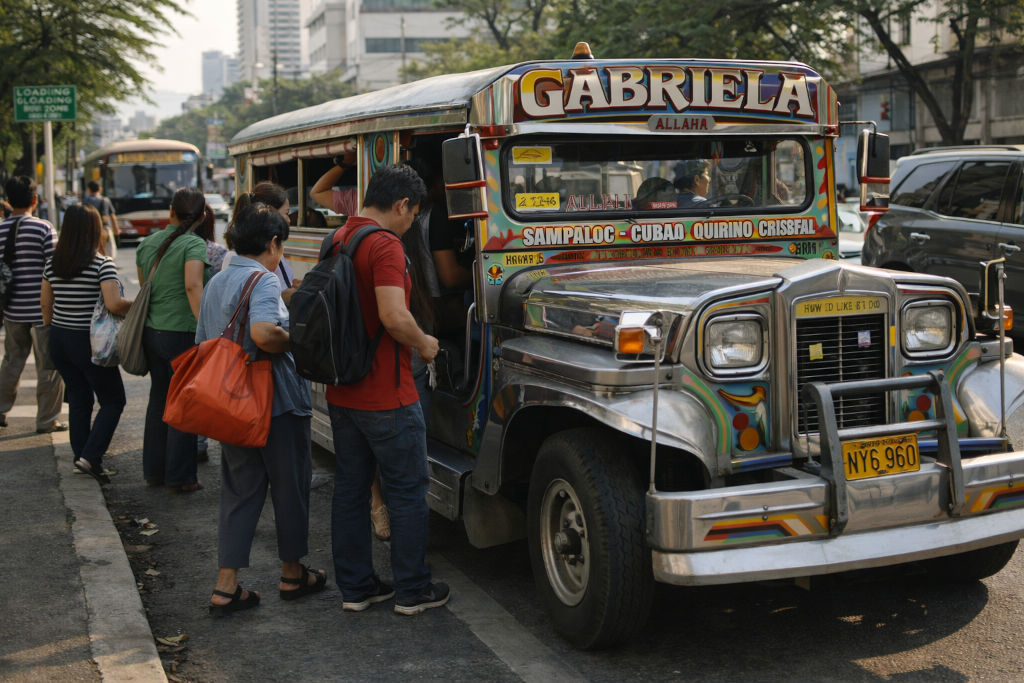
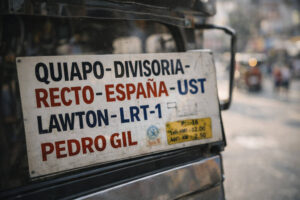
Most jeepneys display route information on a signboard—often showing two endpoints or key areas along the way. Don’t worry if you can’t decode everything at first. Focus on what you recognize: your target neighborhood, a major road, a mall name, or a well-known landmark.
If you want a bit of background on what makes jeepneys unique in Filipino life, the basics here are helpful: jeepney overview.
Reality check: Route signboards can be crowded with abbreviations. It’s normal to ask—locals do it too.
The easiest “am I on the right one?” question
Before boarding (or as you step up), ask politely: “(Destination) lang po?” If you’re not sure what destination name to use, try a landmark: “SM (area) lang po?” or “Palengke lang po?” You can also ask the driver or conductor, “Dadaan po ba ng (landmark)?”
Reality check: If you ask early, you save yourself the awkwardness of realizing it mid-ride while the jeepney is already moving.
How to board safely: step, handhold, settle
Board from the back entrance, watch your step (it can be higher than you expect), and grab the bar right away—especially if the jeepney starts moving quickly after passengers hop on. Slide in carefully and make space when you can.
Reality check: Jeepney floors can be slippery when it’s rainy or dusty. Stable footing and one hand on the bar is your best habit.
Where to sit for a calmer first ride
If you have a choice, sit where you feel steady and near other passengers, not isolated at the far end. Keep your bag on your lap or worn in front, and avoid placing valuables beside the open entrance where they can bump out.
Reality check: When it’s crowded, comfort becomes “good enough.” Focus on stability and keeping your belongings close.
How to get off: “Para po” and moving early
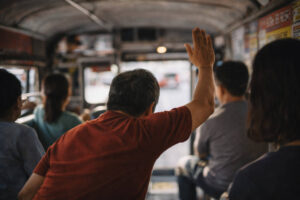 To signal you’re getting off, say “Para po” clearly a little before your stop. Another common stop signal is “Lugar lang.” If the jeepney is crowded, start shifting toward the exit early—small movements add up, and people usually make space when they realize you’re alighting.
Step down carefully and watch for passing motorcycles or bicycles as you exit onto the street.
Reality check: Waiting until the exact second you’re at your stop can make exiting stressful. A small early “Para po” is normal and appreciated.
The “bayad po” system (how it works when you’re far from the driver)
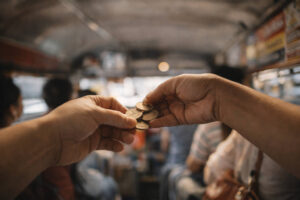
What “bayad po” means in real life
“Bayad po” is how you pay your fare—politely. In a jeepney, you rarely walk up to the driver. Instead, you hand your fare forward and the passengers help pass it along. It’s a small everyday teamwork moment that feels very Filipino once you’ve done it once.
Reality check: Don’t overthink it. You’re joining a routine that locals do dozens of times a week.
The chain-pass system: how to do it smoothly
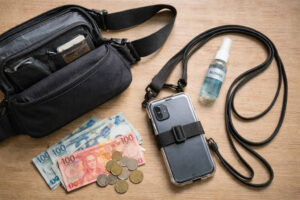 Prepare small bills or coins before the jeepney gets too bumpy. Then hand your fare to the person in front of you and say, “Bayad po.” If you’re paying for more than one person, you can add “dalawa po” (two) or just show two fingers and say it gently.
Passengers will usually pass the money forward toward the driver, and your change (if any) comes back the same way.
Reality check: Exact change helps everyone. It keeps the flow fast and avoids the “wait for change” moment when the driver is busy navigating traffic.
When to pay: soon after boarding is common
Many passengers pay shortly after they sit down, especially if the jeepney is about to move. Others pay mid-ride if they’re still settling. Both can be normal—what matters is being ready and not blocking movement.
Reality check: If you wait too long in a crowded jeepney, paying can become harder because everyone is packed in and the ride is bumpier.
Change awkwardness: how to handle it gracefully
If you only have a large bill, you can still pay—just expect that change may take time, or the driver may not have enough. The simplest approach is to ask nearby passengers quietly if they can break it (not always possible), or wait until you can get smaller bills at a store before your next ride.
Reality check: Feeling awkward about change is normal. The easiest fix is carrying small bills from the start.
Tricycle 101 (hail, agree fare, shared vs special)
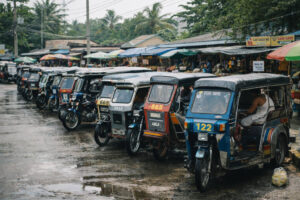 Where tricycles usually operate (and why it varies)
Tricycles often cover short distances in town centers, near markets, along barangay roads, and between neighborhoods where bigger vehicles don’t go as easily. In some places, you’ll find them queued at terminals or “paradahan” near the plaza, palengke, or transport hubs.
For background on what a Philippine motorized tricycle is, here’s a quick reference: motorized tricycle overview.
Reality check: Tricycle rules can be local—some areas have fixed zones or terminals, while others allow flagging on the road.
How to hail a tricycle (terminal vs flagging)
If you see a tricycle terminal with a line of tricycles waiting, start there—especially as a visitor. It’s usually more orderly, and drivers are used to giving directions. If there’s no terminal nearby, you can flag a passing tricycle where it’s allowed and safe to stop.
Reality check: In busy roads, not every spot is safe to stop. Move to the side and choose a well-lit, visible area.
Agreeing on price before you ride (the key line)
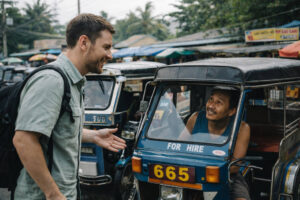 For tricycles, confirm the fare first. Use this simple line: “Magkano po hanggang (destination/landmark)?” Keep it friendly and calm. Mention a landmark if possible—“hanggang palengke,” “hanggang plaza,” “hanggang (hotel name).”
Reality check: Prices can vary by town and tourism level. Asking first avoids surprises and keeps the mood pleasant.
Shared ride vs “special trip” (in plain terms)
Shared ride means you may share the tricycle with other passengers going a similar direction, and the cost is usually lower. Special trip typically means you hire the tricycle just for you (or your group), often direct to your destination, and it costs more.
Both are normal. If you want privacy, have luggage, or you’re traveling with kids/seniors, a special trip can be worth it. If you’re doing a simple short hop solo, a shared ride can be practical.
Reality check: In touristy areas, drivers may assume you want a special trip. If you prefer shared, you can ask, “Pwede po shared?” and see what they say.
Paying for a tricycle ride: a practical approach
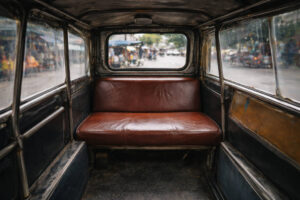 A traveler-friendly default is: confirm the price first, then pay at the end—unless the driver asks otherwise. When you arrive, you can hand over the agreed amount and say “Salamat po.”
Reality check: If your destination is far or you’re making multiple stops, the driver may request payment upfront. Keep it friendly: just restate the agreed price before you hand it over.
Mini phrasebook (what to say, when)
Jeepney phrases (short and usable)
Bayad po — paying your fare (hand money forward).
Para po — please stop (before your stop).
Lugar lang — another common “stop here” signal.
(Destination) lang po — “just to (destination), please.”
Kuya/Manong — respectful way to address a male driver/older man.
Ate — respectful way to address a woman.
Reality check: Your accent doesn’t need to be perfect. A polite tone and a smile do a lot.
Tricycle phrases (short and practical)
Magkano po? — how much?
Hanggang (landmark) — up to (landmark).
Pakibaba po dito — please drop me off here.
Paki-usog po — please scoot over (when seating is tight).
Salamat po — thank you.
Reality check: The word “po” is your friendly softener. It makes everything sound more respectful and less demanding.
Safety checklist for quick rides
Your phone, wallet, and bags: keep them close and quiet
On any short ride, treat valuables like you’re in a busy market: keep them close, zipped, and not flashy. Wear your sling or crossbody bag in front. Avoid dangling earphones or phones near the entrance, and don’t place your wallet in an easy-to-reach pocket.
For broader safety habits that apply across destinations, keep this bookmarked: travel safety tips in the Philippines.
Reality check: Most rides are uneventful, but crowded moments are when you should be most mindful.
Best seating choices (when you can choose)
Choose a seat near other passengers and in a spot where you can brace yourself. If it’s late, avoid isolated rides if you can—especially if you’re alone. For Manila-specific movement strategies, this guide on get around Manila without a car can help you decide when public transport makes sense versus ride-hailing.
Reality check: If you’re carrying luggage or it’s very late, a taxi or ride-hailing option can be the calmer choice—no shame in choosing what feels safest.
Exit safety: your most vulnerable moment
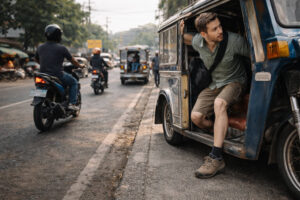 When getting off, watch traffic and motorcycles before stepping down. Keep one hand on the bar, step carefully, and move away from the road edge before checking your phone for directions.
Reality check: The street can be busy even in small towns—give yourself a second to orient before you start walking.
Trust your gut (and how to end a ride politely)
If you feel uncomfortable—whether it’s the vibe, the route, or the situation—trust that feeling. You can ask to be dropped off in a well-lit, populated spot (near a store, barangay hall, or busy corner). Keep it polite and simple: “Dito na lang po.”
Reality check: You don’t owe anyone a long explanation. Your comfort and safety come first.
If you’re riding alone
Solo riders can absolutely use jeepneys and tricycles, especially daytime in busy areas. Choose well-trafficked routes, sit near other passengers, and keep your destination plan clear. If you want more practical habits for moving confidently, these solo travel tips in the Philippines are worth a read.
Reality check: If it’s late or you’re unsure of the area, switching to ride-hailing can be the most relaxing decision.
City vs town differences (what changes outside big cities)
In big cities: more routes, more congestion, more “transfer” moments
In Manila and other big cities, jeepney routes can be more complex, traffic can be heavier, and you may need to transfer (ride one jeepney, then another) to get where you’re going. Landmarks matter more than exact addresses, and timing can stretch longer than you expect.
If you want a culture-and-context read that explains why Manila feels intense and charming at the same time, this Manila travel guide adds helpful perspective.
Reality check: In cities, a short distance can take a long time. Build patience into your plan, especially during rush hours.
In towns: tricycles often dominate short hops
In many provincial towns, tricycles are the neighborhood connectors—quick rides from the plaza to your accommodation, from the palengke to the beach road, from the barangay gate to the main highway. Jeepneys may exist too, but tricycles often feel like the “default” for short rides.
Reality check: Tricycle pricing can vary more in tourist towns. Agree first, smile, and keep it simple.
Tourist areas: expect more “special trip” offers
In tourist-heavy places, drivers may assume visitors want a special trip. That’s not automatically bad—it can be convenient. Just decide what you want: shared to save, special for comfort. Either way, confirm the price upfront so there are no surprises.
Reality check: The price difference isn’t always huge for short hops—sometimes paying a little more is worth the direct ride with less hassle.
A first-timer “script” (step-by-step: what to do in your first ride)
Your first jeepney ride (simple playbook)
Step 1: Choose a short route with a clear landmark destination.
Step 2: Look at the signboard and ask: “(Destination) lang po?”
Step 3: Board carefully, hold the bar, sit, and keep your bag in front.
Step 4: Prepare small fare, hand it forward, and say “Bayad po.”
Step 5: Watch landmarks. When you’re close, say “Para po.”
Step 6: Move toward the exit early if crowded, then step down carefully and check traffic.
Reality check: If you miss your stop, don’t panic—just get off at the next safe spot and reset.
Your first tricycle ride (simple playbook)
Step 1: Find a terminal/paradahan when possible; it’s easier for first-timers.
Step 2: Ask: “Magkano po hanggang (landmark)?”
Step 3: Confirm if it’s shared or special trip in a friendly tone.
Step 4: Ride with your bag secure, and keep your phone tucked away unless needed.
Step 5: At arrival, pay the agreed amount (unless asked otherwise) and say “Salamat po.”
Reality check: If the price feels unclear, pause and clarify before you sit down. A calm question now prevents discomfort later.
Jeepney and Tricycle Guide FAQs
How do I know I’m boarding the right jeepney if I’m new here?
Check the route signboard for familiar endpoints or landmarks, then confirm with a quick “(Destination) lang po?” If you’re unsure, ask “Dadaan po ba ng (landmark)?” Asking is normal.
How do I pay in a jeepney when I’m seated far from the driver?
Prepare small bills or coins, hand your fare forward to the passenger nearest you, and say “Bayad po.” The money gets passed toward the driver, and any change comes back the same way.
What’s the easiest way to say “stop” in a jeepney?
Say “Para po” clearly before your stop. “Lugar lang” also works in many places.
How do I avoid awkwardness about change or exact fare?
Carry small bills and coins early in the day. If you only have large bills, expect change may take time or may not be available—so try to break big bills at a store before your next ride.
Should I pay a tricycle fare before or after the ride?
A good default is to confirm the fare first, then pay at the end—unless the driver asks for payment upfront. Either way, restate the agreed price kindly to keep things clear.
What’s a “special trip” and how do I handle the price politely?
A special trip means you hire the tricycle for your private ride (more direct, higher price). Ask “Magkano po special hanggang (landmark)?” and decide if the convenience is worth it. If you prefer shared, ask “Pwede po shared?”
Is it safe to ride jeepneys and tricycles for short distances as a visitor?
In many areas and especially daytime, yes—if you use smart habits: keep valuables close, sit near other passengers, watch exits and traffic, and trust your gut. At night or with luggage, consider ride-hailing or taxis for a calmer ride.
What should I do if I realize I’m on the wrong jeepney route?
Stay calm. Get off at the next safe, well-lit, populated spot, then reassess. Ask a nearby shop staff or a guard for the right direction, or use your map to find a landmark-based route back. It happens—even locals sometimes misread signboards.
Once you’ve done one short ride, a lot of the mystery disappears. You’ll start noticing the gentle teamwork inside a jeepney, and the way tricycles act like neighborhood bridges in towns. Keep your small change ready, use “po” generously, and remember: a calm, polite question is never out of place. That’s how you turn first-timer nerves into everyday confidence.