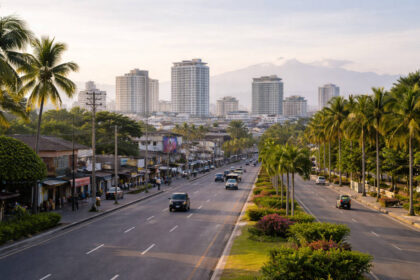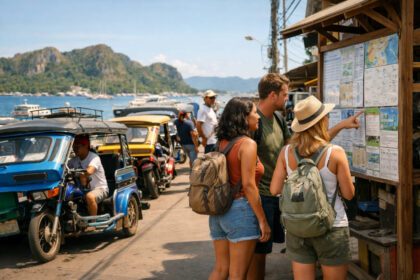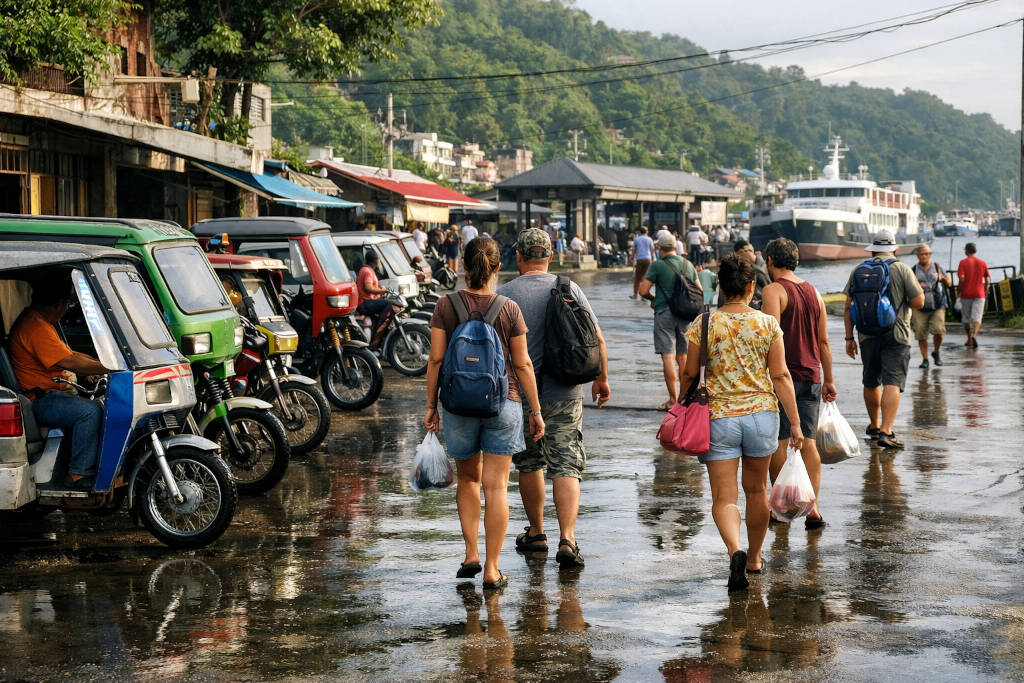
If you’re planning how to get around Romblon, think of the province as three different travel styles in one: short town hops by tricycle, longer road trips by shared van or jeepney (mostly on Tablas Island), and island-to-island moves by boat. The main difference versus big cities is that schedules—not traffic—often decide your day. Boats can shift with weather, shared rides may wait for passengers, and signal can be weak when you need updates.
This guide focuses on plan-changing logistics: what to ride, what it should cost, where to find it, and what to do when plans change—without stress and without guesswork.
Romblon Transport In One Minute: What Most Travelers Use
Here’s the quick mental map for how to get around Romblon: tricycles for short hops around town, shared vans or jeepneys for longer routes where roads allow, and boats between Romblon Island, Tablas Island, and Sibuyan Island. If you prefer a bigger-picture refresher before you arrive, this internal overview is handy: Philippines Public Transport Guide.
The default combo: tricycle for short hops, shared vans or jeepneys on longer roads, boats between islands
Most travelers end up using a “mix-and-match” day: a tricycle to the port or market area, a shared van or jeepney for a longer stretch (especially outside a poblacion), then a boat when the next destination is a different island. Reality Check: the same distance can feel different depending on rain, sea conditions, and how full shared rides are—so keep a little extra time in your day.
Why schedules matter more in Romblon than in big cities
In many Philippine cities, you can recover from a late start by just hailing another ride. In Romblon, the “next ride” might be the next departure window—especially for boats and some shared routes. Build buffers, and try not to stack tight connections on the same day. Reality Check: in peak travel periods, the issue may be availability (sold-out seats) rather than speed.
Best Mode By Distance: Short Hops Vs Day Trips
Walkable zones in Romblon town areas: when walking beats negotiating
For short distances in town centers—especially near markets, basic services, and some port-adjacent areas—walking can be the simplest option. It avoids small fare negotiations and lets you adjust when rain suddenly starts or when you spot a place you want to check. Reality Check: pavements can be uneven and rain can arrive fast, so keep footwear grippy and a light cover within reach.
Short hops: tricycle rules of thumb
For quick point-to-point trips, tricycles are usually the easiest answer to how to get around Romblon on a normal day. The key is to agree on the price before you ride and clarify if it’s a boundary trip (shared/standard) or a special trip (private). If you have luggage, mention it early so the driver can confirm if it fits safely. Reality Check: during rain or late hours, “special trip” pricing becomes more common because fewer drivers are circulating.
Day trips on the same island: when to choose charter tricycle vs motorbike rental vs shared rides
For longer day trips, your choice depends on three things: your comfort with timing, your comfort with riding, and your need to stop along the way.
Choose shared rides when you can align with common departure times and you’re fine with waiting for enough passengers. Choose a charter tricycle when you want door-to-door convenience and predictable stops, but confirm waiting time and return arrangements. Consider a motorbike rental only if you’re already confident riding in mixed road conditions and can handle sudden weather changes; always prioritize helmet use and daytime travel. Reality Check: if weather turns, what felt like a simple loop can become slower and wetter—keep your route conservative.
Inter-island moves: when boats become the real “public transport” and why buffers are non-negotiable
Between Romblon Island, Tablas Island, and Sibuyan Island, boats effectively become your main “public transport.” That’s why buffers are non-negotiable: avoid planning a same-day boat connection to a long inland road trip if the sea leg is the first step. When mapping how to get around Romblon, prioritize the boat schedule first, then plan land transport around it. Reality Check: the safest itineraries are the ones that allow a missed boat without breaking the whole trip.
Tricycles In Romblon: How They Work And How To Agree On Price
Boundary vs special trip in plain language
 Boundary usually means a standard route or a short ride within a common area that may be shared or priced like a typical local hop. Special trip usually means you’re hiring the tricycle privately—often direct to your destination, with fewer stops, sometimes with waiting time included. If you’re learning how to get around Romblon smoothly, just remember: boundary is “standard,” special trip is “private.”
What to say before you ride: destination, price, passengers, waiting time, return trip
Before you sit down, say these items clearly and calmly:
1) Destination (and whether you need a specific drop-off point). 2) Total price for the ride. 3) Number of passengers. 4) Whether you have luggage. 5) If you need waiting time or a return trip, confirm the waiting fee and the return time.
Reality Check: most fare stress happens when details are assumed. A 20-second check-in prevents 20 minutes of friction later.
Cost expectations and common add-ons (waiting time, extra stops, luggage)
Exact pesos vary by distance, time of day, and demand, so think in ranges rather than one “correct” number. As a practical baseline, short hops are usually priced like quick local trips, while longer or out-of-the-way destinations often shift into special trip pricing. Add-ons that are commonly normal (when explained up front): waiting time (especially if you’re doing errands), extra stops, and handling bulky luggage that takes passenger space.
What’s not ideal is add-ons introduced only after you arrive. For how to get around Romblon without surprise costs, the rule is simple: agree first, ride second.
How to avoid surprises without being rude
Use neutral, respectful language: “Magkano po hanggang (destination)?” then repeat the total: “So (amount) po total?” If you need a special trip, say it directly: “Special trip po?” If you’re comparing, you can say, “Sige po, magtanong muna ako sandali.” Reality Check: during rain, drivers may prefer special trips; if the price feels off, it’s okay to ask another driver rather than negotiate aggressively.
Vans, Jeepneys, And Shared Rides: What To Expect Outside The Poblacion
Where shared rides usually wait (terminal, market area, port vicinity)
 Shared vans and jeepneys typically cluster where people naturally gather: transport terminals, market areas, and sometimes near port approaches. If you’re asking locals where to go, use simple phrasing: “Saan po ang terminal ng van/jeep papuntang (destination)?” When planning how to get around Romblon on a day-trip timeline, start by locating the waiting area early in the morning.
Reality Check: in smaller towns, “terminal” can be informal—sometimes just a curbside lineup—so look for the cluster of vehicles and a dispatcher.
How to ask for the next departure and minimum passengers
Ask two questions: “Anong oras ang alis?” and “Ilan pa ang hinihintay?” This tells you the likely wait and whether you should pivot to another option. If you’re traveling with a tight schedule, ask if there’s a known “last trip.” Reality Check: a vehicle can be “leaving soon” but still waiting for a few passengers; treat “soon” as flexible unless a time is stated.
What’s normal for waiting and route changes
It’s normal for shared rides to wait until they’re reasonably full. It’s also normal for minor route adjustments (dropping passengers along the way), as long as your destination remains on-route. What’s less normal is a major reroute that changes your arrival plan without explanation. For calm decision-making while learning how to get around Romblon, keep your day simple: fewer transfers, earlier starts, and one “must-do” activity per day.
Boats And Ferries Inside Romblon Province: The Real Constraint
The planning rule: assume changes, build buffers
 Boats between Romblon Island, Tablas Island, and Sibuyan Island are the backbone of provincial movement, but they are also the most sensitive to weather and sea conditions. The best rule for how to get around Romblon is to assume that departures can move and to build buffers—especially if you have onward bookings. For broader planning habits that work well in island provinces, this internal guide is useful: Philippines Travel Planning Guide For First Trip.
For official context and public information, check the Provincial Government of Romblon official site for official context and public info. If you want a quick geography overview of Romblon Province and its major islands, this helps: quick geography overview of Romblon Province and its major islands. Reality Check: even when a route is common, the exact departure pattern can shift by season and conditions, so don’t plan island transfers like a metro commute.
What to do when canceled or delayed: fallback steps and when to book an extra night
When a boat is delayed or canceled, follow a simple fallback ladder:
Step 1: Confirm status in person at the port (signal can be unreliable). Ask for the next realistic departure window, not just “mamaya.” Step 2: Check if there’s an alternative route via another port or a different vessel type that day. Step 3: If the next option pushes you into late afternoon, consider booking an extra night near the port instead of rushing into a night transfer. Step 4: Inform your accommodation on the receiving island immediately so they can adjust check-in expectations.
Book an extra night when: (a) the sea is visibly rough and warnings persist, (b) the “next trip” is uncertain and keeps sliding, or (c) your arrival would be after dark and you still need land transport. Reality Check: the lowest-stress Romblon itineraries are the ones that treat an extra night as a normal possibility, not a failure.
What to screenshot for proof: booking page, vessel name, date, time, passenger names, reference number
Before you lose signal, screenshot: the booking page, vessel name, travel date, stated departure time, passenger names, and reference number. Also screenshot any message thread or advisory that confirms changes. This protects you during rebooking and helps port staff quickly find your record. It’s a small habit that makes how to get around Romblon much easier on boat days.
Luggage And Comfort Notes
Tricycle luggage: space limits, rain cover, and keeping valuables on you
 Tricycles have limited space. If your bag is bulky, expect a special trip or an added fee—normal if stated upfront. Use a rain cover or a plastic layer even in the dry months; a sudden shower can soak soft bags fast. Keep valuables, documents, and one change of clothes with you in a smaller day bag. Reality Check: a wet bag is a mood-killer, and drying can be slow in humid weather.
Vans and jeepneys: where bags go and what to keep accessible
Bags may go on your lap, by your feet, or in a rear area depending on the vehicle. Keep small essentials accessible: water, snacks, power bank, and any motion-sickness support if you’re prone to it. If you’re mapping how to get around Romblon with multiple legs, pack so you can grab your important items quickly during short stops.
Boat days: waterproofing, labels, and arrival time habits
On boat days, waterproof first: a dry bag for electronics, zip pouches for documents, and an outer plastic wrap for backpacks. Add a simple name label and contact number to your main bag. Arrive early enough to handle ticket checks and boarding calmly. Reality Check: ports can feel orderly one minute and crowded the next, especially when multiple departures bunch together.
Late-Night Safety And Arrival Tips
What’s realistically available after dark
After dark, options narrow. Tricycles may still be around in busier areas, but shared rides are less predictable and boats won’t be your safety net. If your plan depends on a late arrival, assume you may need a private tricycle and have a clear pickup point. This is a key part of how to get around Romblon without pressure decisions.
Safer defaults: short rides, agreed price, trusted pickup points, share your plan
Choose well-lit pickup points near ports, terminals, or your accommodation. Agree on the price before boarding. Keep rides short when possible, and message a trusted contact your route and estimated arrival. For a broader safety mindset tailored to local transport, this internal resource is useful: Travel Safety In The Philippines Guide. Reality Check: the safest nights are the ones where you don’t have to improvise—avoid late transfers if you can.
Red-flag situations that should trigger a change of plan
Change your plan if: the driver refuses to state a price, you’re pressured to ride “now” without details, the pickup area feels isolated, or your arrival would require a long ride on unlit roads. If anything feels off, step back to a brighter area, ask your accommodation for a recommended pickup point, or wait for a clearer option. Reality Check: it’s normal to choose caution over speed, especially in provinces where transport is less standardized.
Booking Tips And Low-Stress Habits
Where to ask first: accommodation hosts, port staff, terminal dispatchers
Your most reliable human sources are usually: accommodation hosts (who hear daily transport realities), port staff (for boat updates), and terminal dispatchers (for shared ride fill-up patterns). If you’re still deciding how to get around Romblon across islands, ask your host which transfer direction tends to be smoother for your dates.
What to screenshot and why it matters when signal is weak
Screenshot confirmations, reference numbers, your accommodation address, and any schedule messages. Also screenshot a simple note with your Plan A and Plan B (next boat window, alternative route, and “extra night” option). Weak signal is common enough that offline proof reduces stress.
Small habits that reduce stress: carry small bills, confirm exact drop-off, agree on return time
Carry small bills for tricycle and shared rides. Confirm the exact drop-off point (“sa may (landmark) po, ok?”). If you’re doing a return trip, agree on a return time and waiting fee in advance. These small habits make how to get around Romblon feel straightforward, even when schedules shift.
Normal Vs Not Normal Checklist (Simple And Practical)
Normal: agreed fare before riding, waiting for enough passengers on shared rides, weather-based delays
Normal: agreeing on a fare before riding, shared vans or jeepneys waiting for enough passengers, and boat delays or cancellations tied to weather and sea conditions. It’s also normal to adjust plans and move an activity to another day when an inter-island schedule changes. Reality Check: flexibility is not optional in island provinces—it’s a core skill.
Not normal: refusing to say a price, sudden add-ons after you arrive, pressure tactics, vague “later” departures with no next-trip clarity
Not normal: refusing to state a price, adding fees only after arrival, pressuring you to ride without details, or repeatedly saying “later” for departures with no clear next-trip window. If you’re learning how to get around Romblon confidently, treat unclear terms as a signal to pause and reset.
What to do instead: walk away politely, ask another dispatcher, message your accommodation, adjust the day plan
Walk away politely and ask another driver or dispatcher. Message your accommodation for a recommended option, especially for late arrivals. Adjust your day plan: swap a far activity for a nearby one, or move the island transfer to the next morning. For perspective on navigating transport systems in a busier setting, these comparisons can help shape expectations: How To Get Around Cebu City and How To Get Around Iloilo City. If you need a bigger safety-and-mindset reset for moving around without a private car, this internal read is also useful: Manila Without A Car.
At the end of the day, how to get around Romblon is less about mastering one perfect route and more about keeping your plan flexible: confirm before you commit, carry simple backups, and build time buffers around boat days. When you plan that way, even delays feel manageable—and you’ll have more headspace to enjoy the pace of island travel. For more calm planning reads, you can browse Tips And Inspiration.