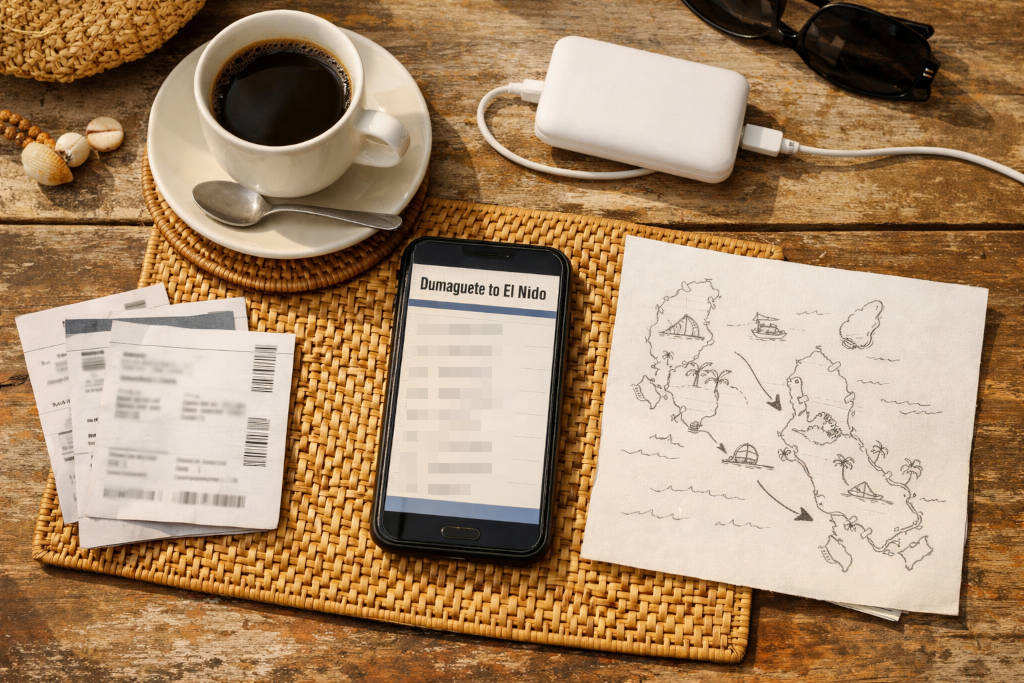
If the trip is starting in Negros Oriental, the jump from Dumaguete to El Nido is very doable—but it’s not a single “one ride” journey. What usually makes or breaks the day is not the flight time, but the waiting time: check-in lines, layover buffer, terminal changes, and the last-mile transfer from the airport or terminal into El Nido town. This guide lays out the main route options with realistic door-to-door time ranges, cost drivers, and the common points where travelers get stuck. For quick Dumaguete context before you move on, save this Dumaguete travel guide for later.
At-a-Glance
- Best time window: Expect smoother travel during calmer sea and wind months; peak rainy/windy periods can disrupt small-airport flights and ferry crossings, so plan extra buffer.
- Realistic door-to-door time: Fastest smooth run is often 6–10 hours (flight connection to ENI). Safer backup via PPS often lands at 11–18 hours.
- Budget band (one-way, per person): Wide range. Typical planning bands run from mid (PPS + van/bus) to higher (ENI flights), depending on baggage allowance, seat sales, and how tight your connection is.
- Crowd and traffic risk: Medium to high at major hubs (Manila or Cebu) during peak weekends/holidays; allow extra time for security and walking between gates.
- Rain/heat backup: Keep a Plan B route via Puerto Princesa and a Plan C overnight option. Pack a light layer and water—terminals can mean long, warm waits.
Reality Check: Dumaguete to El Nido plans are most fragile when you rely on the last flight of the day or a very tight layover. A calm plan is built around buffers, not perfect timing.
Quick Answer (Best Route for Most Travelers)
 For most travelers, the lowest-friction default is Option A: a connecting flight from Dumaguete–Sibulan Airport (DGT) to El Nido Airport/Lio Airport (ENI) via a hub (usually Manila (MNL) or Cebu (CEB), depending on schedules). When the connection lines up, this is typically the fastest Dumaguete to El Nido route door-to-door because it avoids the long Palawan road transfer.
If you want the best backup that still feels practical, choose Option B: fly to Puerto Princesa (PPS), then transfer overland to El Nido by shared van or Cherry Bus. It’s longer on the road, but PPS usually has more flight options—meaning more ways to recover if flights shuffle or get canceled.
Which option is lowest stress?
- Best default (lowest stress for most): Option A with a safe layover buffer, ideally on a single booking (one ticket) and preferably earlier flights.
- Best backup when flights get disrupted: Option B via PPS + land transfer. It’s slower, but it’s often easier to re-route into PPS than directly into ENI.
Reality Check: ENI has limited flights, so rebooking can be slow if weather or aircraft rotation causes cancellations. If you need a sure arrival for a next-day tour, build in extra time.
Before You Book: What Matters (Time, Cost, Stress, Weather)
Planning Dumaguete to El Nido is mostly about choosing where you want your uncertainty to live: in the air (limited ENI flights), on the road (long PPS transfer), or at sea (ferry cancellations and rough water). Before you pay, decide your priorities and set rules for yourself (like “no layovers under 2 hours” or “no last flight into ENI”). If you’re building a multi-stop trip, this guide on travel planning basics for your first Philippines trip is worth saving—especially for buffer days and transport expectations.
Five plan-changing questions to answer
- Is arriving same-day required? If yes, avoid late-day routes and give yourself a bigger layover buffer.
- Are you checking a bag? Checked baggage increases risk on tight connections, and small airports can be strict on weight.
- Are you traveling during windy/rainy periods? Small-airport flights and seas can be disrupted; choose a route with easier reroutes (often via PPS).
- Do you get anxious with terminal changes? Prefer Cebu (CEB) connections when possible (often more compact than multi-terminal transfers), or allow extra time in Manila (MNL).
- Do you want fewer steps? Fewer steps usually means flying more, not mixing ferry + flights.
Reality Check: The cheapest Dumaguete to El Nido plan on paper can become expensive if it forces an unplanned overnight or a last-minute van booking. Price the “buffer” into your decision.
Option A (Fly With Connection to ENI): Step-by-Step + Time + Cost Drivers
 This is the classic fastest Dumaguete to El Nido route when schedules cooperate. You fly out of Dumaguete–Sibulan Airport (DGT), connect in Manila (MNL) or Cebu (CEB), then fly into El Nido Airport/Lio Airport (ENI). AirSWIFT is the airline commonly associated with ENI routes, and you may also see ENI flights ticketed within larger systems depending on current arrangements.
Step-by-step (planner version)
- Get to DGT: From Dumaguete City, allow 20–45 minutes for the ride plus a little extra if you’re traveling at rush hour or in heavy rain.
- Check-in and security at DGT: Allow 1.5–2 hours. If you have checked baggage or strict cabin weigh-ins, plan closer to 2 hours.
- Flight DGT → hub (MNL or CEB): Actual flight time is short, but plan for delays and disembark time.
- Layover + terminal transfer (if any): This is where stress lives. Build a layover buffer that matches your risk tolerance and whether you have bags.
- Hub → ENI (Lio): ENI flights are limited; being early in the day helps if rebooking becomes necessary.
- ENI → El Nido town: Expect a 20–45 minute transfer depending on traffic and your hotel location.
Realistic door-to-door time range
- Fast, well-aligned connection: 6–10 hours (early departure, one booking, no terminal change, light baggage).
- Typical day with safe buffers: 8–13 hours (2–4 hour layover buffer, possible terminal walk/shuttle, checked baggage).
- Slow day / disruptions: 12–18+ hours (long layover, delay, missed connection, or waiting for the next ENI flight).
What makes it faster: first flights of the day, one-ticket connecting flight, carry-on only, no terminal change, pre-booked ENI transfer.
What makes it slower: late departures, separate tickets, terminal changes at MNL, strict baggage weigh-ins, weather holds, and limited ENI rebooking options.
Cost drivers to watch
- ENI flight pricing: Limited seats often cost more than flying into PPS.
- Baggage allowance: Add-ons can change the total a lot—especially if your fare doesn’t include checked baggage.
- Layover buffer choices: A longer buffer can mean meals and lounge/coffee costs, but it reduces missed-connection risk.
- Airport fees: Some terminal fee charges are included in tickets, others are paid on-site; keep small bills ready.
Arrival in El Nido logistics
ENI (Lio) is outside the main town area, so plan the final transfer as part of your Dumaguete to El Nido budget and timing. Most travelers use a hotel pickup, a pre-arranged van, or an airport shuttle, then a short tricycle ride if you’re staying deeper inside town roads. Once you’ve arrived and settled, this El Nido travel guide (tours and practical tips) helps with tour timing, town navigation, and realistic day planning. If you’re continuing onward (like El Nido to Coron), keep this Palawan island hopping plans (El Nido to Coron) page saved for transfer logic and pacing.
Reality Check: If your Dumaguete to El Nido plan lands in ENI late afternoon, even small delays can push you into nighttime transfers and fewer transport choices. If that feels stressful, bias earlier flights.
Option B (Fly to PPS Then Land to El Nido): Step-by-Step + Time + Cost Drivers
This is the practical “safer backup” Dumaguete to El Nido strategy. You still fly out of DGT, but instead of aiming for ENI, you aim for Puerto Princesa (PPS), then travel overland to El Nido via shared van or Cherry Bus. PPS often has more flight frequency and more airline options (including Cebu Pacific on many domestic routes), which makes it easier to recover from disruptions.
Step-by-step
- Dumaguete City → DGT: 20–45 minutes, plus buffer.
- DGT check-in: 1.5–2 hours.
- Fly DGT → hub (MNL/CEB) → PPS: Choose a connecting flight with a layover buffer that can handle delays and baggage transfers.
- PPS arrival + regroup: Allow 30–75 minutes for baggage claim, restroom, ATM, and finding your transfer.
- PPS → El Nido by road: Shared van or Cherry Bus, with comfort stops.
- El Nido terminal → hotel: Many arrivals end at a transport terminal area, then a short tricycle ride to your accommodation.
Realistic door-to-door time range
- If flights align and you catch an earlier road transfer: 11–15 hours.
- Typical with safe buffers: 13–18 hours.
- If you land late and miss the last van/bus: 16–24+ hours (often includes an overnight in Puerto Princesa).
What makes it faster: landing PPS before midday, pre-booked shared van, minimal waiting between airport and road departure.
What makes it slower: landing late afternoon/evening, long layovers, peak-season road traffic, heavy rain affecting travel speed.
Cost drivers to watch
- Two-part transport: Airfare to PPS plus land transfer costs (van/bus + small terminal fees).
- Comfort choices: Private van costs more but reduces waiting and stops; shared van is cheaper but less flexible.
- Road-day add-ons: Snacks, meals, and quick stops add up—bring water and light food to avoid expensive impulse buys.
Reality Check: PPS-to-El Nido is a long road day. Even on a good run, it can feel tiring—so this option is “safer” for rebooking, but not always “easier on the body.”
Option C (Ferry First Then Fly): When It Makes Sense + Friction Points
This Dumaguete to El Nido approach starts with a sea segment to reach the Cebu area, then you fly onward either to ENI via a hub or to PPS then continue by land. It can make sense if DGT flights are expensive/sold out, if you’re already planning to pass through Cebu, or if you prefer to “reset” in a bigger hub before heading to Palawan.
If you’re mixing ferries, terminals, and fees, it helps to understand the basics of timing, ticketing, and lines—bookmark this guide on how public transport works in the Philippines so you know what’s normal (and what’s a red flag).
Two common patterns
- Fast craft Dumaguete → Cebu City, then airport transfer: You’ll still need to cross the city to the airport area, so the “short ferry” doesn’t mean “short day.”
- Short RoRo Sibulan → Liloan/Santander (Cebu), then bus to Cebu City/airport area: More moving parts, but sometimes more departure choices.
Realistic door-to-door time range
- Best-case with aligned schedules: 14–20 hours.
- Typical with buffers: 18–26 hours.
- Disruption-prone day: 24–36+ hours (ferry delays, missed flights, or needing an overnight in Cebu).
Key friction points (why it feels complex)
- Terminal fees and check-in rules: Many ports require terminal fee payment and extra steps before boarding; lines can be unpredictable.
- Weather sensitivity: Rough seas can delay or cancel crossings, especially on small craft.
- City transfers: The port-to-airport transfer in Cebu can be slow with traffic—plan conservatively.
- Schedule domino effect: One late ferry can break your connecting flight.
For ferry schedules and official booking info, start with the operator’s official site (for example, OceanJet official site) and match your plan to the day’s departure windows.
Reality Check: Option C can work well when you intentionally plan an overnight in Cebu (so ferry delays don’t threaten a same-day flight). If you try to do it all in one long day, it often becomes a stress test.
Option D (Mostly Sea): Why It’s Usually Not Worth It + Who It’s For
A mostly sea-based Dumaguete to El Nido journey typically involves multiple transfers (and often an overnight or two): ferries between islands, long waits at ports, and then a final Palawan land transfer. It’s time-heavy and disruption-prone, so it’s generally not recommended unless you truly want the long ride and you’re comfortable with changing plans on the fly.
Realistic time expectation
- Typical: 24–48+ hours total travel time.
- With cancellations or missed connections: 2–3 days is possible, especially during rough sea conditions.
Who this is for
- Travelers deliberately building a slow, multi-stop route with flexible accommodation.
- People traveling with plenty of time and a high tolerance for port waiting, schedule changes, and seasickness risk.
Reality Check: Even if the sea route looks “cheap,” it can become costly after meals, unexpected overnights, and last-minute ticket changes. Choose it for the journey, not the efficiency.
Ticket Buying and What to Save Offline (Checklist)
For Dumaguete to El Nido trips, the safest booking rule is simple: use official airline sites/apps when possible, and use official bus/ferry operators for ground and sea legs. If you must use third-party platforms, double-check baggage allowance and name spelling before paying, and keep every confirmation thread.
Where to book (low-stress approach)
- Flights: Airline official sites/apps (including Cebu Pacific where relevant). For ENI routes, you may see AirSWIFT availability and system notes; if you’re unsure how a booking is handled, read the official advisory like AirSWIFT airlines migrates to Cebu Pacific system and follow the latest instructions shown during checkout.
- Shared van PPS ↔ El Nido: Use reputable operators recommended by your accommodation, or book through established transport counters in Puerto Princesa. Confirm pick-up point and latest departure time.
- Cherry Bus: Prefer official counters or official booking channels when available; confirm whether your trip is direct or has stops.
- Ferries: Use official operator sites and port counters. Expect port procedures and terminal fees.
What to screenshot/save offline (phone checklist)
- Booking reference / full itinerary (all legs of your Dumaguete to El Nido route)
- Proof of payment
- Baggage add-ons and baggage allowance details (carry-on and checked)
- Check-in confirmation / boarding pass (if available)
- Ferry e-ticket and any terminal fee receipts
- Terminal address pin (airport/port and pick-up points)
- Customer support contact and your booking email thread
Also: keep IDs easy to reach (not buried in luggage), charge a power bank before travel day, and carry small cash for terminal fee payments, snacks, and quick rides.
Reality Check: Signal can be weak at ports and some terminals. Offline screenshots save time and reduce panic if apps won’t load at the gate.
Luggage Rules and Terminal Friction (Airports, Ports, Vans)
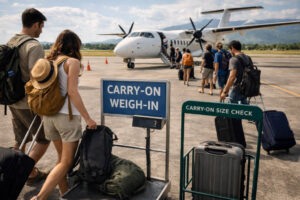 This is the section that prevents most “why is this suddenly hard?” moments on a Dumaguete to El Nido travel day. The goal is to reduce surprises: strict weigh-ins, fewer rebooking options, long terminal walks, and long road transfers.
Common friction points to expect
- Small airports can be strict: DGT and especially ENI routes may enforce cabin and checked baggage limits closely. If your bag is even slightly heavy, it can trigger repacking or fees.
- Limited ENI flights: Fewer flights means fewer rebooking choices when something goes wrong. This is why Option B (via PPS) is a strong safety net.
- Major hub terminal changes: In Manila (NAIA) and other large hubs, you may need to change terminals or walk long distances; shuttles and queues can add a lot of time. Build a layover buffer that assumes friction, not smoothness.
- PPS land transfer realities: Shared vans can be tight, with fixed departure times and comfort breaks. Cherry Bus is usually more spacious, but may take longer. Either way, you commonly arrive in El Nido at a transport terminal area, then take a short tricycle ride to your stay.
- Port/terminal fees and lines: Ferries often require on-site steps (fees, seat assignment, security checks). Lines can move slowly, and cancellations happen in rough weather.
Low-stress packing and arrival tips
- Arrive earlier than you think: Especially if you’re on a connecting flight to ENI. A calm Dumaguete to El Nido plan starts with time, not speed.
- Keep essentials in one small bag: IDs, wallet, meds, chargers, a light jacket, water, and a snack—so you’re not rummaging at checkpoints.
- Avoid tight connections if you get anxious: A longer layover buffer is cheaper than rebooking and less stressful than sprinting.
- Pack for weather: A small umbrella or rain jacket helps during transfers; a dry bag or zip pouches protect documents and electronics.
For a calm but realistic approach to travel-day awareness, keep this page saved: practical safety reminders for Philippine travel days.
Reality Check: If you’re traveling with laptops, camera gear, or fragile items, a shared van and multiple transfers increase handling risk. Fewer steps (even if it costs more) may be worth it.
Backup Plan for Cancellations and Missed Connections
The Philippines has real weather variability: strong winds can affect small-airport flights, and rough seas can cancel ferries. A calm Dumaguete to El Nido plan includes an action flow before anything goes wrong. If you’re joining a tour the next day, consider arriving a day earlier—especially in months when wind and rain are common.
Plan A / Plan B / Plan C flow
- Plan A: Book a connecting flight DGT → (MNL or CEB) → ENI with a safe layover buffer. Prefer earlier flights, and avoid the last ENI flight when possible.
- Plan B: If ENI gets canceled or seats disappear, reroute to Puerto Princesa (PPS), then take a shared van or Cherry Bus to El Nido. This is often the most available recovery path.
- Plan C: If same-day arrival becomes unrealistic, plan an overnight in the hub city (Manila, Cebu, or Puerto Princesa) and continue the next morning. This prevents risky late-night transfers and protects your energy.
Buffer strategy that actually works
- Don’t build around the last flight: Last flights are fragile because there’s no later option to “catch up.”
- Add one flexible night when seasons are rough: If forecasts look windy/rainy, keep your first Palawan night refundable if possible.
- Match your buffer to your trip stakes: If you’re meeting a boat tour, a wedding, or a fixed booking, build a bigger cushion (sometimes that means arriving a day early).
If you’re still in Dumaguete and deciding how many “extra hours” you can realistically give yourself, this guide helps frame buffers without overplanning: a Dumaguete itinerary that builds in realistic buffers.
Reality Check: When disruptions happen, the calmest move is often to stop trying to “win the day” and shift to Plan C. A rested morning departure is better than a risky midnight scramble.
Dumaguete to El Nido FAQ
What is the fastest Dumaguete to El Nido route?
The fastest option is usually Option A: fly DGT → (MNL or CEB) → ENI, as long as the connection and layover buffer are reasonable. Door-to-door, a smooth run is often 6–10 hours, but it can stretch if you miss the ENI flight.
What is the safest backup if ENI flights get canceled?
Option B via Puerto Princesa (PPS) is the most practical backup because PPS typically has more flight choices. From PPS, take a shared van or Cherry Bus to El Nido, and expect a long road leg.
Can Dumaguete to El Nido be done in one day?
Yes, it can be done in one day via Option A (best case) or Option B (long day), but it depends on schedules and disruptions. If your arrival time matters (like a next-day tour), consider arriving earlier or adding an overnight buffer.
How much layover buffer should be planned for a connecting flight?
For domestic connections, many planners feel comfortable with 2–3 hours if everything is on one ticket and you’re staying within the same terminal area. If you expect a terminal change, heavy queues, or checked baggage, 3–5 hours is calmer. If your tickets are separate, build even more time because baggage and re-check procedures can break tight plans.
Is Cebu (CEB) or Manila (MNL) better for connecting?
It depends on the day’s schedules and what gives you a safer buffer. Cebu connections can feel simpler for some travelers, while Manila can have more route choices but may involve longer terminal transfers. The calm choice is the one with the best timing and buffer, not the shortest flight time.
Is a shared van or Cherry Bus better from Puerto Princesa to El Nido?
Shared van: Usually faster door-to-door if departures line up, but tighter seating and fixed departure times. Cherry Bus: Often more comfortable and spacious, but may take longer depending on stops and schedule. If you’re prone to motion sickness, bus comfort can be worth the extra time.
What luggage issues are most common on this route?
The most common issues are strict weigh-ins (especially when flying into ENI), baggage allowance confusion between fare types, and delays caused by re-checking bags on separate tickets. Keep essentials in a small bag and avoid packing right up to the weight limit if you can.
Do ports and airports require extra fees like terminal fee?
Sometimes. Some terminal fee charges are bundled into tickets, while others are paid at the airport or port. For ferries, it’s common to pay port-related fees and go through extra counters. Carry small cash and keep receipts saved offline.
What should be checked the day before travel?
Check your airline notifications, weather advisories, and any port updates if you’re taking a ferry. Then re-check again on the morning of travel. For Dumaguete to El Nido, weather can affect both sea crossings and small-airport operations, so a quick status check can save hours.
Where should travelers commonly expect to get stuck?
The usual pinch points are: tight layovers at hubs, terminal transfers at major airports, waiting for the next limited ENI flight, late arrival into PPS that misses the last shared van/Cherry Bus, and ferry delays due to rough seas.
Once you’ve settled, keep these sections saved for ongoing planning: more El Nido guides on Bakasyon.ph and more calm travel tips and inspiration.
Final planning note: The calmest Dumaguete to El Nido trip is rarely the one with the shortest connection—it’s the one with the clearest Plan A, a ready Plan B via Puerto Princesa, and enough buffer to handle the Philippines’ very real weather and queue realities without panic.