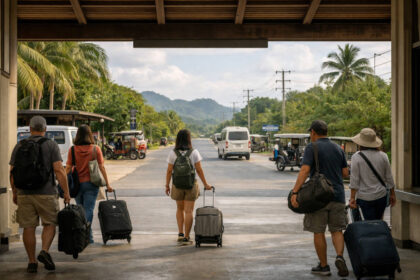
If the goal is a calm, low-stress trip from Davao City to Boracay, the biggest win is choosing a route with fewer “moving parts.” In practice, that means picking the flight and transfer combination that matches your budget, luggage, and tolerance for queues—then adding buffers so small delays do not domino into missed boats or rushed check-ins.
This guide lays out the main ways to do Davao City to Boracay: flying to Caticlan Airport for the shortest transfer, flying to Kalibo Airport for more flight availability (but a longer land transfer), and a “last resort” multi-leg land and ferry concept when flights do not work. Along the way, it covers realistic door-to-door time, cost buckets (without pretending prices are fixed), where to buy tickets, what to screenshot, and a backup plan for weather and sea conditions.
If helpful while planning, browse travel checklists and trip ideas under Tips and Inspiration, and keep a bookmark to Davao Travel Guides for airport and city logistics.
At-a-Glance: The Fastest, Calmest Planning Baseline
 Best time window: Outside major holidays and long weekends when possible; calmer seas are more common in fair-weather months, but conditions can change quickly.
Realistic door-to-door time: Fastest days are usually flight + short transfer via Caticlan (often half-day range with buffers). Via Kalibo, plan for a noticeably longer day because of the land transfer.
Budget band: Expect two big buckets—flight costs (highly variable) plus transfers and port fees (more predictable, paid per person in steps).
Crowd and queue risk: Midday arrivals and weekend peaks can mean longer lines at Caticlan Jetty Port and transport queues on the island.
Rain and sea backup: If boats pause due to sea conditions, the plan becomes “wait safely near the port, rebook calmly, keep receipts,” rather than forcing a risky crossing.
Reality Check: Even on smooth days, Davao City to Boracay includes multiple checkpoints—airport, transfer, port, boat—so a buffer is not “extra,” it is the difference between relaxed and rushed.
Start Here: The Lowest-Stress Route Most Travelers Use
Quick summary: Fly to Caticlan when possible
For most travelers, the lowest-stress Davao City to Boracay plan is: fly into Caticlan Airport, do a short transfer to Caticlan Jetty Port, take the boat to Boracay, then continue by e-trike or similar transport to your hotel area. It is the “shortest chain,” which usually means fewer chances to miss a connection.
Start with broad planning basics—IDs, buffers, payment prep, and transport expectations—using the Philippines Trip Planning Guide. It helps prevent the most common stress points: last-minute baggage surprises, cash shortages for fees, and tight connection schedules.
When Kalibo makes sense
Kalibo Airport can make sense when flights to Caticlan are limited, much more expensive, or sold out—especially around peak dates. The tradeoff is time and energy: you add a longer land transfer (often by bus or van) before you even reach the port and boat portion.
Reality Check: Davao City to Boracay via Kalibo is not “hard,” but it is longer and more sensitive to traffic, loading times, and how quickly you can get a seat on the next transfer.
Option 1: Fly Davao City To Caticlan, Then Quick Transfer To Boracay
Realistic door-to-door time (include buffers and waiting)
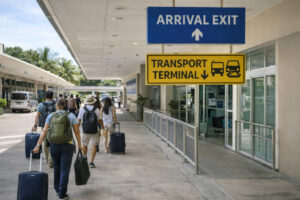 For Davao City to Boracay via Caticlan, the flight portion is only part of the day. A realistic door-to-door estimate should include:
1) Airport arrival buffer in Davao City (check-in, baggage drop, security, boarding), 2) flight time, 3) deplaning and baggage claim (if checked), 4) short transfer to Caticlan Jetty Port, 5) port processing and fees, 6) boat wait and boat ride, and 7) island transport to your hotel area plus check-in timing.
A practical planning move: treat your scheduled arrival time in Caticlan as “landing,” not “already on the beach.” That mindset prevents overly tight hotel check-in plans and rushed lunch or activity bookings.
Step-by-step after landing: airport exit to port to island to hotel area
Step 1: Exit Caticlan Airport and confirm your transfer plan. Some travelers pre-book a transfer package (airport-to-port, boat, and island transport). Others pay step-by-step. Either way, keep your group together and confirm what is included before paying.
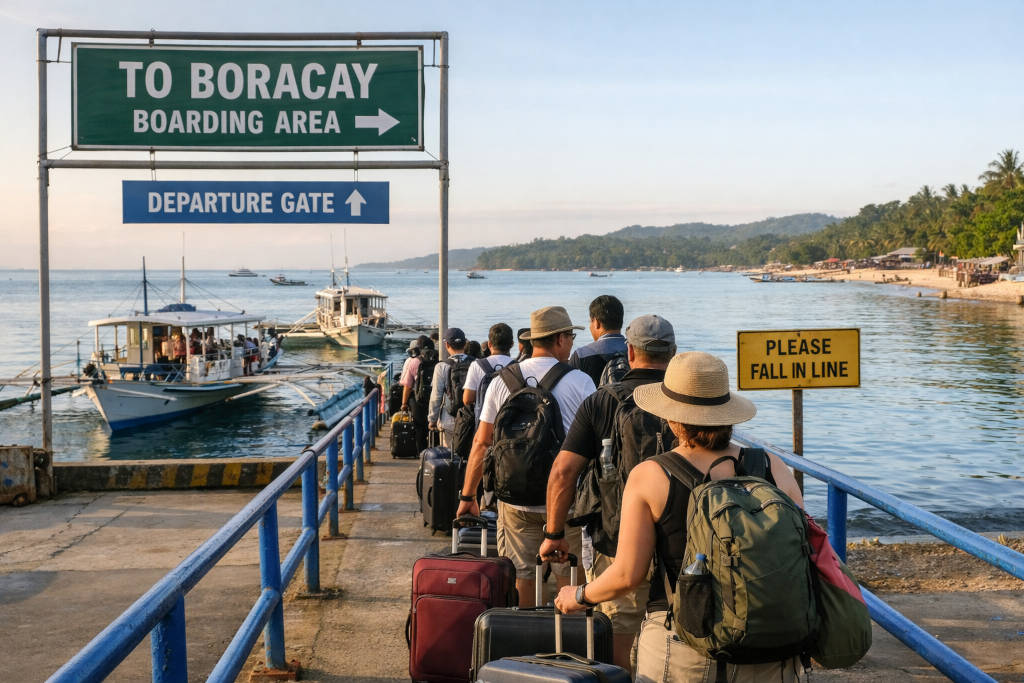
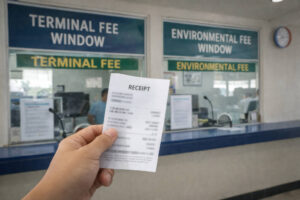
Step 2: Go to Caticlan Jetty Port and follow the entry workflow. Expect lines during peak hours. You will typically pay required fees (commonly described as terminal-related and environmental-related fees) and receive receipts and/or stubs that may be checked more than once.
Step 3: Board the boat and cross to Boracay. Boat schedules can feel “rolling” rather than fixed, depending on demand and conditions. Keep tickets and receipts accessible.
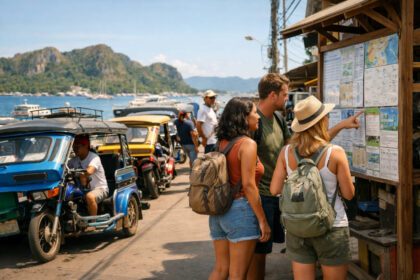
Step 4: Arrive on the island and continue to your hotel area. Many transfers go through Cagban Port on Boracay, where you will see organized lanes and transport options like e-trikes. Have your hotel address and a map pin saved offline for quick showing.
Before traveling, skim Boracay Travel Advisory and Guidelines for any entry reminders, local rules, or changing workflows that could affect your port steps and check-in timing.
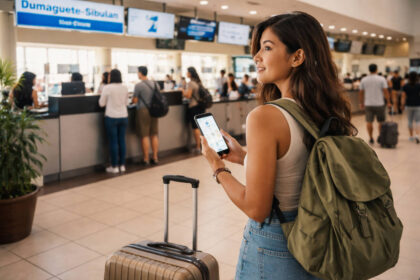
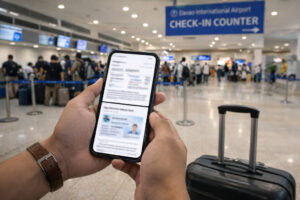
What to screenshot/save (boarding pass, booking ref, payment proof, hotel booking, ID photos, important receipts)
Save these to your phone (and consider one offline folder) before leaving Davao City:
• Flight booking reference and itinerary details (including baggage add-ons)
• Boarding pass (once available) and any airline emails or app confirmations
• Payment proof for flights and pre-booked transfers (if used)
• Hotel booking confirmation and contact number
• Clear photos of valid IDs (front and back when applicable)
• Screenshots of port fee receipts once paid (or clear photos of paper receipts)
• Offline map pin of your hotel and a backup pin of the nearest main road
Friction points and fixes (queues, port fees, limited seating, sudden boat timing changes)
Queue spikes: If multiple flights land close together, lines can jump quickly. Fix: avoid scheduling anything “must-not-miss” within a tight window after landing. Keep water and a small snack accessible.
Port fee confusion: Fees may be paid in steps, and receipts can be checked at different points. Fix: put receipts in one zip pouch and keep them easy to reach, not buried in a backpack.
Limited seating and hot waiting areas: Waiting can be uncomfortable in peak sun. Fix: light layers, a small towel, and hydration help; if traveling with seniors or kids, prioritize shaded areas and sit breaks.
Boat timing shifts: Departures can adjust based on demand and sea conditions. Fix: stay near your lane or assigned waiting area, keep phones charged, and avoid separating from your group.
Reality Check: The shortest Davao City to Boracay route still involves a “mini-system” at the port—plan for lines, and treat receipts like passports for the next step.
For a quick look at what to do after you arrive and settle in, see Things to Do in Boracay—but schedule activities with a buffer on arrival day.
Option 2: Fly Davao City To Kalibo, Then Land Transfer + Boat To Boracay
When this option is worth it (cost vs time vs availability)
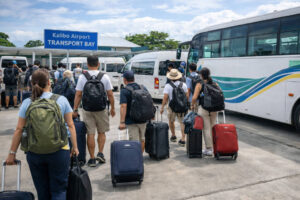 Davao City to Boracay via Kalibo Airport is often chosen for one of three reasons: better flight availability, lower airfare on certain dates, or schedules that fit better with work and school calendars. It can also be a fallback when Caticlan Airport flights are full or priced high.
This route is more comfortable when you are okay with a longer travel day, you pack light (or pack smart), and you treat the land transfer as a real segment that needs hydration, restroom planning, and motion-sickness prep if needed.
Realistic door-to-door time (show why it’s longer)
Compared with Caticlan, Kalibo adds a long ride to reach the port area. That means door-to-door time includes: airport processing in Davao City, flight time, arrival flow in Kalibo, waiting to fill a van or load a bus, the land transfer itself, plus the same port and boat steps you would do anyway.
The hidden time cost is not only the ride—it is the “in-between” minutes: buying tickets, waiting for departure, restroom stops, and loading luggage. Build a bigger buffer if you are landing later in the day.
Step-by-step: airport to bus/van, to ports, to island, to hotel
Step 1: Arrive at Kalibo Airport and identify your transfer channel. Look for official counters or accredited providers. If you are unsure how bus and ferry systems work in the Philippines, skim the Philippines Public Transport Guide so you know what “normal” looks like (queueing, ticket stubs, loading rules, and luggage handling).
Step 2: Take the land transfer toward the port. Keep valuables and breakables in a day bag that stays with you. If the vehicle stops, use the break to hydrate and reset—this part is where fatigue can sneak in.
Step 3: Complete port steps and cross to Boracay. Once you reach the port, the process becomes similar: fees, receipts, lane management, and boat boarding depending on conditions.
Step 4: Continue from Cagban Port to your hotel area. Expect a short queue for island transport at busy hours. Have your hotel name and landmark saved (and readable) for quick handoff to the driver.
Comfort tips (hydration, motion sickness, luggage handling, rest breaks)
Hydration and snacks: Bring water and something light that can handle heat. Long transfers feel longer when hungry.
Motion sickness: If prone, pack meds in your day bag and take them early. Choose seats with less sway when possible.
Luggage handling: Use one “grab bag” for documents and chargers, and keep heavier items in a main bag that is easy to lift. Bags with wheels are convenient but can be awkward on uneven surfaces at ports.
Reality Check: Davao City to Boracay via Kalibo is a marathon day—plan it like a travel day, not a sightseeing day, and you will arrive in better shape.
Costs You Should Expect (Without Guessing Exact Prices)
Flight cost variability (sales vs peak dates, baggage add-ons)
 Flights are the most variable part of Davao City to Boracay. Prices can change based on date, time, demand, seat sales, and how early you book. The most common surprise cost is baggage: what looks like a cheaper fare can climb once you add checked baggage or larger cabin baggage options.
When comparing routes, compare the “true total”: airfare + baggage add-ons + transfer packages + port fees + island transport. A slightly higher flight to Caticlan Airport can sometimes balance out if it saves a paid land transfer from Kalibo Airport.
Transfer costs (airport-to-port, boat, port fees, island transport)
Transfers and fees are paid in steps, usually per person. Common buckets include:
• Airport-to-port transport (separate ticket or packaged transfer)
• Boat fare and associated port processing
• Terminal-type fees and environmental-related fees (keep receipts)
• Island transport from port to your hotel area (e-trike or similar)
For official, local guidance on visitor flow and reminders, see Official Boracay Tourist Guide from Aklan and Malay-Boracay Tourism Offices.
Cash and payment reminders (small bills, receipts, offline copies)
Even when some counters accept cashless payments, it is safer to carry small bills for fees and quick purchases. Save receipts as photos, and keep one offline folder for all trip screenshots in case mobile signal becomes patchy.
Reality Check: The most stressful cost moment in Davao City to Boracay is not the total—it is being short on small bills at the exact counter that needs payment right now.
Luggage Rules And Packing That Prevents Stress
Airline baggage basics to double-check before you fly (weight, size, add-ons, batteries/power banks)
Before flying Davao City to Boracay, verify baggage rules inside your airline booking: cabin baggage weight and size limits, checked baggage allowances, and how much an add-on costs if purchased late. Airlines can be strict when flights are full, and overhead bin space can run tight.
Power banks and spare batteries generally belong in cabin baggage, not checked baggage. Keep them easy to show at security if asked. Also pack chargers and one power cord in your day bag so delays do not drain your phone at the worst time.
Port and boat practicality (waterproofing, easy-to-carry setup, sandals vs shoes)
Ports involve walking, ramps, and occasional splashes—especially during boarding. A simple waterproof layer (dry bag, rain cover, or plastic inner lining) protects clothes and gadgets. Wear footwear that can handle wet surfaces without slipping; sandals work for some travelers, but closed shoes can feel safer on crowded ramps.
What to keep in your day bag (IDs, chargers, meds, snacks)
Pack your day bag as if your main luggage might be out of reach for a few hours. Essentials include IDs, wallet, phone, power bank, charging cable, meds, tissues, wet wipes, a small towel, and a light snack. Keep one pen too—small forms and quick notes still happen.
Reality Check: For Davao City to Boracay, the day bag is the real “lifeline”—it carries what you need during queues, transfers, and sudden schedule changes.
What To Buy Where (Tickets, Transfers, And Proof To Keep)
Flights: book direct with airline sites/apps when possible; confirm baggage and rebooking rules
For flights, the simplest approach is booking directly through official airline websites or apps (for example, Philippine Airlines, Cebu Pacific, and AirAsia Philippines) so you can manage baggage, seat selection, and rebooking rules in one place. After booking, immediately confirm: baggage allowance, name spelling, travel date, and change or cancellation policies.
Transfers: use accredited/official channels when available; avoid last-minute confusion
For transfers, reduce confusion by choosing official or accredited channels when available—airport transfer counters, reputable hotel-arranged transfers, or established transport providers. If booking on the spot, ask what is included (airport-to-port, boat, and island transport) and what receipts you should keep for each step.
What to screenshot/save checklist (make this a tight, scannable list)
Screenshot and save:
• Flight itinerary + booking reference
• Baggage add-on confirmation (if any)
• Boarding pass (when available)
• Hotel booking confirmation + contact
• ID photos and emergency contacts
• Transfer booking proof (if pre-booked)
• Port fee receipts (photo of each receipt)
• Offline map pin of hotel + a nearby landmark
If you like checklist-style reading for planning days, one optional save is Bakasyon Checklist-Style Guides for the quick-scan format (even though it is a different destination).
Reality Check: For Davao City to Boracay, screenshots are not just “nice to have”—they are your backup when signal is weak, counters are busy, and you need to show proof fast.
Delay And Cancellation Playbook (Weather, Sea Conditions, Missed Connections)
If your flight is delayed: what to do before boarding and on landing
If a flight delay happens, the calm move is to protect the rest of the chain. While still in the airport, check the airline app or official messages for updated boarding time and rebooking options. If you booked with the airline directly, rebooking is usually more straightforward inside the same app or helpdesk flow.
On landing (whether Caticlan Airport or Kalibo Airport), reassess the remaining steps: do you still have daylight, are port counters still open, and is your hotel check-in flexible? Keep hotel contact details accessible so you can message a late arrival if needed.
If boats pause due to conditions: how to pivot calmly (wait strategy, lodging backup, re-route)
Sea conditions can pause boat operations. If that happens, prioritize safety and clear information: stay near official waiting areas, keep your receipts, and avoid rushing toward unofficial offers. If you need to wait overnight, choose lodging that is safe and close enough to return to the port early.
Keep your planning grounded with general safety reminders from the Travel Safety in the Philippines Guide, especially if you are traveling with kids, seniors, or valuable gear.
If you miss a connection: rebooking steps and who to contact
If a missed connection happens in a Davao City to Boracay plan, handle it in this order:
1) Confirm what you missed (flight, transfer, boat timing) and what is still operating today.
2) Contact the airline first for flight changes (official app, website, or airport help desk).
3) Contact your transfer provider (if pre-booked) using the number or chat in your confirmation.
4) Inform your hotel with an updated ETA.
5) Save all rebooking confirmations and receipts in the same folder as your originals.
Reality Check: The best backup plan for Davao City to Boracay is not a “perfect alternative route”—it is having the right contacts, proofs, and buffer so rebooking stays simple.
Timing Tips: When To Travel To Reduce Lines And Stress
Early flights vs midday flights tradeoffs
Early flights often help you “get ahead” of queues and leave more daylight for transfers and check-in. Midday flights can be easier for sleep, but they may land during busier port windows and can feel hotter during waits.
Weekends/holidays and crowd patterns (keep it practical and non-absolute)
Weekends, school breaks, and long holidays can increase demand across the entire chain: fuller flights, longer lines at Caticlan Jetty Port, and slower island transport. If you must travel on peak dates, offset it with earlier departures, lighter luggage, and a bigger buffer before any dinner reservations or tours.
Buffer rule of thumb for first-timers
A practical rule: add at least one extra “buffer block” for the transfer and port portion—enough time for a long line, a slow baggage claim, or a short pause in boat flow. If traveling via Kalibo Airport, add another buffer block for the land transfer and loading time.
Reality Check: In Davao City to Boracay planning, buffers are not wasted time—they are what protect you from turning normal delays into expensive changes.
Davao City to Boracay FAQs
What is the easiest way to travel from Davao City to Boracay with the least stress?
The easiest, lowest-stress route for most travelers is flying Davao City to Boracay via Caticlan Airport, then doing the short transfer to Caticlan Jetty Port and onward to the island. It reduces land travel time and keeps the transfer chain shorter.
Should I fly to Caticlan Airport or Kalibo Airport for Boracay?
Choose Caticlan Airport when you value time, fewer steps, and less transfer friction. Choose Kalibo Airport when flight availability or airfare is significantly better and you can handle a longer land transfer day. For families, seniors, or tight schedules, Caticlan often feels calmer.
How long is the trip door-to-door including transfers and waiting?
Davao City to Boracay door-to-door time depends on your flight schedule and queue conditions. Via Caticlan, it is usually the shortest because the airport-to-port segment is quick. Via Kalibo, add a long land transfer plus waiting/loading time. In both cases, include airport buffers, port processing, and island transport in your estimate.
Where do I pay port fees and what receipts should I keep?
Port-related fees are typically paid at the port counters as part of the processing flow before boarding. Keep every receipt or stub you receive, because checks can happen at multiple points. Store them together (zip pouch or dedicated pocket) and take clear photos as a backup.
What should I screenshot/save on my phone before leaving Davao City?
Save your flight itinerary and booking reference, boarding pass (when available), baggage confirmation, hotel booking, ID photos, transfer confirmations (if any), and a map pin of your hotel. Also save photos of port fee receipts after payment so you can show proof even offline.
What is the best backup plan if flights get canceled or boats stop?
The best backup plan is a calm, proof-based pivot: rebook flights through the official airline channel, message your hotel about delays, and stay near official port waiting areas if sea conditions pause boats. Keep cash for essentials, keep receipts, and prioritize safety over rushing. If you need more destination context while you wait, the Philippines Travel Official Boracay Page is a helpful reference for general expectations.
Last-Resort Concept: Multi-Leg Land And Ferry (Only If Flights Truly Do Not Work)
When flights are unavailable or canceled across multiple days, a last-resort Davao City to Boracay concept is a multi-leg land-and-ferry approach: traveling overland in stages, using major terminals, and connecting toward the Aklan area before completing the final port and boat steps. This is not a “default recommendation” because it adds time, more ticket counters, and more points where schedules can shift.
If this is the only option, plan it as a two-day travel effort, not a single push: secure safe overnight stops, keep valuables with you, and confirm each segment using official terminals and accredited operators whenever possible.
Reality Check: This backup is about continuity, not comfort—use it only when flying Davao City to Boracay is not workable, and prioritize safe stops and clear documentation.
Next Step: Build Your Boracay Plan After You Arrive
Once your route is set and your screenshots are saved, the next planning step is choosing your area and pacing your first day to match your arrival energy. For more destination guides, browse Boracay Travel Guides and map out a “light first day” that does not depend on perfect timing.
With the right buffers, tidy proof folder, and realistic expectations, Davao City to Boracay can feel straightforward—even with queues and weather variables—because you already know what happens next at every step.