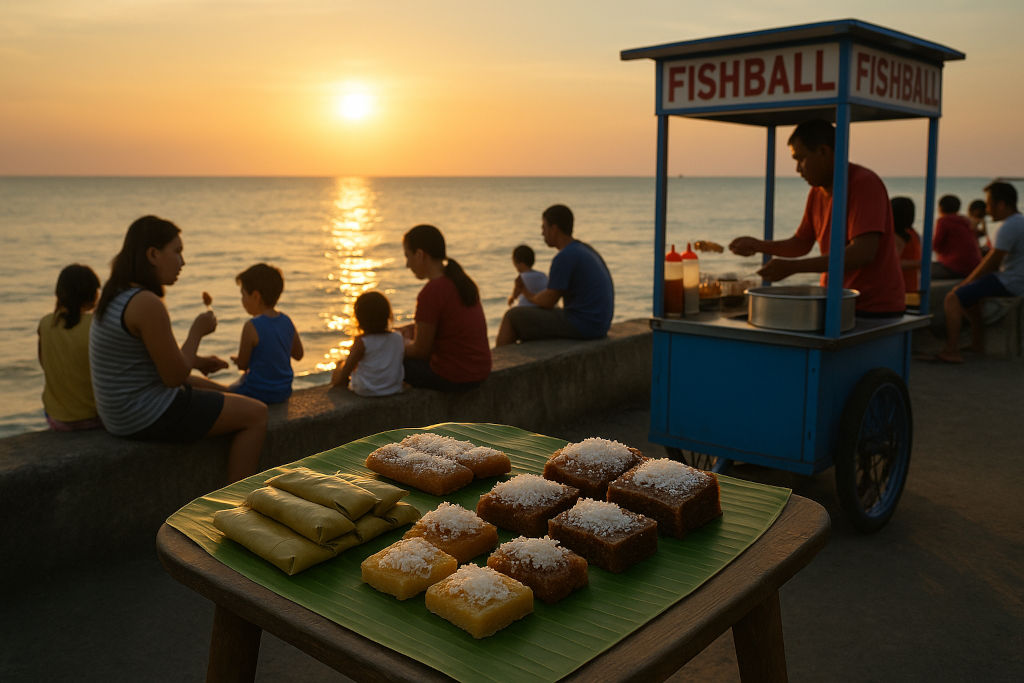
 There’s a certain hour along the shore when everything softens. The sun is lower, the air is still warm but kinder, and the sea feels like it’s breathing slower. Somewhere on a low seawall, someone is stirring coffee in a chipped mug. A vendor opens a plastic container of kakanin. Children, still damp from swimming, line up for fishballs. This is where coastal merienda stories begin: in the small, ordinary moments when the ocean and snack time meet.
In this long walk through merienda by the sea, we’ll sit with fishermen on overturned boats, follow the smoke of inihaw na pusit, and listen to the quiet ways coastal families mark their afternoons. We’ll look at classic seaside snack traditions, how they’re changing, and how visitors can join without turning the shoreline into a stage. Think of it as an afternoon spent people-watching in a small coastal barangay, feet sandy, hair salty, and hands always just a little bit sticky from something sweet—an afternoon woven through with the gentle rhythm of coastal merienda stories.
What Merienda Means in Filipino Life
Merienda as Pause, Not Just a Snack
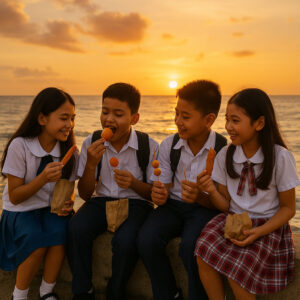 Merienda, in Filipino life, is both a time and a feeling. Usually slipping in between meals—mid-morning or mid-afternoon—it’s the pause that gently breaks the day. A Spanish loanword adopted into local rhythm, merienda can mean coffee and pandesal, turon from a street cart, or a plate of kakanin laid out for whoever walks through the door. It’s less about hunger and more about connection: an excuse to sit down, chat, breathe. In many seaside barangays, those pauses quietly grow into everyday coastal merienda stories shared between neighbors and family.
Across the country, merienda appears in different forms: pancit and puto during birthdays, steaming arroz caldo on rainy afternoons, halo-halo when the heat feels like it’s humming inside your bones. Many of these patterns—and their deeper meanings—live inside the broader universe of Filipino food culture, the same world explored in pieces like Filipino food culture stories that trace how everyday dishes carry memory. Along the waterline, those memories come with salt air and become part of the living archive of coastal merienda stories. If you want a wider context for this tradition, you can also read about the history of merienda in the Philippines, where that small afternoon pause is recognized as a nationwide ritual.
From City Streets to Coastal Merienda Stories
 If city merienda is shaped by jeepney stops and office breaks, coastal merienda is shaped by tides. Here, snack time might wait for boats to dock, for nets to be rinsed, for the day’s catch to be sorted into plastic basins. The snacks themselves—kakanin, grilled corn, inihaw na isda, pan de coco—are familiar, but the background is different: the rasp of rope on wood, the shriek of a distant banca engine, gulls circling above.
That’s what makes Filipino coastal merienda special. It’s still a pause, but it’s also a small ritual of gratitude for the sea: “Nakabalik tayo nang maayos. Kumain muna tayo.” In these coastal merienda stories, the ocean is not just a view; it’s a co-host, a silent witness to every cup of coffee and fishball skewer shared along the seawall.
When the Sea Pauses: Coastal Afternoons in Fishing Towns
The Slow Drift of a Coastal Afternoon
Imagine a small fishing town somewhere in Batangas, Bicol, or Samar. By three in the afternoon, the hardest light has faded. The heat is still there, but softer now, like a hand that’s let go of your collar. Boats that left before dawn have started coming back, hulls bumping gently against the pier. You can tell the time by the sound of their engines cutting off, one by one.
On the shore, life rearranges itself. Someone hurries to string up today’s catch for drying; someone else sweeps sand out of a sari-sari store. Schoolkids spill out of a tricycle, their bags thumping against their backs, eyes already scanning for the first sign of kwek-kwek or banana cue. Radios crackle with ballads and news; a neighbor taps a spoon against an aluminum pot as instant coffee meets hot water. Merienda by the sea is coming, and everyone can feel it. These small shifts in sound and movement are the opening lines of everyday coastal merienda stories.
Sounds, Smells, and Light Before Merienda by the Sea
Coastal afternoons are built from small sensory details. The sound of tsinelas slapping against concrete as someone runs to buy ice; the metallic hiss of soft drinks being opened; the faint sweetness of grilled saba riding on a stronger smell of the day’s fish. Smoke from a small charcoal grill curls into the sky, blending with the salty breeze.
Light, too, has its own personality now. It makes the seawall glow a little, turns fishing nets into lace, and filters through the palms in soft, streaky lines. In these moments, seaside snack traditions feel like they’re woven directly into the landscape—impossible to separate from the glint of sun on water or the way sand sticks to your ankles as you sit down to eat. This is where simple sensory impressions turn into coastal merienda stories you can retell long after the tide has shifted.
Coastal Merienda Stories: Classic Snacks by the Water
Kakanin on Banana Leaves Beside the Shore
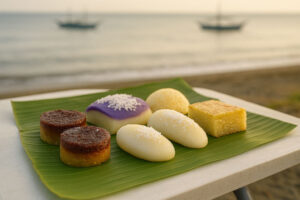 Many coastal merienda scenes start with a low table and a banana leaf. On top: suman tied with thin strips of leaf, kutsinta glistening with grated niyog, biko sliced into sticky squares. In some barangays, a lola sets up right along the seawall, her kakanin laid out in neat rows, the sea as her backdrop and soundtrack.
Locals wander over with coins in hand. A boy still wet from swimming points at a piece of sapin-sapin, colors bright against the green leaf. A teenager buys enough suman to tuck into her lunchbox for school the next day. These scenes echo many of the stories in Filipino coastal cooking adventures, where the line between home cooking and community sharing blurs in the best way, and where new coastal merienda stories are added to the shoreline’s collective memory every afternoon.
Grilled Corn, Inihaw na Isda, and Pusit Smoke
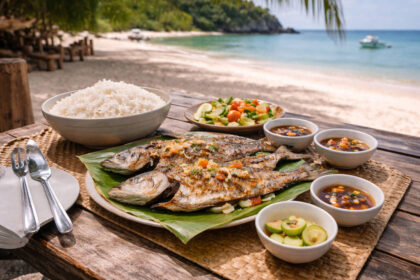
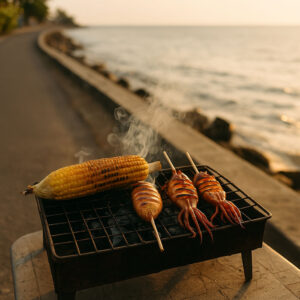
Just a few steps from the water, someone is turning golden ears of corn over a grill. The kernels pop and darken in patches, brushed with margarine and sprinkled with salt. Next to them, small fish—talakitok, galunggong, or whatever came in that day—sizzle over charcoal, their skin crisping and splitting open, releasing a scent that makes passing kids stop in their tracks.
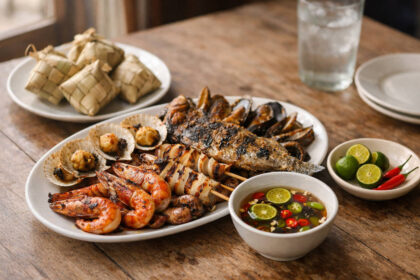
On some coasts, you’ll find rings of inihaw na pusit too, glistening in a sweet-savory marinade. A fisherman who traded part of his catch earlier takes home a few sticks of fish and squid, balancing them carefully so the sauce doesn’t drip. Here, merienda by the sea isn’t always “light”—sometimes it’s a mini meal, a bridge between a long morning at sea and a simple dinner at home. These smoky, satisfying plates are some of the richest coastal merienda stories, told entirely in scent and flavor.
Fried, Steamed, and Rolling-Store Favorites
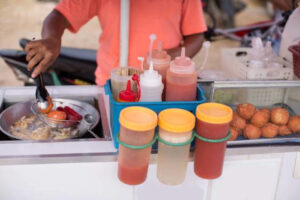
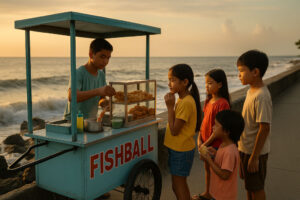 Where there’s a seawall, there’s almost always wheels: fishball carts, siomai stands, turon vendors pushing their small glass cases under the shade of a tree. Oil snaps as a fresh batch of kikiam drops into the pan; a mix of sweet and spicy sauces waits in plastic jars. Kids line up with plastic cups, each skewering their own deep-fried prize before dipping it into the sauce of their choosing.
Coastal merienda stories here intersect with the wider world of Filipino street food—the kind you might trace in a big-city crawl like Filipino street food diaries in Manila, Cebu, and Davao. The difference is that out here, after you’ve paid and taken your first bite, you can turn around and see the sea catching the last light of the day, framing your own small coastal merienda stories in real time.
Coffee, Pandesal, and Pan de Coco After the Catch
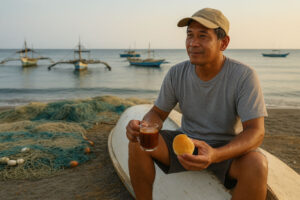 Not all coastal merienda happens on the street. In many fishing towns, there’s a small bakery just off the main road, where pandesal is still warm by mid-afternoon. Fishermen and boatmen duck inside or lean against the doorway, cradling paper bags of bread and pouring three-in-one coffee into plastic cups.
One of my favorite coastal merienda stories came from a tiny bakery in a town in Quezon. A fisherman named Mang Lito told me, “Dati, gatas tsaka tinapay lang ‘to, galing sa bote na recycled. Ngayon may iced coffee na rin, pero itong pan de coco na ‘to, lase pa rin nung bata ako.” He tore a piece of the bread, coconut filling warm and sweet inside, and handed me half. Outside, his boat was still dripping from the afternoon tide, another reminder of how bread, coffee, and seawater can share the same storyline.
Fishermen’s Afternoon Routines and Seaside Rituals
Sorting the Catch, Sharing the First Bites
For many fishermen, merienda marks the moment work edges into rest. After docking, they unload the catch: crates passed hand to hand, fish glinting in the hot light. There’s bargaining, laughter, the soft clink of coins in plastic basins. When the bustle quiets, someone brings out a thermos and a few enamel mugs. Another unwraps a bag of pan de sal or cassava cake from home.
They eat standing by the boat or sitting on the pier, legs dangling over the water. Stories spill out with the steam from their mugs—about a near miss with bad weather, about a big catch on a day when no one expected one, about merienda from their childhood when boats were wooden and smaller and everyone still used kerosene lamps. Coastal merienda stories become a way to measure time: “Naalala mo nung wala pang concrete na seawall? Ganito na rin merienda natin noon.”
Father-and-Child Merienda by the Boats
Sometimes, the sweetest scenes happen away from the big group. A father, still smelling of the sea, sits with his child on the step of a small bodega, sharing a single bottle of soda and a paper bag of fishballs. The child’s feet swing above the sand; the father’s hands are rough, nails dark from handling nets. They eat slowly, talking about school, about whether tomorrow’s tide will be kind, about what snack they’ll buy next time.
In moments like this, merienda by the ocean carries quiet cultural meaning. It’s a soft way of saying, “I’m home. We’re safe. We have enough, at least for today.” In a country where many livelihoods are tied to unpredictable seas, that little shared snack is a small ritual of gratitude and reassurance—one more scene added to the long-running reel of coastal merienda stories.
New Waves in Coastal Merienda
Bottled Drinks, Instant Coffee, and Bakery Boxes
Like everything else, coastal merienda is changing. Where there used to be only brewed barako or coffee boiled straight in a battered pot, now there are sachets of instant cappuccino, iced lattes in plastic cups, energy drinks stacked high in sari-sari stores. Kids who grew up sipping powdered juice now ask for branded milk tea, even in towns where the sea is just a few steps from the counter.
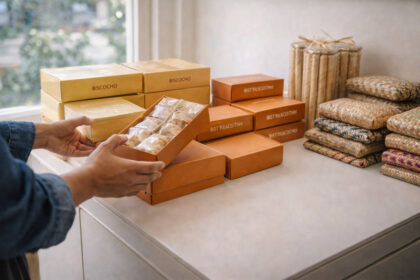
Bakery boxes show up too—doughnuts from the city, pastel-colored mamon, brownies in plastic clamshells. In some places, families bring these treats to the seawall for a special Sunday merienda, mixing them with older favorites like bibingka or suman. It’s not so different from how coastal towns join bigger national celebrations; the same mix of old and new flavors you see in Philippine festivals food traditions shows up quietly in everyday snack time, too. All of these evolving habits are modern chapters of coastal merienda stories, written in iced coffee foam and imported doughnuts as much as in barako and bibingka.
Tourists, Cameras, and Café-Style Drinks by the Pier
Tourism adds its own layers. In well-known seaside towns, small cafés pop up near the pier, offering iced coffee, smoothies, and pastries meant for both locals and visitors. Travelers take photos of their merienda by the sea: a latte against a sunset, a slice of cake with waves in the background. For some residents, it’s a welcome source of income and pride; for others, there’s a worry that the old seaside snack traditions will fade into props for social media.
There’s a delicate balance here. Coastal merienda stories now include baristas pulling espresso shots a few meters away from a fish vendor scaling her catch, and both belong. The question is how to let these new waves roll in without wiping out the quieter rituals that came before. If you’re curious about how coastal communities worldwide are navigating similar changes, movements like Slow Fish by Slow Food share stories of small-scale fishers and traditional seafood cultures fighting to stay visible.
Regional Flavors from Luzon to Mindanao Coasts
Across the archipelago, coastal merienda wears different flavors. In parts of Luzon, you might find bibingka cooked in clay pots by the sea, or halo-halo served in fogged-up plastic cups. In Visayan coastal towns, there might be puso (hanging rice) and kinilaw shared as the sun drops. Down south in Mindanao, seaside merienda might mean pastil, tiyula itum enjoyed later in the day, or local kakanin whose names are new to visitors.
There’s no single “official” Filipino coastal merienda. Instead, there are overlapping layers of regional snacks and stories, the same way Pampanga’s inland food culture—spotlighted in guides like the Pampanga food trip through the food capital—adds its own twist to merienda far from the shore. What connects them all is the instinct to pause together over something small and satisfying, then fold those moments into local coastal merienda stories told again and again.
How Visitors Can Join Merienda by the Sea Respectfully
Where to Sit, What to Order, How to Listen
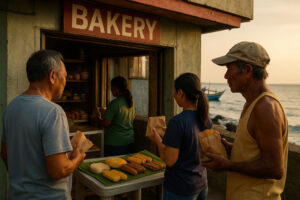 If you’re a visitor hoping to experience coastal merienda stories firsthand, start small. Look for where locals gather in the late afternoon: a seawall with kakanin laid out, a corner where a fishball cart naturally draws a crowd, a humble bakery with people lingering outside. Buy whatever catches your eye—suman, turon, a skewer of inihaw na pusit—and find a place to sit that doesn’t block pathways or interfere with people working.
Ordering is simple: greet the vendor (“Magandang hapon po”), point and ask (“Magkano po dito?”), and say thank you (“Salamat po”) even if your accent is wobbly. Then, as you eat, listen. Resist the urge to immediately record everything on your phone. Notice how people move, who shares snacks with whom, how kids gravitate toward certain carts. You’re not just tasting food; you’re stepping into a living scene of Filipino food culture in real time, and contributing your own quiet line to the local coastal merienda stories.
Buying from Small Vendors and Photographing with Care
One of the kindest ways to join merienda by the sea is to support small vendors directly. Choose the lola selling kakanin from a tupperware, the tito with a portable grill on the back of a tricycle, the sari-sari store that doubles as the neighborhood’s gossip hub. Not only does your money go straight into the community, you also get a taste of what locals actually crave in that place.
When it comes to photos, be gentle. Ask before taking close-ups of people, especially children and elders. A simple “Pwede po bang mag-picture?” goes a long way. If someone says no, smile and let the moment pass. Coastal merienda stories are richest when you’re part of the scene, not just staging it for your feed—an idea that also runs through longform explorations like Filipino coastal cooking adventures and Filipino food culture stories, where respect is an ingredient as important as salt.
Sustainable Coastal Merienda and Ocean-Friendly Habits
Reusable Cups, Less Plastic, and Gentle Shorelines
Coastal merienda might feel small—just a fishball stick here, a cup of juice there—but its impact can add up, especially in fragile seaside ecosystems. Sustainable snacking by the sea starts with a few simple habits. Bring a reusable water bottle you can refill at your lodging or a cooperative store. If you know you’ll be snacking a lot, tuck a reusable container or small cloth bag into your tote for kakanin or bread, instead of accepting extra plastic.
When you do end up with wrappers or cups, don’t leave them in overflowing seaside bins or, worse, balanced on rocks “for now.” Take your trash back to a larger bin inland if you can. The same principles show up in broader guides like sustainable travel practices: a Filipino guide, but at merienda scale they look like this: one less straw in the sand, one less plastic bag that might end up in the water, one more shoreline that feels cared for. Protecting the coast this way ensures that future coastal merienda stories still include clear water, clean sand, and healthy fishing grounds.
At the end of the day, as the last fishball stick is tossed, grills are covered, and the sea shifts into deeper blue, what lingers isn’t just the taste of sugar or smoke. It’s the feeling of having shared a moment with a place and its people—of having watched the afternoon open and close around the rituals of rest, gratitude, and simple joy.
That’s the heart of coastal merienda stories. Whether you’re a local who grew up rinsing sand off your feet before grabbing turon, or a visitor tasting pusit for the first time by the seawall, merienda by the sea invites you to slow down and pay attention. Taste what’s offered. Listen more than you speak. Carry your trash, your cup, and your questions gently. In return, the shore might give you something you didn’t know you were hungry for: a deeper sense of how food, sea, and community hold each other in the quietest hours of the day—and how your own memories become part of the long, ongoing line of coastal merienda stories along the Philippine coast.