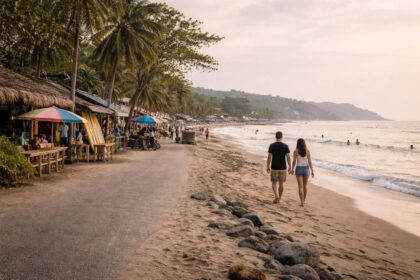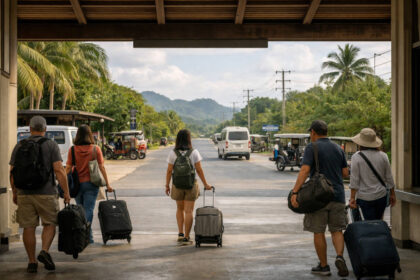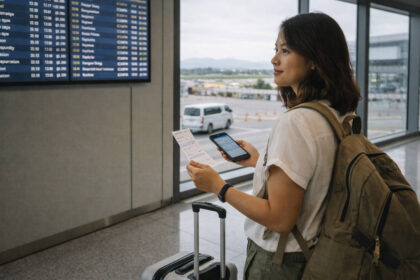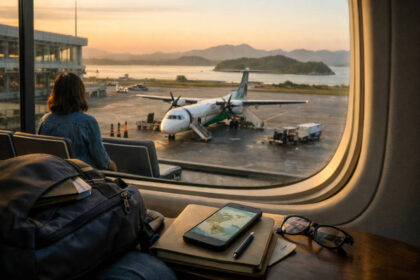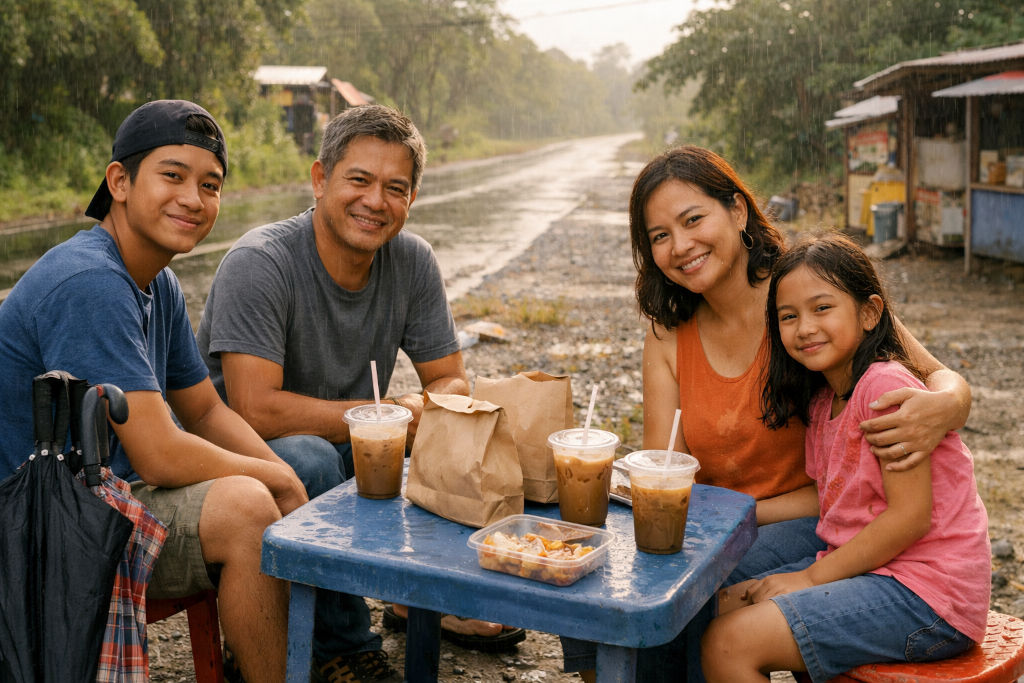
If you’ve ever planned a trip with Filipino family or barkada, you already know the secret: the itinerary isn’t just places—it’s people, pacing, and pagkain. The best trips feel “smooth” not because everything went perfectly, but because you planned for real life: late starts, bathroom breaks, snack stops, surprise ulan, and that one tita who needs a seated rest every hour.
This guide is a culture-forward way to do bakasyon planning without sounding strict or feeling stressed. Think of it as the friendly system you can reuse for a day trip, a weekend, or a Manila run—so you still get the fun, but you also get everyone home safe, fed, and happy.
At-a-Glance
Best time window: Plan around heat and rain—earlier mornings feel gentler, especially with kids and seniors.
Realistic travel time: Add traffic and “people time” (toilets, photo stops, waiting) before you lock in anything.
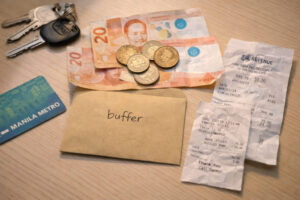
Budget band: Build a buffer (even small) for snacks, parking, and “since we’re here…” moments.
Crowd and line risk: Weekends and holidays can double your waiting time—tickets, elevators, restos, even CR.
Rain/heat backup: Keep one indoor fallback and one “shorter loop” option ready.
Reality check: If your plan has zero extra minutes, it’s not “efficient”—it’s fragile. A calm trip needs breathing room.
What bakasyon planning looks like in the Filipino real world
Why buffers are kindness (not laziness)
In Filipino trips, buffers are a love language. Extra time means no one gets blamed for being slow, no one is rushed while eating, and the driver isn’t pressured to “humabol” in traffic. Good bakasyon planning assumes humans—not robots—are traveling.
Reality check: Even the “fast” person slows down in the heat, in crowds, or when the nearest CR is a 7-minute walk away.
The definition you can actually use (and the culture behind it)
For me, bakasyon planning means choosing what matters most each day, then protecting it with time, food, and flexibility. It’s planning with warmth: you’re not just chasing spots—you’re keeping the group comfortable enough to enjoy them.
If you want a quick grounding on language and how we use the word in real life, the bakasyon meaning guide is a fun read before you map out details.
Reality check: A “perfect” plan that makes everyone iritable by 2 p.m. isn’t a win. Comfort is part of the itinerary.
Pre-trip basics that buy you calm
Before you fall in love with a schedule, lock the basics: confirmations, screenshots, and a simple budget. If flights or hotels are involved, use a clear, step-by-step reference like booking flights and hotels so you’re not juggling five tabs the night before.
My go-to: (1) one shared notes doc for the group, (2) a “Plan A / Plan B” list, and (3) a small cash buffer separate from your spending money.
Reality check: The less you “wing” the essentials, the more freedom you actually have on the day itself.
The simple framework: One anchor + buffers + recovery time
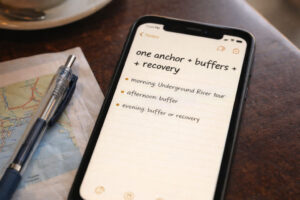 One anchor: the main reason you’re going
The anchor is the one thing you’d still be happy doing even if the rest gets messy: a museum, a beach sunset, a food crawl in one area, a family lunch, a concert, a market run. In bakasyon planning, one anchor keeps you from overstuffing the day and turning everything into a race.
Reality check: If you have “three anchors,” you have zero anchors—because the day becomes a negotiation.
Buffers: the hidden schedule that saves you
Buffers are time blocks you assign to real life: traffic, parking, buying tickets, waiting for the rest of the group, CR breaks, and those spontaneous “Ay, picture muna!” moments. Buffers make bakasyon planning feel gentle instead of tight.
Reality check: A 20-minute drive on a map can become 50 minutes when it’s weekend traffic plus parking plus walking.
Recovery time: the part people forget (then regret)
Recovery time is what prevents “uwi na tayo, pagod na” from happening too early. It can be a café stop, a shaded bench break, an early checkout window, or even a “quiet hour” back at the hotel. In bakasyon planning, recovery time also includes what happens after: a lighter next morning, laundry time, or a no-plans evening.
Reality check: If you arrive home exhausted and cranky, you didn’t “maximize” the trip—you just shifted the cost to tomorrow.
A quick sample day you can copy (day trip)
Anchor: late-morning attraction + early dinner.
Sample flow: 7:30–8:30 depart (built-in late start window) → 8:30–9:00 coffee/CR stop → 9:00–10:15 travel + parking + walk → 10:15–12:30 anchor activity → 12:30–1:30 lunch (not rushed) → 1:30–2:00 “recovery” merienda or shaded rest → 2:00–3:30 optional nearby add-on (only if energy is good) → 3:30–5:00 travel back with one last CR stop → 5:00–6:30 early dinner near home.
Notice how the optional part is truly optional—your anchor is protected, and everyone still has energy at the end.
Pacing rules for family trips
With kids: plan for “mini milestones”
Kids do better with predictable beats: snack, toilet, move, rest, repeat. In bakasyon planning, place short “wins” between long stretches—like a quick playground stop, a small treat after walking, or a shaded sit-down every hour. Pack wipes, extra shirt, and a simple “comfort snack” that doesn’t melt.
Reality check: When kids melt down, the whole group slows down—so you might as well plan the slow parts kindly.
With seniors: seats, shade, and shorter walking loops
For titos and lolas, comfort is the itinerary. Choose places with benches, elevators, and nearby CRs. Keep walking loops short: do one area well instead of crossing districts. In bakasyon planning, ask one simple question before committing: “Saan tayo uupo if we need to rest?”
Reality check: Heat fatigue feels sudden. Even a healthy senior can crash if the schedule ignores shade and hydration.
With barkada or a big group: simplify decisions
Group trips fail in the “in-between”: where to eat, where to meet, who’s paying, who’s late. Keep it light by assigning roles (one navigator, one budget keeper, one “food lead”) and setting two meetup times only: “meet for breakfast” and “meet for the anchor.” That’s bakasyon planning that respects everyone’s independence.
Reality check: The more chat threads you have, the slower decisions get—so reduce decision points, not fun.
Food is the schedule
Breakfast timing: protect the first hour
If there’s one thing that derails plans, it’s starting the day hungry (or starting too heavy). A light but filling breakfast—rice meal, bread + eggs, oatmeal, even taho + banana—makes your morning smoother. In bakasyon planning, treat breakfast like your first buffer: it prevents hangry arguments and impulsive detours.
Reality check: A “quick coffee lang” can turn into a full stop once someone realizes they’re starving.
Merienda anchors: the Filipino cheat code
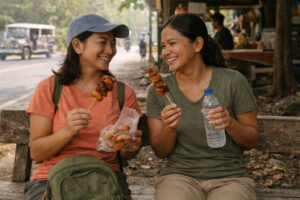 Merienda is not extra—it’s strategy. Place it right before the most tiring part (a long walk, shopping, museum hopping) or right after the anchor to reset moods. Bring easy options (nuts, crackers, candies) so you’re not forced into overpriced snacks at the worst time.
Reality check: Waiting feels twice as long when you’re hungry—especially in lines, traffic, or under the sun.
Where to place the big meal so it doesn’t hijack the day
Big meals take time: ordering, waiting, eating, digesting. If your anchor is physical (walking, swimming, sightseeing), put the big meal after—not before. If your anchor is “food trip,” then the big meal is the anchor, and everything else becomes secondary. That’s bakasyon planning with honesty.
Reality check: Overeating at noon often leads to the 2 p.m. slump, where everyone suddenly wants to go home.
Buffers that actually save the day
Traffic and late starts: add time where it hurts most
Filipino reality: “On the way na” rarely means “arriving soon.” Build a late-start cushion into your departure time, especially for family groups. Add extra blocks for parking, walking from the parking area, and the “sandali lang” stops along the way. In bakasyon planning, your travel time isn’t just driving—it’s the whole transfer.
Reality check: If you schedule a strict arrival for a group, you’ll spend the first hour stressed and apologizing.
Lines, CR breaks, and prayer time: the invisible itinerary
Assume you’ll queue—for tickets, elevators, popular restos, even bathrooms. If your group includes someone who needs frequent CR stops, plan them like checkpoints. And yes, if your family likes to visit a church or pause for a quick prayer, honor it as part of the day, not a “delay.”
Reality check: The moment you pretend these don’t exist, your schedule collapses and you start rushing.
Photo stops and “quick detours”: plan for joy
Filipinos love documenting memories—so give it space. Instead of fighting photo stops, plan a 10–15 minute “picture buffer” after the anchor. Allow one optional detour only, with a rule: if it adds more than 20 minutes, it becomes “next time.” This keeps bakasyon planning fun and firm at the same time.
Reality check: Detours multiply. One “quick stop” can become three, and suddenly it’s dark and everyone’s tired.
Pasalubong planning without chaos
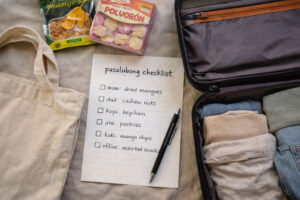 The simplest system: budget cap + priority list
Pasalubong is sweet—but it can quietly wreck your wallet and luggage space. Start with a cap (example: a fixed amount per household) and list the people who truly matter first. If you want background on the tradition, here’s a simple definition of pasalubong that explains why we do it.
Reality check: If you buy for everyone, you’ll either overspend or end up with rushed, random items you don’t feel proud to give.
Buy earlier, pack smarter (and avoid last-minute panic)
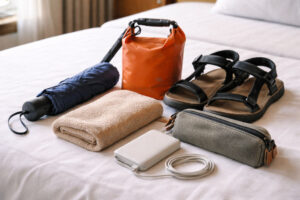 When possible, buy pasalubong earlier in the day or earlier in the trip—when you still have energy and choices. Bring an extra eco bag or foldable tote for overflow, and keep fragile items in the center of your bag with soft clothes around them. In bakasyon planning, “luggage space rules” are simple: if it doesn’t fit without forcing zippers, it’s not coming home.
Reality check: Last-minute pasalubong shopping is when prices are higher, options are fewer, and tempers are shorter.
Weather readiness (biglaang ulan, habagat, and warnings)
Quick checks that actually help
Weather is the boss in the Philippines, so make it part of your routine. Do a quick check the night before and again in the morning using PAGASA, then match your plan to the season with this Philippines weather guide. In bakasyon planning, the goal isn’t perfection—it’s readiness.
Reality check: “Mukhang okay naman” can turn into a heavy downpour in 20 minutes, especially in the rainy months.
Rainy-day pivots: decide your Plan B in advance
Plan B should be easy: indoor museum, café crawl, covered markets, a mall-based route, or a shorter loop that still feels like a win. Pack with rain in mind: an umbrella you’ll actually carry, sandals or shoes that dry fast, and a small dry bag for gadgets. Good bakasyon planning treats ulan as a scene change, not a trip-ender.
Reality check: When the weather flips, the worst time to brainstorm is while everyone is wet, hungry, and looking at you for answers.
Manila bakasyon without burnout
Plan by neighborhood, not by “top 10 spots”
Manila feels exhausting when you bounce across the city like it’s a theme park map. The antidote is neighborhood-based planning: choose one area as your anchor, then layer food and small stops nearby. If you want a ready-made example, follow this low-stress 24-hour Manila itinerary and notice how it minimizes long transfers.
For meals, it helps to pick options near where you already are—this guide on where to eat by area in Manila makes it easier to stay within one zone and still eat well.
Reality check: In Manila, “near” can still mean 45 minutes when it’s rush hour, raining, or you’re hunting for parking.
Heat, traffic, and indoor fallbacks: the Manila survival trio
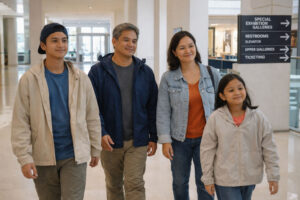 Build your day around cooler hours: start earlier, do outdoor walking before noon, then shift indoors mid-afternoon. Keep one indoor route ready so you don’t waste time debating when the sky turns gray. For a practical fallback, bookmark Manila rainy-day indoor routes and treat it like your safety net.
If you’re moving with family, add generous buffers between stops—waiting for Grab, finding entrances, passing security checks, and the “CR muna” routine can stack fast. Smart bakasyon planning in Manila isn’t about cramming—it’s about choosing what you can enjoy without sprinting.
Reality check: The city can drain you quietly—noise, heat, and crowds add up even if you’re “just” sightseeing.
A simple planning template readers can copy (plus FAQs)
Copy template (mini checklist):
1) Anchor (one main activity): ________
2) Must-eat (one meal or merienda): ________
3) Buffers (choose 3): traffic / parking / lines / CR / photo time / prayer / “late start”
4) Recovery time (where/when): ________
5) Plan B (indoor or shorter loop): ________
6) Budget buffer (set aside): ________
Sample timeline (easy mode):
Morning: travel + light breakfast + anchor
Midday: big meal or shaded rest
Afternoon: optional add-on (only if energy is good) + merienda recovery
Evening: early dinner + travel home + “tomorrow buffer” (lighter night)
Reality check: If the group is already tired by lunch, your “optional add-on” is not optional—skip it and protect everyone’s mood.
Bakasyon Planning FAQs
Q: What does “bakasyon planning” really mean for Filipino trips (and why is it different)?
A: It’s planning that expects real Filipino travel realities—traffic, weather shifts, food stops, and family pacing—so the trip feels smooth instead of stressful.
Q: How do I choose one “anchor” activity per day without overstuffing the itinerary?
A: Choose the one thing you’d still do even if everything else gets cut. Then treat all other stops as optional layers that must fit around it.
Q: How much buffer time should I add for traffic, lines, and slow mornings?
A: As a rule, add at least one “late start” cushion (30–60 minutes) plus extra time for transfers (parking, walking, waiting). In high-crowd areas, assume lines can take 20–45 minutes.
Q: How do I plan food stops so the trip stays happy (not hangry)?
A: Lock in breakfast and one merienda anchor, then place the big meal where it won’t sabotage energy (often after the most physical part).
Q: How do we pace a trip when traveling with kids, seniors, or a big group?
A: Add more seated rest moments, shorten walking loops, reduce decision points, and set clear meetup beats (morning + anchor). Comfort isn’t “extra”—it’s what keeps the day enjoyable.
 Q: What’s the simplest pasalubong plan that won’t wreck the budget or luggage?
A: Set a cap, prioritize households that matter most, buy earlier when you can, and follow one packing rule: if it doesn’t fit without forcing zippers, it stays.
Q: What should I do if the weather flips (biglaang ulan, habagat, typhoon warnings)?
A: Check official updates, switch to your indoor Plan B, and simplify the route. Rain-ready footwear and a small dry bag can save your mood fast.
Q: How do I avoid burnout in Manila when everything feels far and crowded?
A: Plan by neighborhood, start earlier to beat heat and crowds, add bigger buffers between stops, and keep an indoor fallback ready.
Q: How do I build “recovery time” so I don’t come home exhausted?
A: Schedule one intentional rest moment during the day (merienda, café, hotel break) and a lighter window after the trip (easy evening, slower next morning). Your future self will thank you.
When you plan this way, the trip stops feeling like a checklist and starts feeling like a real bakasyon—warm, breathable, and shared. You don’t need a perfect schedule. You just need one anchor, honest buffers, and recovery time that lets everyone enjoy the day—and still have energy to smile in the photos.