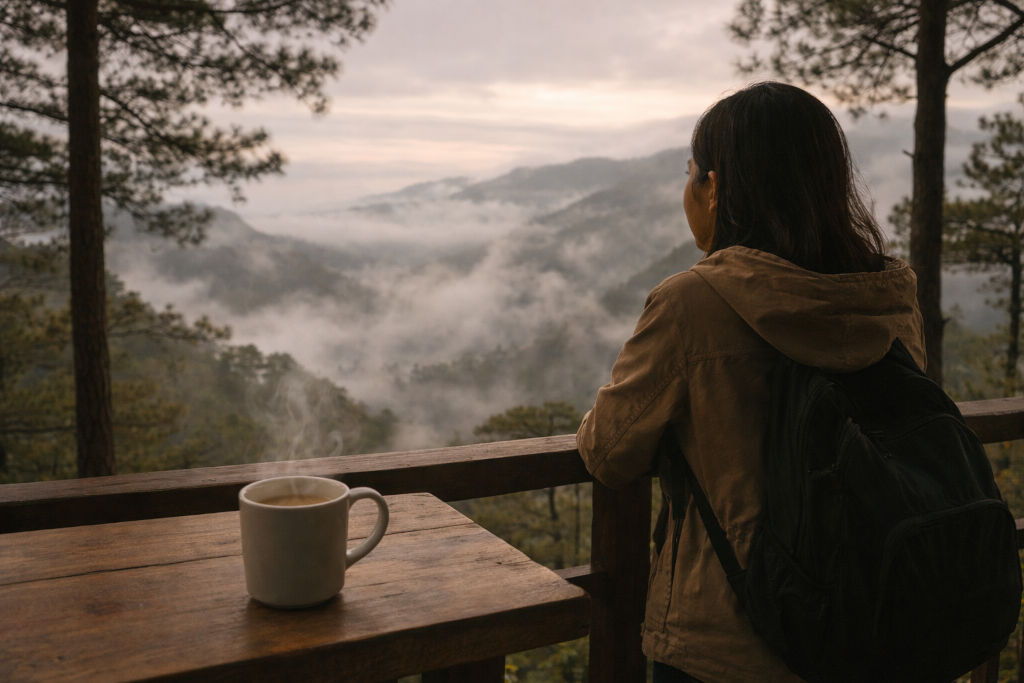
Why Baguio Runs on Coffee
It’s 6 a.m. near Baguio’s public market. Vendors are unloading crates of pechay and carrots, a man is shouting prices over a pile of strawberries, and somewhere between the ukay stalls and the vegetable section, a small thermos stand is already busy. You wrap your hands around a tin cup of hot barako, feel the steam on your face, and watch it mingle with your own breath in the cold air. This is where our Baguio coffee guide starts: not in a shiny café, but right where the city wakes up.
Baguio runs on coffee. From students cramming in Baguio student cafés along Session Road, to artists drafting zines in artsy corners, to market vendors sipping 3-in-1 while waiting for suki (regular customers), coffee is part of the city’s rhythm. The air is cooler, the hills are steeper, and a warm mug just hits differently when you’ve climbed three flights of stairs and walked a Session Road slope in drizzle. In this Baguio coffee guide, that everyday caffeine buzz is our backdrop.
This Baguio coffee guide isn’t about chasing just one “famous” café photo. It’s a walking companion: we’ll wander through market-side barako stalls, Session Road strips, creative hubs, pine-forest coffee decks near Camp John Hay, and hillside cafés with mountain views. We’ll talk about where to drink coffee in Baguio on a student budget, where to find Benguet and Cordillera beans, how much a café day actually costs, and how all of this fits into a bigger story of Baguio as a cool, creative highland city. If you want more context on food and drink beyond coffee after reading this Baguio coffee guide, you can dive into more stories on Filipino food and drink after this cup.
Beans in the Clouds – Cordillera Coffee 101
Before we café-hop in this Baguio coffee guide, it helps to know what’s in your mug. The highlands around Baguio—Benguet, Atok, Kibungan, and nearby Cordillera towns like Sagada—grow arabica coffee in cool, high elevations. According to background on Benguet coffee, the province has a long history of smallholder farmers cultivating arabica on mountain slopes, often intercropped with vegetables or fruit trees.
In practical, non-nerdy terms: higher altitude and cooler nights slow coffee cherry ripening, which can lead to beans with brighter acidity and layered flavors—citrus, floral hints, chocolate, nuts—depending on the exact variety and processing. Many Baguio cafés proudly label “Benguet,” “Atok,” or “Sagada” on their menus. Single-origin Benguet or Atok beans give you a taste of the surrounding Cordillera ridges in each sip, and this Baguio coffee guide will help you recognize those labels when you see them.
Locally, coffee is livelihood and culture. Farmers and cooperatives supply roasters and cafés, and more and more shops talk openly about where their beans come from. A feature in local news about Cordillera coffee culture, like this PNA article on coffee in the region, shows how coffee is both everyday drink and pride of place. When you order “Benguet pour-over” or “Sagada brew,” you’re tasting that connection—beans grown in clouds, roasted in the cool air, then poured into your cup on a foggy Baguio afternoon that could be straight out of any Baguio coffee guide.
Market Mornings and Session Road Sips
 Downtown Baguio is dense but surprisingly walkable if you don’t mind hills. One of the easiest ways to start exploring this Baguio coffee guide in real life is a morning loop: market to Session Road, then down to the Burnham fringe and back.
Market-side brews and barako thermos stalls
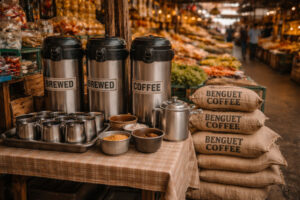
Start at the public market. In and around the alleys you’ll find small stalls selling brewed coffee in thermos dispensers, usually barako-style or generic “kapeng mainit” (hot coffee) with your choice of sugar and milk. This isn’t third-wave: it’s strong, straightforward, and usually under ₱40–₱60 a cup. Perfect for warming up before you face the vegetable maze and the first stop in your on-the-ground Baguio coffee guide.
As you sip, you pass stalls selling ground Benguet coffee in plastic bags, whole beans in jars, and simple drip sets. Some vendors will talk about where their beans come from—Sagada, Atok, local Benguet towns—others just say “mountain coffee” with a shrug. Ask for their timpla (preferred blend) and you might get a small history lesson along with your pasalubong recommendations. For a deeper dive into flavors beyond caffeine that complements this Baguio coffee guide, pair this with Baguio food culture from market to table to see how coffee fits into the larger city palate.
Session Road café strip
From the market, wander down to Session Road. This sloping main street and its side alleys are dotted with cafés: some old-school, some modern, some hiding above bakeries or in small buildings that look like they only sell office supplies. A classic Baguio coffee guide Session Road walk might mean:
- A student-friendly spot with homey interiors and affordable brewed coffee, where group projects take over whole tables and you hear Tagalog, Ilokano, and English mixing freely.
- A dessert café serving affogato, cakes, or waffles; the kind of place where titas (aunties) and barkada (friend groups) settle in for merienda and chismis (catching up).
- A more serious specialty coffee bar on a side street, where baristas talk about Benguet single-origin or Sagada beans, offer pour-over or Aeropress brews, and have beans displayed on shelves for sale.
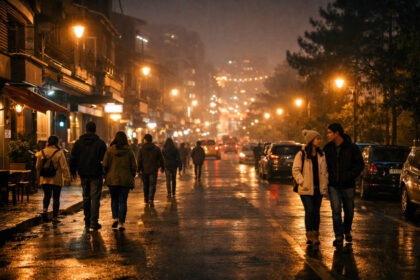
The walk between these cafés is only a few minutes on the map, but add hills, traffic crossings, and occasional drizzle, and it feels like a true mini urban hike. On a rainy afternoon, windows fog up from inside while you watch Baguio traffic crawl through mist outside, exactly the kind of scene this Baguio coffee guide is written for.
Night market and late-night coffee
At night, Session Road nearby and Harrison Road transform. Ukay stalls open, street food carts line up, and coffee shifts from “wake up” to “keep wandering.” You might grab a paper cup of instant coffee or hot chocolate from a stall, then weave through racks of jackets and vintage denim while you look for the perfect “Baguio jacket” to wear the next morning.
Some cafés stay open late enough for post-ukay tambay—perfect if you want to warm up your hands before heading back to your hotel. If you’re planning a full Baguio weekend around this Baguio coffee guide, it’s worth skimming a full Baguio travel guide so you can balance café time, market runs, and sleep.
Creative Corners – Cafés for Artists, Writers, and Students
Baguio is a university town and a UNESCO Creative City, so it makes sense that a lot of cafés double as mini studios, book corners, or unofficial thesis consultation spaces. Any solid Baguio coffee guide has to include these creative corners, not just the most Instagrammed spots.
Bookshop-adjacent and artsy cafés
Scattered around downtown and the university belt are cafés linked to bookshops, small galleries, or indie spaces. You’ll know you’re in one when you see zines or local art for sale near the counter, posters for open mics and film screenings on the walls, and tables full of sketchbooks and laptops.
Here, your coffee might arrive in mismatched ceramic mugs, with local art on every wall. The soundtrack is more likely to be OPM, lo-fi beats, or someone testing lines for a spoken word piece than Top 40. It’s the kind of place where you’ll see an older tita reading a novel in one corner and a group of young writers arguing about metaphors in another, exactly the kind of texture a Baguio coffee guide hopes to capture.
Long-haul study and remote-work spots
Near universities and quieter streets, you’ll find Baguio cafés built for long stays: bigger tables, outlets under benches, and reasonably stable Wi-Fi. Students camp out with textbooks and laptops for hours, often with one big drink and a pastry per person. Remote workers and digital nomads also gravitate here, especially during cool months when working feels better with pine air in your lungs.
Etiquette-wise, one drink every few hours and some food is a good minimum if you’re planning a long tambay. If you’re staying all afternoon, it’s kind to avoid hogging the largest table during peak times. Think of it as renting space with your consumption; your timpla of coffee and cake keeps the lights—and the routers—on, and keeps this living Baguio coffee guide of cafés thriving.
Camp John Hay and Pine-Forest Coffee Breaks
Move away from downtown and things get greener. The cafés inside or near Camp John Hay offer something different: pine needles underfoot, cooler breezes, and decks where you’re eye-level with branches instead of traffic. No Baguio coffee guide would be complete without at least one pine-forest coffee break.
Decks and verandas in the trees
Imagine sitting on a wooden deck with pine trunks rising all around you, mug of Benguet brew in hand, while a light drizzle taps on leaves above. These pine-forest coffee shops are ideal when you want to feel like you’ve left the city without actually going far.
Some cafés inside Camp John Hay integrate with walking trails; you can start the day with a loop through the trees, then reward yourself with a hot latte or local pour-over while watching joggers and dog walkers pass by. Others sit closer to roads but still offer a sense of being wrapped in green, especially when morning fog sits low among the branches and you’re mentally checking off another stop in your personal Baguio coffee guide.
Quiet corners for slow mornings
If you’re the type who likes reading or journaling with coffee, these piney cafés are perfect. Come early, before the lunchtime crowd, and you might have a whole veranda mostly to yourself. Bring a light jacket; even if the sun is out, a breeze can sneak under tables and through any gap in your scarf.
Pairing this with a forest walk makes a lovely half-day: stroll, sip, stroll again, and then head back downtown for a different side of Baguio coffee culture. When you’re ready to plan around trails, cafés, and viewpoints in one go, a Baguio itinerary for art, markets, and mountain escapes is a good next read alongside this Baguio coffee guide.
Hilltop and View Cafés – Coffee with Mountain Vistas
Beyond downtown and Camp John Hay, some of the most atmospheric Baguio café experiences are on hillsides and ridges. These are the “Baguio coffee shops with a view” that every Baguio coffee guide loves to highlight: homes turned into cafés, small structures hanging off slopes, balconies that look over city lights or distant mountains.
Coffee with a view of the city or mountains
In these hilltop cafés, you might sip coffee while looking down at clusters of tin roofs and colored houses stacked on hillsides, or out toward pine-covered ridges and pockets of fog. By day, you get layers of green and blue; by night, a scattering of city lights that makes even a simple brewed coffee feel cinematic.
Reaching them can mean a jeepney ride plus a short walk, a taxi ride (often easiest if you’re in a group), or a determined uphill trek if you’re feeling sporty and the weather cooperates. In strong rain or heavy fog, those hills hit differently, so don’t be shy about calling a cab. This is the part of the Baguio coffee guide where I tell you: yes, your legs will feel it; yes, the view is worth it.
Typical Prices and What You Get for Your Pesos
Baguio isn’t the cheapest place in the Philippines, but compared to big Metro Manila malls, many cafés here are gentle on the wallet—especially if you’re okay with simple brews and sharing food with friends. This Baguio coffee guide isn’t just about vibes; it’s also about what your pesos actually buy.
- Market-side and basic brewed coffee: Around ₱30–₱70 for a cup of barako or “mountain coffee” from thermos stalls or tiny eateries near the market. No latte art, but lots of warmth.
- Standard café brewed coffee: In regular Baguio cafés, a basic brewed cup might range from ₱80–₱140 depending on beans and setting.
- Espresso-based drinks: Espresso, cappuccino, latte, or flavored drinks usually land around ₱120–₱220, with specialty or signature drinks a bit higher.
- Pastries and cakes: ₱80–₱100 for simpler pastries, ₱120–₱200+ for cakes and big slices. Many cafés do generous portions you can share with a barkada.
- Café meals: Pasta plates, rice bowls, or all-day silog meals hover around ₱180–₱350+ depending on the café and location.
A Baguio student café day might look like: one brewed coffee (₱100), a pastry (₱90), and maybe a budget lunch or lomi bowl later (₱150–₱200). A more splurge-y café date day could be two signature lattes (say ₱180 each) plus shared cake (₱180) and a light meal each (₱250+), which adds up faster but still feels gentler than big-city specialty chains. Use these ranges from this Baguio coffee guide to sanity-check your daily budget.
Buying Beans and Bringing Baguio Coffee Home
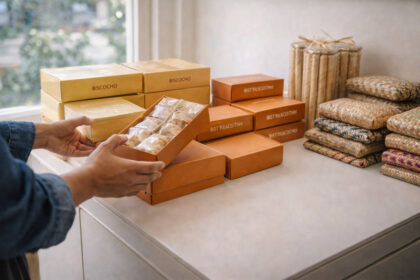
 Good news for tita shoppers and caffeine tourists: Baguio makes it easy to bring home a piece of its coffee scene, and this Baguio coffee guide wouldn’t be complete without a quick pasalubong section.
You’ll find Benguet and Cordillera beans in at least three types of places:
- Public market stalls: Sell pre-ground and whole beans, sometimes labeled with origin (Benguet, Atok, Sagada). Ask vendors about grind size if you’re using a French press, drip machine, or moka pot at home.
- Café shelves: Many specialty cafés stock their own roasts or local roasters’ bags. Labels often list origin, roast level, and tasting notes. If you’re not sure what suits your timpla, ask the barista; they’ll likely have a favorite to recommend.
- Souvenir corners and hotel shops: Great if you forgot to buy beans earlier, though prices can be slightly higher and selection more generic.
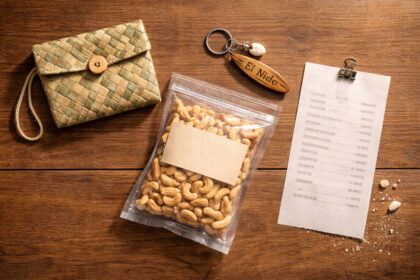
For carrying beans home, resealable bags are your friend; if not available, double-bag in ziplocks and keep them in your hand-carry to avoid being crushed. Freshly roasted beans generally travel fine as long as they’re kept dry and away from strong odors. If you fall in love with a particular Benguet coffee while following this Baguio coffee guide, consider grabbing an extra bag—you’ll thank past-you when you’re back in the lowland heat.
How Café Culture Connects Baguio’s Artists, Students, and Visitors
Baguio’s cafés are more than “pretty background for drinks.” They’re where artists launch zines, student orgs plan events, NGOs hold informal meetings, and visitors slowly realize how deep the city’s creative roots go.
On any given night, you might walk into a café and find an open mic, a small art exhibit, or someone quietly rehearsing lines for a play. Students spread out laptops and sketchpads, tourists update travel journals, and tita groups gossip over cakes and brewed coffee. Some cafés become suki spots for particular communities—writers’ groups, musicians, or hobby clubs—all woven into the same pine-scented air that this Baguio coffee guide is trying to map out for you.
When you zoom out, these cafés join the markets, parks, and galleries that make Baguio more than just a “cold city.” They’re part of the city’s wider creative and mountain identity. If you’re curious about how this connects to other highland spots after finishing this Baguio coffee guide, explore more Baguio and Cordillera destinations to see how coffee culture is one thread in a larger tapestry.
Sample Baguio Café-Hopping Routes
To make this Baguio coffee guide useful on the ground, here are a couple of narrative routes you can actually walk (with occasional taxis when the hills or bags get too real).
One-day downtown coffee walk
Morning: Start at the public market. Grab a cheap barako or “mountain coffee” from a thermos stall, then wander produce and pasalubong sections. Move down toward Session Road slowly, letting the caffeine and cool air wake you up.
Late morning to afternoon: Choose a Session Road café cluster—maybe one with a student vibe for your second cup. Walk a bit farther to find a more serious coffee bar that highlights Benguet or Sagada beans. Have lunch in a café with decent meals or a nearby eatery, then continue down to the Burnham fringe for a park stroll and maybe a third, lighter drink (or switch to tea).
Evening: Walk toward the night market area, grab street snacks, then end in a cozy café near downtown for hot chocolate or your final coffee of the day. If the hills and drizzle feel heavy by night, don’t hesitate to hop in a taxi for the last stretch back to your hotel. This route alone can make the whole Baguio coffee guide feel real in just one long day.
Cool weekend pairing – Baguio cafés plus pine forests
Day 1 (Downtown focus): Follow the one-day downtown coffee walk, maybe adding a visit to a bookshop-adjacent or artsy café in the afternoon. Mix in a park or small museum, and anchor your day around cafés that show different sides of Baguio’s coffee scene. Use a Baguio itinerary for art, markets, and mountain escapes as a skeleton and plug cafés into slots where you’d naturally rest or wait out rain.
Day 2 (Pines and views): In the morning, head to Camp John Hay or another piney area. Grab coffee on a deck, take a forest walk, and linger on a veranda with a second cup while the wind moves through the trees. In the afternoon, make your way to a hilltop café with a view—use a taxi if needed; your legs will thank you. Watch the city or mountains shift from afternoon haze to golden hour, then take a final mug to-go before your bus or drive back down to the lowlands. By then, this Baguio coffee guide will have turned into your own set of memories.
Baguio Coffee Guide FAQs
What makes Baguio’s coffee scene special?
The combination of cool air, local Benguet and Cordillera beans, and a strong artist-and-student community makes Baguio’s cafés feel different. You can go from a thermos stall in the market to a pine-forest deck to a tiny specialty shop in a single day, all within a city that lives and breathes creative work and university life. That mix is exactly why a dedicated Baguio coffee guide like this one makes sense.
Where can I taste coffee made from local Cordillera beans?
Look for cafés that label “Benguet,” “Sagada,” or other Cordillera origins on their menus, especially along Session Road, near universities, and in piney areas. Many public market stalls also sell Benguet coffee for brewing at home, and some will serve you a cup right there in simple cups or glasses. This Baguio coffee guide encourages you to ask baristas and vendors about origins whenever you can.
Which cafés are best if I’m on a student budget?
Student-friendly spots cluster along Session Road and nearby streets: look for places with straightforward brewed coffee, affordable rice meals or pasta, and plenty of students with laptops. Market-side stalls are even cheaper if you just want a quick caffeine hit before class or ukay hunting. For budget-conscious travelers, this Baguio coffee guide suggests mixing one or two specialty cafés with lots of simple, everyday stops.
Which spots have the best views or pine-forest atmosphere?
For pines, head toward Camp John Hay and surrounding areas with forest-adjacent cafés and decks. For hilltop views—city lights or mountain ranges—check ridges and higher neighborhoods just outside downtown; many “Baguio coffee shops with a view” are perched along these slopes and accessible by jeepney or taxi. This Baguio coffee guide balances both: pines in the morning, city or mountain views at sunset.
What are typical coffee and pastry prices?
Expect ₱30–₱70 for simple market-side brewed coffee, around ₱80–₱140 for café brewed cups, ₱120–₱220 for most espresso-based drinks, and ₱80–₱200+ for pastries and cakes. All-day meals in cafés usually sit around ₱180–₱350+. Use these ranges from this Baguio coffee guide as a quick reference while planning your daily budget.
Is café-hopping in Baguio walkable, or do I need taxis?
Downtown loops (market–Session Road–Burnham fringe) are walkable if you’re okay with hills and stairs. Once you add pine-forest cafés and hilltop view spots, taxis or jeepneys help a lot—especially in rain, fog, or when you’re carrying beans and pasalubong. Think of this Baguio coffee guide as “walk + occasional rides” rather than “walk everything.”
Where should I buy beans to bring home?
For variety and lower prices, start at the public market’s coffee stalls. For more curated selections and clear origin info, buy from specialty cafés that roast or partner with local roasters. Hotel and souvenir shops are fine for last-minute buys but often have higher prices and less information on where beans come from. As this Baguio coffee guide keeps repeating: if you love a brew, ask if you can buy the beans.
In the end, the best Baguio coffee experience isn’t just one perfect latte photo. It’s a whole day (or weekend) of tiny moments: cold fingers on a ceramic mug, fog outside a window, the sound of Ilokano mixing with English at the next table, baristas chatting about their favorite Benguet roast, and that warm rush of stepping back into the cool street with a full heart and just enough caffeine to climb one more hill. That’s the real heart of this Baguio coffee guide.